

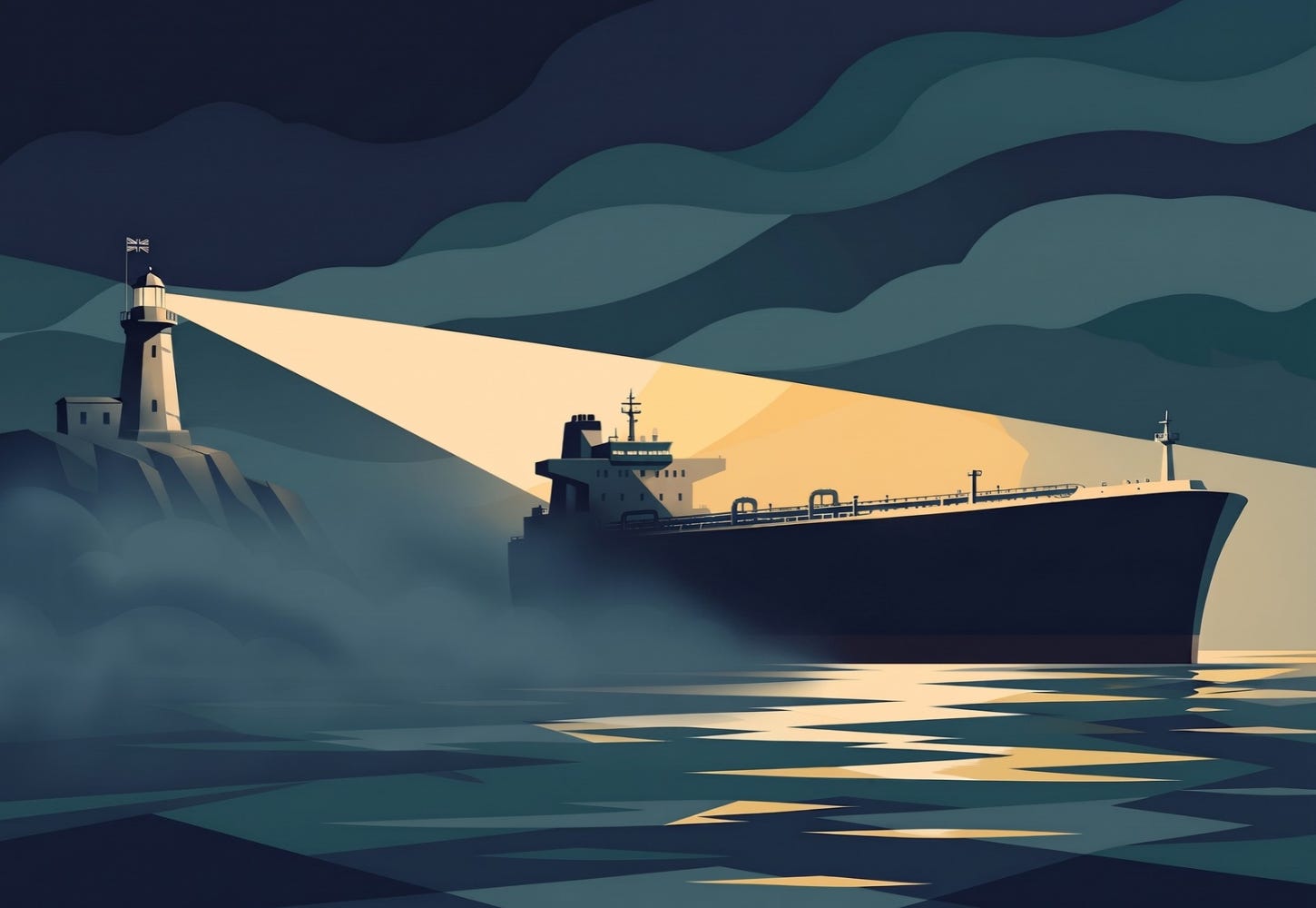
Russia’s ‘shadow fleet’ is coming out of the dark. Third-country registries are increasingly expelling sanctioned tankers under diplomatic pressure, while European states have used false flagging and statelessness as legal grounds for interdiction under the United Nations Convention on the Law of the Sea (UNCLOS). The Kremlin’s response has been to reflag its tankers openly to the Russian registry in increasing numbers, providing a refuge to vessels no longer shielded by opacity.
Between January 2025 and June 2026, 107 vessels have followed this trend and joined Russia’s national flag registry – bringing the total number in the registry to 382, according to the Centre for Research on Energy and Clean Air. 87% of these new additions were under sanctions when they were reflagged. This is a substantial change, but forcing the Kremlin to acknowledge its link to the shadow fleet is a hollow victory. It does not eliminate the problem; it only complicates it.
Britain’s strategic quandary
Reflagging tankers to the Russian registry gives them the protection of flag-state jurisdiction, removing the key legal justification for interdiction. Under UNCLOS, statelessness is one of a small number of exceptions that can be used to interfere with freedom of navigation, and it has been disproportionately useful for tackling the shadow fleet. According to Windward, 12 out of 13 European interdictions in the first half of 2026 were conducted on the basis of statelessness, including the United Kingdom’s (UK) seizure of the Smyrtos in June that year.
The Kremlin’s response means that the legal hook is now increasingly unavailable. Without it, interdictions must either be scaled back, or the law ignored. Both options are dangerous. The former would boost Russia’s war economy and juxtapose European toothlessness against escalating ‘grey-zone’ hybrid warfare. The latter risks undermining the open maritime order upon which British economic power has traditionally depended, as well as setting a precedent that adversaries could exploit.
Even before reflagging introduced this problem, European interdiction efforts were lacklustre. 13 interdictions in the first half of 2026 represent a tiny fraction of total shadow fleet shipping transiting in or near European waters. As stated by His Majesty’s (HM) Government, between 24 March and 25 June 2026, 173 UK-sanctioned vessels sailed through the Strait of Dover alone. Some of the reticence has been for legal reasons, but it has also been due to fears about escalation.
However, it would be a mistake to think of legality and escalation management as separate issues. Framing shadow fleet interdiction as a matter of maritime law enforcement – tackling false flagging, statelessness, and registry abuse – is helpful for controlling escalation, as it preserves the line between peacetime law enforcement activities and military confrontation. With Russia neutralising the main legal justification for interdiction, Britain and allied European nations face an additional escalation dilemma, alongside the legal one.
Yet, this quandary also presents an opportunity to reset the current approach, which has been marked by an excess of legal and strategic caution, thus eroding European deterrence by demonstrating a propensity for inaction amid an escalating campaign of aggression. The answer is neither to break the law nor allow Russia to hide behind it, but to seek to change it and build a new framework that manages both the legal and escalation risks.
A state of hostility
In 1943, the prominent legal scholar Georg Schwarzenberger argued that the binary distinction between peace and war had been upended by state practice involving hostile acts below the threshold of war. The law, he contended, should recognise a new state of relations: a status mixtus. In 1954, jurist Philip Jessup similarly proposed consideration of a ‘state of intermediacy’.
This scholarship never translated into changes to international law, which still lacks an adequate framework for sustained sub-threshold hostility, and status mixtus eventually receded from legal discourse. Today, as Russia probes the boundaries of hostile conduct and European nations are hobbled by mismatched peacetime responses, it is overdue for a revival.
It is time to recognise that Britain and Russia, through the actions of the latter, are in a state of hostility. This is not peace, nor war, but a status mixtus. Declaring this openly would have a strategic, political, and legal dimension. Strategically, it would allow the UK to match Russia lower down the escalation ladder, while establishing a ceiling for escalation beyond peacetime law enforcement but short of war. Politically, it enables HM Government to communicate much more effectively to the public that Britain is no longer at peace, paving the way for difficult conversations on defence, risk, and resilience. Legally, although the declaration would not itself create new legal rights, it creates an opening for Britain to challenge the inadequacy of international law and seek to change it, starting with the legal grounds for interdiction.
Towards a systematic interdiction solution
Within the state of hostility framework, the UK could pursue a new policy of systematic interdiction of the shadow fleet. It is important to note that ‘systematic interdiction’ does not mean universal interdiction: Britain would still choose which tankers to target and which to let through based on suspected cargo, risk of confrontation, and history of the vessel. However, the balance would shift away from interdiction as a rare exception to being a regular occurrence.
Three justifications for interdiction could be envisaged: if a vessel is suspected of direct involvement in a hostile act against the UK or its allies and partners, most likely an act of sabotage; if a vessel is suspected of carrying out surveillance against undersea infrastructure with hostile intent; or if it is involved in fuelling Russia’s war economy.
Legally, following this course of action would mean that Britain would stop relying on statelessness or other restrictive peacetime exemptions to freedom of navigation. Instead, the policy would be justified as a countermeasure against Russia’s campaign of aggression and hostility towards free and open nations, as part of a new state of hostility doctrine. The word ‘countermeasure’ is important, because if the Kremlin challenges the legality of this doctrine under UNCLOS, it enables the UK to borrow from an existing body of law in constructing its defence: the United Nations’ (UN) Responsibility of States for Internationally Wrongful Acts.
This body of law allows a state injured by the conduct of another to take countermeasures without resorting to armed conflict. In this case, the countermeasure would involve suspending the obligation not to interfere with Russian-flagged vessels. Countermeasures have limitations, and there are areas in which the law is not fully settled, including regarding collective countermeasures. However, that can be an advantage, allowing Britain to advance an expansive interpretation that not only provides an initial legal defence, but also a gateway for a broader argument around status mixtus.
A Russian legal challenge would be anticipated as part of this strategy, and would be beneficial should it materialise. It would give the UK a lengthy legal process in which to advance its argument that bounded exceptions should apply to the law of the sea in circumstances of sustained hostility below the threshold of war. While this process is ongoing, Britain would be able to start reshaping international law on the ground as well as in the courts, working in coalition with like-minded states to assert the new doctrine through state practice.
Working in coalition would not only establish the broader pattern of state practice needed to develop international law, but would also solve a practical constraint, as the UK lacks the capacity to enforce systematic interdiction on its own. For example, building on its Maritime Proposition of July 2026, the Joint Expeditionary Force (JEF), in cooperation with France, could provide such a coalition.
Recovering British statecraft
This approach would depart radically from the UK’s current risk-averse, compliance-oriented statecraft. However, it is not new. In fact, it would revive an older tradition of British legal and strategic activism in the maritime domain.
When the UK abolished the slave trade in 1807, international law prevented it from interdicting ships with foreign flags suspected of transporting slaves, leaving it unable to enforce the ban effectively. Britain did not ignore the law, nor simply accept its limitations, but instead sought to change it. Over several years, through a combination of treaty-making with other flag states and the accumulation of state practice, a new anti-slavery exception to freedom of navigation was established – now recognised in UNCLOS.
To tackle the shadow fleet, the same calibre of strategic imagination will be needed. If it looks hard enough, the UK will find those instincts are not new to it, but have merely been neglected.
Andrew Noakes is the founder of Future Statecraft, a project rethinking statecraft for Britain and other free and open nations in the aftermath of the ‘international rules-based order’.
To stay up to date with Britain’s World, please subscribe or pledge your support!
What do you think about this Memorandum? Why not leave a comment below?