

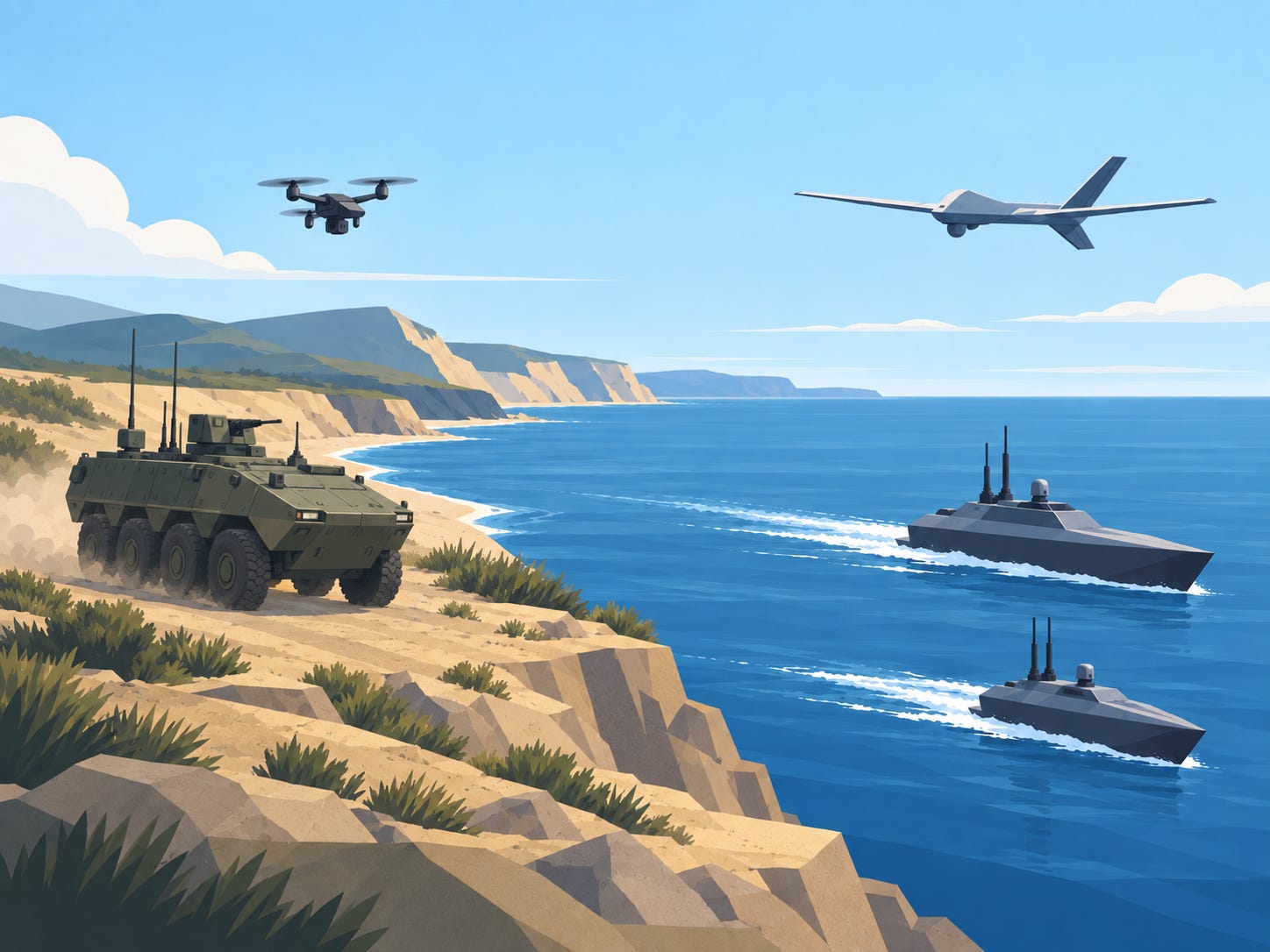
Drone revolution is transforming warfare in ways which are, to a large extent, undeniable. There are still the inevitable holdouts who refuse to acknowledge it, or filter what they see to fit their legacy thinking, but the argument that it is a fad or does not apply to high-intensity combat (or whichever corner of warfare you choose) no longer holds water.
Ukraine has shown – as have Iran, the Houthis, and others – that drones are reshaping the battlefield and maritime arenas. This applies everywhere, over land and across the seas. Yet, the ways in which drones are affecting land warfare and naval warfare are almost polar opposites in key ways.
In general, drones in land warfare have shifted the tactical advantage to the defender. Meanwhile, at sea they give the advantage to the assailant. The underlying difference is that on land armies need to seize territory to control it, whereas at sea there is always a degree of manoeuvre. Thus, on land it is increasingly difficult to advance, while at sea it is increasingly difficult to defend.
On land, drones favour defence
In land warfare, drones – mainly First-Person View (FPV) quadcopters – provide an effective means to blunt any advance. Attacking troops need to move forward to seize land, whether they are in tanks or on electric scooters – or quad bikes, horses, or whatever the Kremlin’s troops grasp at next. As they advance, they can be picked off by FPV drones.
There have been attempts to overcome this, such as small squad or even single-person infiltration tactics, and reimagined armoured columns of turtle tanks with heavy Electromagnetic Warfare (EW) defences, but nothing has reversed the trend. The current dynamic is for an increasingly deep no-movement zone with mid-strike drones picking off forces before they have even had a chance to start their assault.
There are of course situations and areas where drone technology is also changing the ability to attack – for example long-range strike drones, or Operation SPIDER WEB, where masses of small drones suddenly emerged from disguised truck launchers. However, these types of attacks do not capture ground.
We can perhaps imagine a very near future battlefield where ground drones are the primary means of offence, with humans only following in their wake. But this will not change the drone dynamic: they will still be attrited by FPV-style systems. So, on land, a well-prepared and resourced defender has the overall advantage, and it is hard to see that changing. This largely explains why Ukraine has been able to limit Russian advances despite the Kremlin’s relentless ‘meat grinder’ approach.
At sea, drones favour offence
At sea, navies have seen the opposite to their land counterparts. Drone technology, principally Uncrewed Surface Vehicles (USVs) but also aerial and underwater drones, are becoming the primary means of offence.
Traditional navies are on the back foot. The inherent expendability of uncrewed platforms, particularly ones designed to be cheap, changes the risk calculation on offensive operations. Even if the uncrewed vessels themselves are individually inferior, and nearly always get destroyed before they reach their target, they only have to get through once. One barely hears about the hundreds of naval drones that are destroyed before they reach their target, this not even being a metric among obsessive Russian milbloggers, but the world hears every time that one does get through. The asymmetry is not just in the tactical and operational sense, it is in the narrative sense too.
Even Russia’s most recent naval success of any note, the sinking of the Ukrainian intelligence ship Simferopol on 28th August 2025, was carried out by uncrewed platforms. A Russian USV struck the vessel on the Danube River, watched over and possibly controlled by an Uncrewed Aerial Vehicle (UAV) flying further out to sea. Similar attacks have been launched against Odesa, some successfully. These are operating in waters which Russian Navy vessels haven’t sailed since 2022. The Kremlin is hoping that uncrewed systems can do what its crewed navy dare not even attempt.
Meanwhile Russia’s traditional crewed warships remained in the relative safety of port, although even these are not safe. Physical defences can reduce their vulnerability to surface and underwater drones, but the skies above them are contested. Even with large volumes of air defences, some strike UAVs can get through. So, the traditional Russian Navy is not getting sea time, but is slowly getting degraded by Ukrainian aerial drone and missile strikes. These strikes will only rarely result in the loss of a ship (the UAVs’ warheads are simply too small), but they still cause damage.
Long-range UAVs have enabled these offensive missions to reach the Russian Navy far beyond the Black Sea. Recently, a Russian missile corvette was hit by Ukrainian drones in the Baltic Sea, over 1,000 kilometres from Ukraine, and similar strikes have occurred in the Caspian Sea.
Rebalancing defence and offence
These developments pose significant challenges for traditional navies. The central question is twofold: how to exploit the drone revolution for offensive capabilities while simultaneously defending against those same capabilities in enemy hands. The Russian Navy, the principal force confronting this threat today, has increasingly resorted to hiding in port, supplemented by old-fashioned physical boom defences and an increasingly creative (or desperate) array of drone cages and nets. Some Russian vessels have even adopted First World War-style dazzle camouflage, while others have been painted red with fake windows to resemble a longhouse. It is clear, however, that a strategy based on simply waiting out the threat in port will not be viable across the board.
Free and open nations’ navies would be better served by investing in layered defence, distributed sensor and weapons platforms, and, most importantly, low-cost defensive munitions. Interceptor drones similar to those being used to defeat Shahed drones in Ukraine could, for example, provide both air defence and point defence against enemy surface drones. Extending these defensive capabilities to auxiliaries and secondary vessels will also become increasingly important, as adversary drones will naturally seek out the least-protected platforms.
The most important consideration, however, may be ensuring that protecting the traditional navy does not itself become the objective. The strategic priority should be to adapt to and exploit the new capabilities that drone technology provides.
Swallowing the new reality
This is not just a reflection of the dismal performance of Russia’s Black Sea Fleet since the beginning of its full-scale invasion in 2022; it is the new reality of warfare. Uncrewed systems have allowed Ukraine to conduct strikes and have strategic effects, allowing Kyiv to bottle up the Russian Navy in ways which are inconceivable with any plausible crewed navy. The Kremlin is now finding that it needs to do the same.
Of course, drones cannot replace every ship and every mission in a navy. However, if there is the need to send a system to attack the enemy, to go ‘down threat’, the first instinct is going to be to send something uncrewed. This very quickly changes the equation because those systems become expendable, even relatively expensive ones (or, to use more defence analyst speak, ‘attritable’).
It is difficult to find where this new reality is really being grasped by the slow acquisition process and strategic cycles of free and open nations’ navies. That is not to say that drones are not now top of the agenda. Everyone is buying uncrewed platforms, and the Royal Navy is far from a laggard with its new Hybrid Navy plan.
However, the world is not seeing the mass of expendable systems geared to offensive operations. Free and open nations’ armed forces need to start buying plenty of cheap air, surface, and sub-surface drones, lest they miss the boat.
H I Sutton is a writer, illustrator and analyst who specialises in submarines and sub-surface systems. He is also an Adjunct Fellow at the Council on Geostrategy.
To stay up to date with Britain’s World, please subscribe or pledge your support!
What do you think about this Memorandum? Why not leave a comment below?