

The contemporary geostrategic environment has never been more volatile and uncertain. The international system is under sustained pressure from the self-interested actions of the states possessing the world’s three largest nuclear arsenals, and the maritime domain – the indispensable global commons – is more important than ever.
Against this backdrop, and the increased risk of North Atlantic Treaty Organisation (NATO) conflict with Russia, how can the Royal Navy exercise sea control in the North Atlantic at the moment where its size reaches a historical nadir? By any metric, it requires a huge increase in the number of platforms capable of delivering military effect at, under, and above the sea. However, the prospect of any significant increase in the sum (or share) of British taxpayers’ money allocated to conventional maritime forces seems slim.
The cost of building large, complex warships in Europe is now in the region of £2-£2.5 billion per hull, and the cost of maritime strike aircraft and specialised naval helicopters are now approaching £100 million per airframe (e.g., the F-35B Lighting II Joint Combat Aircraft and next-generation Merlin AW101). The imperative to break the vicious cycle of ever fewer numbers of ever more expensive platforms has never been clearer.
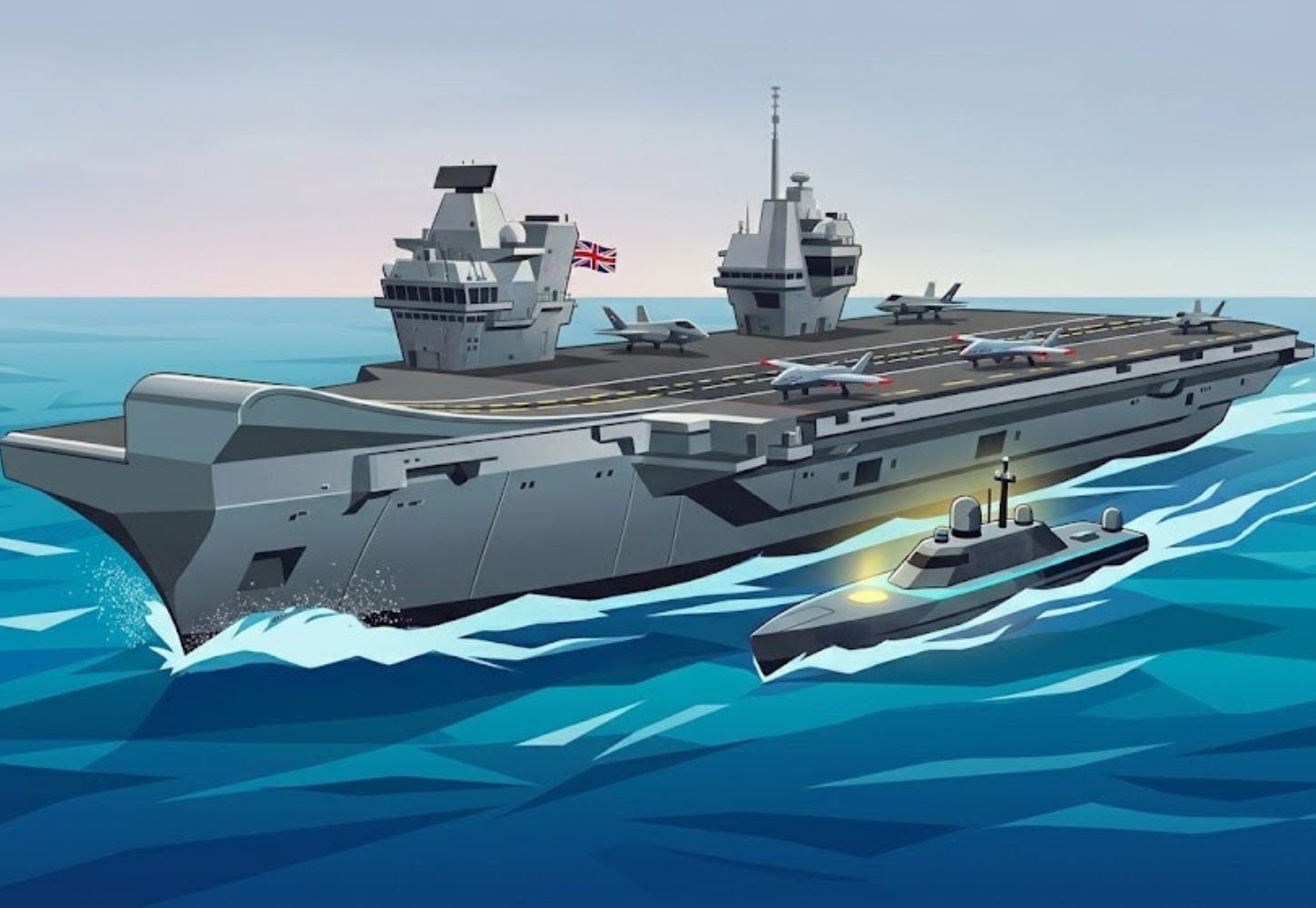
In June 2025, the Strategic Defence Review (SDR) revealed the Royal Navy’s answer to this question: a ‘New Hybrid Navy’ in which highly capable crewed submarines, warships, and aircraft are augmented with far larger numbers of remotely operated and autonomous uncrewed systems in every warfighting domain. The Defence Investment Plan (DIP) in June 2026 fleshed out the ambition: a fleet of ‘state-of-the-art crewed ships networked with uncrewed surface and undersea craft’, all connected and orchestrated by a secure, high-speed ‘Maritime Fighting Web’. One eye-catching announcement was the unveiling of the plan for ‘at least six’ flexible, lower-cost Common Combat Vessels (CCVs), replacing previous proposals for a small number of highly specialised, very expensive Type 83 destroyers.
In the air domain, programmes were announced for fixed wing (Project VANQUISH) and rotary wing (Project PANTHEON) Autonomous Collaborative Platforms (ACPs), to work alongside existing Fleet Air Arm crewed aircraft as a ‘Hybrid Air Wing’. Overall, at least £1.5 billion has been profiled over the next four years to unlock this vision, as part of the £5 billion allocated for advanced uncrewed systems across defence in the DIP.
Evolution or revolution?
Executing such a major shift in maritime doctrine while simultaneously introducing untested and fast-moving technology is far from straightforward. The principle ‘crewed where necessary, uncrewed wherever possible, and integrated always’ is laudable, but much harder in its execution than it is in its design.
At its heart, this new way of warfare represents both continuity and rupture. Continuity lies in the problem set: North Atlantic sea control, protection of the United Kingdom’s (UK) nuclear deterrent, seabed infrastructure security, integrated air and missile defence, and protection of NATO’s northern flank. Rupture is the message sent by the cessation on any further work on the Type 83 destroyer – although in reality, Type 83 was never a programme to be cancelled, but merely a proposal that might have delivered the Future Air Dominance System (FADS) requirements.
This move away from ‘a small number of large, expensive ships’ is not just because of cost per hull, but also because of the necessity of increasing single points of presence vastly; to use the language of a ‘system of systems’ approach, functions once stacked on one complex platform – sense, decide, effect – are now to be spread across far more interconnected assets.
Risks and opportunities
History, however, teaches temperance of technological enthusiasm. Battleships ceded primacy to aircraft carriers only after navies (and air forces) developed doctrine and tactics, built aircrew pipelines, perfected aircraft launch and recovery procedures, and built a viable industrial base. Nuclear submarines transformed underwater endurance and reach, but required new safety cultures, shore infrastructure, and specialist crews that took four decades to build. What lessons can be drawn from these transitions?
In each case, the platform was the visible element of a deeper change in command, logistics, infrastructure, and training. Those experimenting and innovating with these transformational technologies were bold, knew the sea and the perils of operating in the middle of a huge ocean, and were not afraid to fail in order to succeed on the next try. That is the culture that will succeed in the 21st century.
However, the siren call of armchair admirals, populist podcasters, and energetic politicians with limited maritime knowledge, extrapolating lessons directly from the Black Sea to the North Atlantic, is already being seen. This is a major category error. Cheap, massed, and precise systems matter, but Britain must protect oceanic trade routes, nuclear-power ballistic missile submarine (SSBN) bastions, and NATO strike groups operating far from friendly ports. Ukraine’s success has been sea denial in an enclosed sea with small expendable craft, not the sea control that the UK requires for a massive ocean. The Hybrid Navy must remain centred on high-end crewed platforms, with uncrewed assets expanding sensing, effect, and presence.
To see true success, defence must change its delivery culture. One recent article laid down nine decision points which, in the delivery of the Hybrid Navy, necessitate ‘conscious trade-offs…each balancing the four forces that pull against each other in every choice: cost, crew, capability, and cadence’. It is difficult to argue with the logic here, as the choices described – of quality versus quantity to at-sea versus alongside maintenance – are at the heart of ensuring success.
This risk can only be mitigated by conducting the Hybrid Navy acquisition process using subject matter experts, not rusticated to delivery teams in a remote location. Now is not the time for generic programme delivery professionals, but the moment for maverick, free-thinking mariners who know the domain and will make the right calls.
Conditions for successful delivery
If the aforementioned risks are appropriately sentenced, and the ‘Defence Lines of Development’ (Training, Equipment, People, Infrastructure, Doctrine and concepts, Organisation, Information, and Logistics; alongside Safety and Security) – as unglamorous but decisive as they are – are considered accordingly, there are therefore two main areas where the conditions for successful delivery need to be set: regulatory permissions, and the culture of feedback.
Today, the safety, regulatory and policy permissions needed to operate Uncrewed Surface Vessels (USVs) larger than 24 metres routinely in British waters do not yet exist. No uncrewed vessel of this size has received either civilian (MCA) or defence (DMR) operating clearance; neither civilian classification societies nor the Naval Authority and Technical Group have yet approved a USV design. Stories abound of Kafkaesque restrictions and illogical conditions being applied to USVs, which prevents even the most benign of activities at sea, with the siren call of ‘more safety’ missing the very reason as to why these vessels exist.
This culture cannot be solved through tweaking paperwork nor attempting to convince (well-meaning and hard-working) maritime regulators to take more risk. The first condition that must therefore be set is to maximise the freedom that defence already has in legislation to allow the Hybrid Navy to learn by doing, with operators given the freedom to fail safely without worrying about interminable paperwork and shoreside meddling from people incentivised to say ‘no’.
Secondly, a lesson from Ukraine that is relevant to the Hybrid Navy is the power of the feedback loop. Against Russia’s full-scale invasion, defence technology companies equipping the Armed Forces of Ukraine aim for the ‘rule of six’: six hours to get operator feedback to the manufacturer, six days to get any required software update applied in the field, six weeks to get hardware changes deployed back to the front line, and six months to replace any given system completely. By comparison, feedback cycles on most British defence programmes are often measured in months or years. Software and hardware upgrades can take years, if they happen at all.
The Hybrid Navy must adopt the former model, embedding an evergreen feedback loop into the system from the outset, using closed messaging groups, informal channels of communications, and incentivised manufacturers.
Will it work?
The benefits of successfully delivering a Hybrid Navy are numerous and easy to elucidate: distributed UK sensors and persistent uncrewed presence can offset crewed hull availability shortfalls, and increased mass without proportional crew growth eases the frontline people recruitment and retention problems.
In testing the hypothesis, hybrid war games are claimed to have delivered a substantial uplift in combat mass and roughly threefold missile capacity for a North Atlantic contest. There seems little other route by which Britain can sharpen its conventional deterrence and introduce a genuine wartime level of physical presence at sea, but history’s lesson is blunt. Naval revolutions (many of which were the UK’s to trigger) reward those who are bold and confident in their planning, but it is imperative to learn from their failures.
R. Adm. (rtd.) James Parkin CB CBE served in the Royal Navy for 28 years, primarily at sea as a frontline warfare officer. From 2021 to 2025, he worked in Navy Command HQ as Director Develop.
This article is part of the Council on Geostrategy’s Strategic Defence Unit.
To stay up to date with Britain’s World, please subscribe or pledge your support!
What do you think about this Memorandum? Why not leave a comment below?
I would respectfully suggest today’s RN leadership knows little of its post-1945 history; where such stark force design changes always result in capability losses. Somewhere the ghosts of Duncan Sandys, Denis Healy and John Nott are laughing.
https://warontherocks.com/2026-and-all-that-another-benchmark-year-in-royal-navy-decline/
Admiral sir, i found this a well structured and adept analysis of exactly the issue the RN faces as warfare develops and we seek the next generation of capability and a pathway to the future. My respectful challenge though; you posit there needs to be a shift in thinking and risk taking to realise the hybrid navy. You yourself, and your contempories in recently departed senior leadership positions, clearly have the intelligence, talent and understanding to identify the end point that needs to be reached during this transition you identify. Indeed many of them write strikingly similar articles when they departed service. Here is my challenge; why did so many, now armchair admirals and generals and air marshalls, fail to move the needle when they were in the service and were able to affect the direction of travel, fail to do any of what you suggest we should do now? I whole heartedly agree this is the direction we should go, your arcticle is right; but it is challenging in the reality of the products on offer by so many companies, kraken included. You yourself were the 2 star in charge of dev div, the flag officer most able to affect the policy to shape this directional shift you now suggest, having left your brothers and sisters in arms for the private sector you now suggest we should embrace. Why is this option that you, and so many others with equivolent credentials and greater to yours, so clearly recognised in policy (which is free to change by the way, unlike so many procurement projects) find so impossible to take when in service rather outside it? That is my challenge. Why is it (from the bottom looking up) so many of our senior leaders are able to see the problem and yet do so little about it, I make two exceptions from immediate (last 2 years ish) experience, the first sea lord's direction and frankley, sage warnings, and Rear Admiral Rimmington's (dir fgen) leadership in that cause (I cannot speak for others as I don't have specific knowlegde in that regard). Sir, to remain frank, I tire of former seniors retiring moving to civilian jobs and finally speaking from a pedestal about how defence should be while so many talented officers and ratings continue to deliver the direction of government to meet the national need, and they do that every single day despite the policy issues that could have been dealt with by so many now out of the service.