

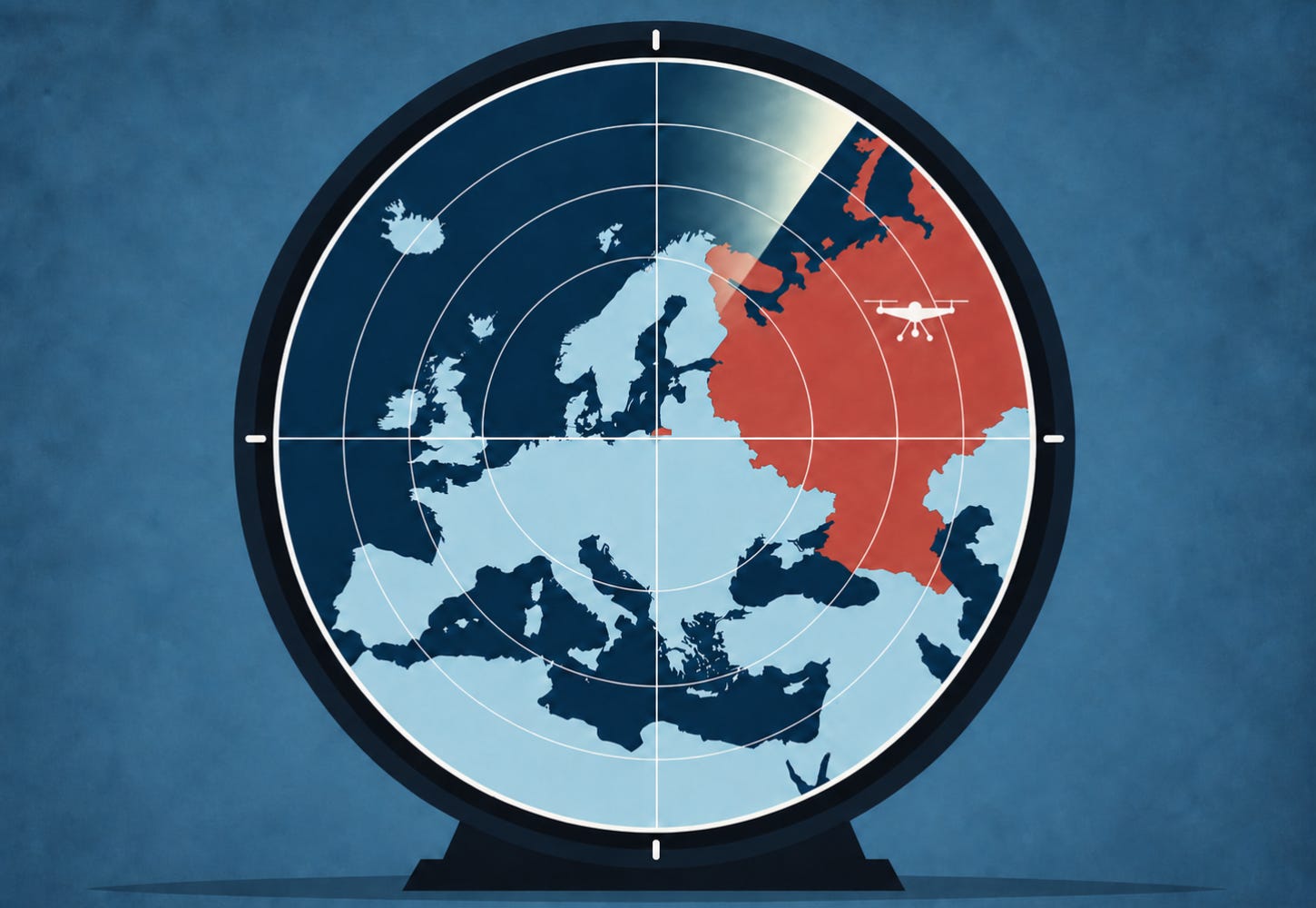
Over the past year, drone incursions over European airspace have become increasingly common. What were major news stories in 2025 are now commonplace events, with Luxembourg and Berlin airports being the most recently affected by drone sightings. Despite its denials of responsibility, such probing of European and North Atlantic Treaty Organisation (NATO) Critical National Infrastructure (CNI) is typical of Russia’s sub-threshold hostilities against free and open nations.
As the Kremlin’s needling of the continent continues, the United Kingdom (UK) as an upholder of European security should send a clear message that such actions are intolerable. This necessity forms the basis for this week’s Big Ask, in which we asked eight experts: How can Britain deter Russian aggression in Europe?
Senior Lecturer in Post-Soviet Security, Department of War Studies, King’s College London
As Russia continues its full-scale invasion of Ukraine, its aggression against the rest of Europe is growing. Sub-threshold attacks have been occurring for several years, and countries including the UK have been slow to respond. The current escalation seems to have several causes, including the weak response to earlier attacks, a misplaced perception of Russian strength and European weakness, and the Trump administration’s fracturing of NATO.
The British response needs to address all these issues, in cooperation with its allies. Deterrence relies on credibility, and the Kremlin needs to believe that further attacks – let alone escalation – will be met by a proportionate response, including a military response if necessary.
Most European states have been fearful of the consequences of this, but the real danger comes from letting Russia believe that the continent is too weak to impose any red lines. European countries need to demonstrate that they can and will act independently of the United States (US), now that Washington is prioritising detente with Russia over alignment with Europe.
European states, including the UK, need to stop sending mixed messages to the Kremlin. The European Union (EU) lifting sanctions on two oligarchs was a serious mistake. The statement made by Andy Burnham, Prime Minister, earlier this month that national security ‘can’t come at the expense of social security’ was deeply unhelpful in the signal it sent – domestically, to allies, and to Russia.
Lastly, all of Europe needs to recognise that the most effective way to deter Russian aggression is to help Ukraine to win.
Director, Conflict Studies Research Centre, and Senior Consulting Fellow, Chatham House
Politics and military capabilities evolve, but the fundamental principles of deterring Russia remain constant. Potential victims of the Kremlin’s aggression need to demonstrate that they and their allies are both capable of inflicting costs on Russia that would be meaningful and personally threatening for its leadership, and are determined to do so if attacked.
This means that since current and previous British administrations have declined to join European allies in reinvesting in conventional capabilities, His Majesty’s (HM) Government must resort to asymmetric means of challenging the Kremlin, and more convincing displays of the will to use them.
Russia will not challenge a NATO ally until it is fully convinced that the US will not come to its aid. However, it will also not challenge a country where a sufficiently powerful coalition of European states has made it clear that aggression will be answered assertively. When that challenge comes, there is unlikely to be much time available to create an ad hoc coalition of the able – and a purely performative ‘coalition of the willing’ will be of little relevance. The balance between making sufficient preparations for a non-NATO response to Russia, and overcompensating in a way that hastens erosion of faith in the alliance itself, is delicate but vital.
The UK has already squandered much of its leadership capital through defence delinquency, leading to active discussion even of its status as the framework nation of the Joint Expeditionary Force (JEF). If Britain wants to play a more significant role in European deterrence, the first and essential step is to overcome its own reluctance to regenerate the capabilities to do so.
Defence Sector Lead, Walker Morris LLP, and Army Reserve Officer
Russia’s increasing use of drone incursions, cyber activity, and other forms of sub-threshold coercion reflects a deliberate effort to probe European vulnerabilities without crossing into open conflict. These incidents are not merely acts of provocation; they are attempts to test response times, expose weaknesses, and assess political resolve. The UK’s task is therefore not simply to respond to individual incidents, but to convince the Kremlin that such efforts will fail.
This begins with deterrence by denial. Britain should continue to strengthen air and missile defence, counter-drone capabilities, and persistent surveillance alongside its NATO allies. Recent experience in Ukraine has demonstrated how relatively inexpensive uncrewed systems can impose disproportionate costs on defenders. The UK should help to lead efforts to reverse that equation by better integrating intelligence, detection, and response capabilities across Europe.
Yet, military capability alone is insufficient. Russia has adapted its economy for sustained confrontation with free and open nations, and European countries must demonstrate greater staying power. Deterrence rests not only on immediate military strength, but also on perceptions of endurance. Faster procurement, resilient supply chains, and a defence industrial base capable of scaling production during crises are therefore strategic necessities rather than economic ambitions.
Ultimately, the UK can best deter Russian aggression by helping to build a Europe that is resilient, technologically advanced, and industrially prepared. A continent that can absorb pressure, sustain competition, and deny strategic gains is one that the Kremlin will be far less inclined to challenge.
Head of Studies, International Centre for Defence and Security
Britain is already a major pillar for deterring Russian aggression. It leads NATO’s’s forward land presence in Estonia, serves as the framework nation for the JEF, and contributes in myriad other ways – conventional, unconventional, and, of course, nuclear. Its military aid to Kyiv – its main and most effective instrument for imposing costs on the Kremlin and coercing it into peace – dwarfs that of some other key powers in NATO.
The problem, therefore, is not a lack of willingness to demonstrate resolve and take action. Effective deterrence requires sustained investment in capability, rebuilding mass and reserves wherever relevant and necessary; expediting the integration of Ukraine’s lessons from drone warfare; and fortifying British society against coercion by adversaries.
The British Armed Forces have been losing mass across all services for years, and have struggled to secure the investment required to bring both their existing and emerging capabilities to the necessary scale and readiness levels that would properly impress Russia. The UK’s industry and society are woefully exposed and unprepared for the disruptions and hardships that fighting a large-scale peer conflict would inevitably impose.
Fixing this is not only about reaching the formal NATO commitment of spending 5% of Gross Domestic Product (GDP) on defence and defence-related matters – a commitment that nonetheless keeps slipping out of HM Government’s reach. Just as importantly, it is about moving at the speed and scale required, with the requisite sense of urgency, and as a whole-of-society endeavour. The credibility of NATO’s Article 5 rests on, and indeed starts with, the robustness of Article 3 – something that Britain needs to place back at the heart of its deterrence posture without further delay.
Postdoctoral Fellow, Finnish Institute of International Affairs (FIIA)
Deterrence policy in Europe is multifaceted. The UK has a key role leading evolution in nuclear and conventional deterrence as well as in resilience against sub-threshold threats. British leadership on deterrence in Northern Europe is longstanding, but the French-led nuclear ‘forward deterrence’ initiative is currently a major talking point in Nordic and Baltic capitals.
Supplementing NATO’s extended nuclear deterrence, strength in French proposals will still be seen through Paris’ bilateral partnership with London – centred on the Lancaster House Treaties and refreshed in 2025 to prioritise technological cooperation on nuclear stockpiles. The UK’s leadership of NATO’s forward land forces in Estonia, and of the JEF to ensure it remains militarily effective, are key priorities in conventional deterrence.
Resilience against sub-threshold ‘hybrid’ threats more closely concerns Britain’s maritime hinterland and the protection of CNI. The UK sits strategically at Europe’s transatlantic frontier, generating and facilitating critical data and energy connectivity linking its closest neighbours. Critical undersea infrastructure and important air corridors need to be protected from any sub-threshold manoeuvres that the Kremlin may contemplate.
To avoid difficult defence resourcing choices between protecting domestic supply flows and maximising deterrence commitments elsewhere in Europe, investment in Britain’s defence technological innovation is necessary in tandem with solutions for its military’s recruitment and retention problems. A closer partnership with the Republic of Ireland, focused more on common strategic realities and less on historical precedents, will mutually benefit both countries’ resilience against sub-threshold activities in the Atlantic and the Irish Sea, helping to secure important supply lines linking the UK, Ireland, and the wider EU.
Adjunct Fellow, Council on Geostrategy
The first, obvious point is that Britain cannot deter Russian aggression alone – it has to be a coordinated effort alongside European allies. This can be done through a combination of groupings – NATO remains the bedrock of European security, but alternative structures like the JEF or bilateral agreements can add flexibility and complicate matters for the Russian adversary. The UK should work closely with European allies to develop contingency plans for deterring Russia, with clear agreements on responsibility and effort.
Russian sub-threshold and political warfare should be robustly countered, ideally in a planned, coordinated fashion to ensure that the Kremlin feels pain for attacking Europe. Seizing ‘shadow fleet’ vessels, injections of funding to Ukraine, and countering Russian influence through covert action are examples of tools in Europe’s arsenal that can be wielded against the Kremlin.
Britain can also add significant heft through its status as a European nuclear power. While carefree nuclear ‘sabre-rattling’ should be strictly avoided, there should be serious consideration of how Russian threats might be managed through deliberate strategic messaging, using both conventional and nuclear means.
Of course, to do so, the UK has to have the capability and capacity to match its rhetoric, or it will be increasingly seen as a paper bulldog by both adversaries and allies. In both the long and short term, the clearest strategy that HM Government can take is to rearm seriously, credibly, and sustainably. Britain’s bark must be backed up with serious bite.
Co-President (Research), Council on Geostrategy
To deter Russian aggression in Europe more effectively, HM Government should combine domestic resilience, credible military capabilities, and proactive regional leadership.
First, the UK needs to harden its domestic information space to prevent the Kremlin from exploiting British political openness. By developing the new National Centre for Information Defence and legislating to compel social media companies to remove or hide anonymous accounts, HM Government can close off the primary vectors through which Russian political warfare operates.
Second, the UK should initiate a large boost to defence spending while generating a sub-strategic nuclear capability. As dramatised in The Wargame this week, relying solely on conventional forces or the Royal Navy’s strategic Continuous At-Sea Deterrent (CASD) leaves a dangerous operational gap. Russian doctrine is engineered to exploit structural ambiguity; establishing a credible sub-strategic nuclear option would eliminate this vulnerability and reinforce Britain’s ability to deter, even if the US was unable to assist.
Third, the UK should transform the JEF into a high-readiness vanguard for NATO while simultaneously deepening its military assistance to Ukraine. Rather than adopting a passive or reactive posture, Britain should show decisive leadership by coaxing European allies into accepting, and fully resourcing, a joint plan for Ukrainian victory.
By countering sub-threshold ‘grey zone’ actions, bridging critical force posture gaps, and rallying European strategic resolve, the UK can project the strength required to deter the Kremlin from attempting to revise the Euro-Atlantic order any further.
Programme Director for Security Studies, Centre for Defence Strategies, and Joint Programme Leader, Future of Ukraine Programme, Centre for Geopolitics, University of Cambridge
Britain can deter Russian aggression by making hostile action harder to conduct, less useful when attempted, and more costly once attributed. That means affordable counter-drone defences, resilient CNI, credible collective consequences, and a permanent security partnership with Ukraine.
The Kremlin’s drone campaign against Europe is not a series of isolated provocations. They will become more evident each month as Russia tests Article 5 and expands non-kinetic actions with kinetic ones. Britain cannot deter by matching each incursion with a fighter sortie, but it can deter by making denial cheap, punishment predictable, and Ukraine’s battlefield expertise a permanent part of European defence.
Consider Leipzig/Halle Airport. In August, an explosive-laden drone was found beside a Ukrainian An-124, at a hub serving both NATO airlift and Ukrainian supply; Berlin attributed it to Russia four weeks later. Probing has moved from surveillance to sabotage, and its target is European support for Ukraine. Meanwhile, NATO allies still answer cheap drones with expensive jets.
The UK already builds Ukraine’s Octopus-100 interceptor, which hunts Shahed-type drones at a fraction of their cost. Yet, this remains the exception: beyond it, few Ukrainian firms have opened British offices, and government-to-government delivery at scale has not followed. The UK should match Octopus’ contribution to European defence by pre-announcing the costs of attributed attacks.
Ukraine must be central to this effort. Its armed forces and defence industry have accumulated unmatched experience in drone interception, Electronic Warfare (EW), rapid innovation, dispersed logistics, and infrastructure protection under attack. Britain should elaborate on implementation plans for both the 100-year partnership and its role within the EW coalition, covering joint training, testing, lessons learned, research and development, and co-production. The UK brings capital, industrial capacity, training infrastructure, and NATO interoperability; Ukraine brings battlefield knowledge and a proven culture of rapid adaptation.
Deterrence also demands consequences. Britain and its allies should pre-agree proportionate responses to attributed drone incursions, sabotage, and attacks on CNI: diplomatic action, targeted sanctions, intelligence exposure, lawful cyber measures, and increased military support for Kyiv. The Kremlin must understand that deniable coercion will not remain cost-free.
Finally, the UK must communicate this strategy clearly to the public. Citizens need confidence that HM Government recognises the threat, protects essential services, and makes sure it is in balance with other budget lines. It is becoming increasingly necessary to explain that support for Ukraine, counter-drone investment, and infrastructure resilience are not distant foreign policy choices.
If you enjoyed this Big Ask, please subscribe or pledge your support!
What do you think about the perspectives put forward in this Big Ask? Why not leave a comment below?