

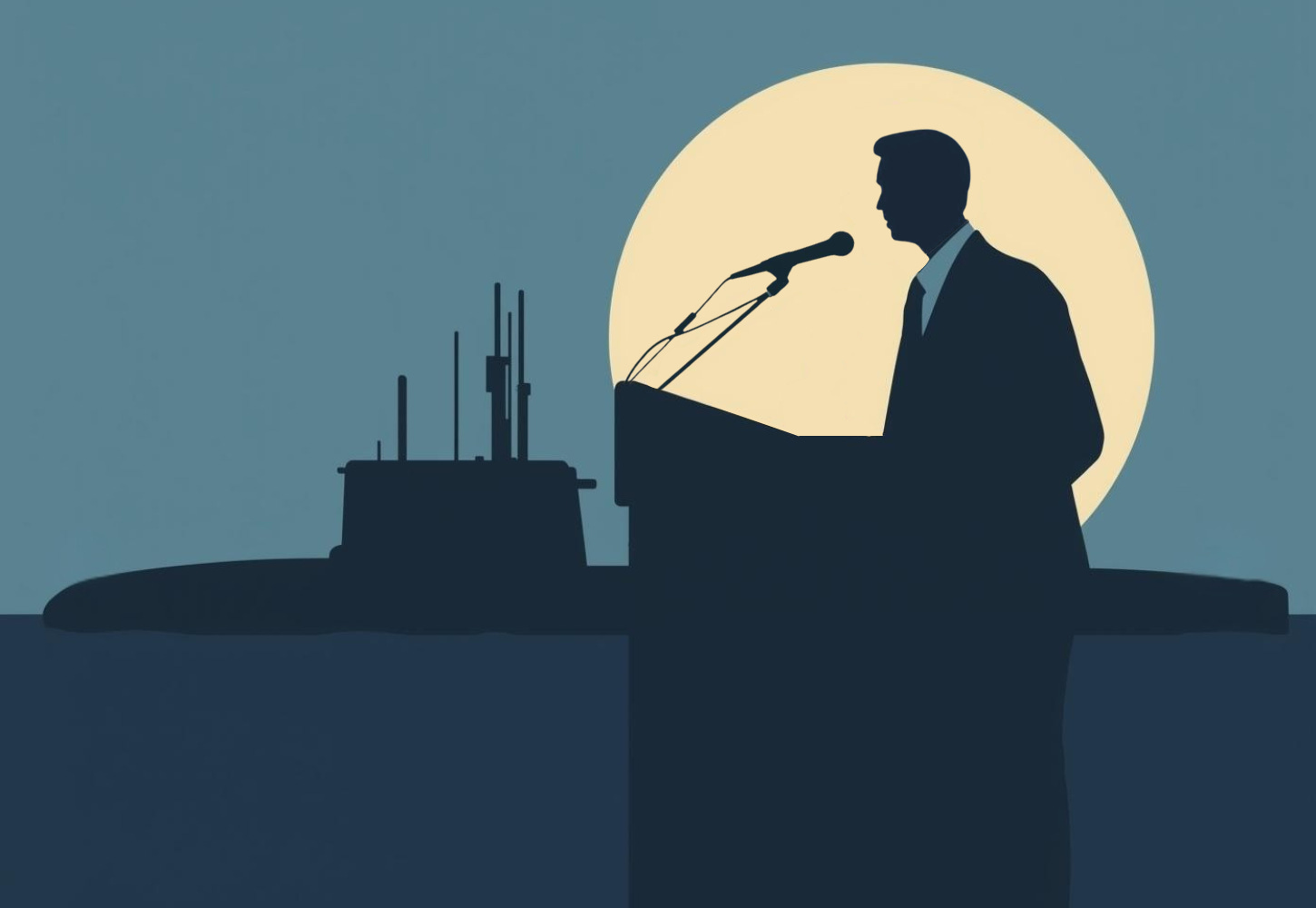
In early March, Emmanuel Macron, President of France, announced a major shift in France’s nuclear doctrine. Speaking at Île Longue nuclear submarine base in Brittany, Macron stated that the French nuclear arsenal will increase from 290 warheads – a number unchanged since 1992 – to an undisclosed amount, and that France will begin to collaborate with its non-nuclear allies across Europe to develop ‘forward deterrence’ against adversaries.
Unlike the British nuclear deterrent, which is thoroughly strategic, the ‘force de dissuasion’ is a broader deterrent, but one which has, until now, only protected France. While the change in French nuclear posture reflects the increasingly volatile state of international relations, it will also have an impact on the United Kingdom’s (UK) nuclear calculations. This forms the basis of this week’s Big Ask, in which we asked nine experts: How will France’s shift in nuclear doctrine affect Britain?
International Fellow, Council on Geostrategy, and Executive Editor, Internationale Politik Quarterly and Internationale Politik
Macron’s proposals – essentially, to take the first steps towards ‘Europeanising’ the French nuclear deterrent – should be a moment for the UK to rethink its own approach to nuclear deterrence, including the question of its dependence on the United States (US). Although it would mean a quicker and more extensive increase in British defence spending than currently envisaged, the UK considering this and joining the effort would be advantageous – certainly when viewed from Berlin.
Friedrich Merz, Chancellor of Germany, has always been clear that he would want to see both European nuclear powers – Britain and France – engaged with Germany in this effort. While closer French-German cooperation on nuclear deterrence is now underway, many questions, some of huge consequence, are far from being resolved. It is true that the UK, which already works closely with France on nuclear issues, playing its own new role in the context of European nuclear deterrence would make the effort more complex.
However, it would also make European nuclear deterrence more stable and balanced in the longer term. Germany remains highly unlikely to build its own nuclear deterrent, but hosting British as well as French weapons would lead to a stronger posture in case of an American withdrawal, and to Berlin’s decision-makers sleeping more soundly.
There are also further, greater benefits. As Macron (rightly) argued at the Munich Security Conference in February 2026, nuclear deterrence is the ‘cornerstone’ of European defence integration; cooperation in this field will ‘trickle down’ into other domains. It could pave the way for a shared strategic culture soundly underpinning European security – including a strong British element.
Chief Executive Officer, Geopolitics and Security Studies Centre
From a Baltic and Northern European perspective, France’s shift is very welcome – and it should be understood correctly. It does not displace the US’ strategic deterrent, which remains the supreme guarantee of European North Atlantic Treaty Organisation (NATO) security. The UK’s deterrent continues to play an important complementary role, while France is adding a more explicitly European dimension to the overall deterrence debate.
Thus, the British role only increases. The UK has assigned its nuclear forces to NATO since 1962, and in June 2025 decided to buy at least 12 F-35A Lightning II Joint Combat Aircraft and join NATO’s Dual-Capable Aircraft (DCA) mission. This was certainly noticed in the Baltic states.
That is not symbolic. It reinforces Britain’s role as the key European connector between the American nuclear umbrella and European nations’ own deterrent contribution, and also shows that the transatlantic bond continues to evolve in practical ways despite political turbulence.
So, the broader significance of France’s move is strategic. Paris itself has said that its new cooperation with Germany will ‘add to, not substitute for’ NATO’s nuclear deterrence and NATO’s nuclear sharing arrangements. This signals that Europeans are thinking more seriously, and more long-term, about continental security at the strategic level. That is good news for the UK, and for the Baltic region.
Doctoral Fellow and PhD Candidate, University of Surrey
Standing before the nuclear-armed Le Téméraire submarine, Macron’s speech highlighted the extent to which French nuclear and military posture has adapted more successfully to the realities of the security crisis facing European nations than Britain’s has. Demonstrated further in recent days with the deployment of the French Navy to Cyprus in lieu of the Royal Navy’s own deployment due to delays, France’s shift in nuclear doctrine is a wake-up call to the UK to start taking its own nuclear arsenal more seriously, and could encourage many similar moves for Britain’s own nuclear posture.
The European countries interested in participating in this new forward posture should also convince the UK that it is in its interests to be more multilateral and engaged. By creating a unified joint European nuclear umbrella with France, covering further nations beyond just those with forward presence, Britain and its allies can hedge against the worst possibility of a complete reduction of American deterrence.
France’s shift also draws attention to the UK’s lack of a tactical nuclear arsenal, highlighting a key gap in the British nuclear posture. While debate still rages over cost, and conventional versus nuclear munition benefits, the UK should at least respond to France’s shift with its own understanding of the role of its nuclear arsenal, where its gaps lie and how it intends to fill them, lest others answer this question with aggressive posturing of their own.
Senior Analyst, Foundation for Strategic Research (FRS)
Macron’s speech announced a major shift in France’s nuclear deterrence policy: for the first time in its history, Paris invited eight of its closest allies to participate directly in its nuclear operations through the new concept of forward deterrence.
Britain holds a privileged position in this French initiative, both due to its status as a nuclear power and the deep strategic ties that have bound the two countries for decades. The Northwood Declaration of July 2025 already broke new ground by mentioning the possibility of political, technological and – most importantly – operational coordination between the two nations’ nuclear deterrents.
The forward deterrence concept will significantly enhance the resilience of the UK and France’s strategic forces, opening the door to the deployment of nuclear assets on each other’s territory – potentially including strategic submarines. Furthermore, Royal Air Force (RAF) participation in French air-based nuclear operations could enable it to regain expertise lost with the withdrawal of the WE.177 gravity bomb from service in 1998, potentially paving the way for a future national programme.
Above all, this doctrinal evolution and the coordination of British and French deterrents will provide a solid foundation for a European security and defence architecture in the face of adversaries, particularly Russia.
Co-founder (Research), Council on Geostrategy
In some ways, France’s decision to establish forward deterrence – by deploying nuclear-capable aircraft to a plethora of European partners, albeit on a temporary basis – means very little. It will play a relatively small role in boosting the defence of Europe, as the Kremlin knows that these aircraft could soon be withdrawn if they apply serious pressure.
Without extended deterrence (an explicit and durable entanglement whereby a nuclear-armed nation stations forces on the territory of a non-nuclear-armed ally), a nuclear opponent may think it can force concessions. In some ways, France’s forward deterrence may even undermine the defence of Europe for the simple reason that it is so ambiguous.
In other ways, the French decision may attract desperate allies who believe the established order in Europe is coming apart. This would provide France with greater influence over the future direction of continental security, alongside all the economic and industrial benefits that come with it. France – not the UK – would become strategically indispensable.
What Britain should do now is straightforward: establish its own sub-strategic nuclear weapons and delivery programme. For one, this would provide the UK and its allies with the means to match Russia’s potential escalatory steps – the Kremlin possesses nuclear forces at all levels, and has demonstrated a propensity to leverage its nuclear status for geopolitical effect. For another, if this could form part of a British-led sub-strategic nuclear sharing system – perhaps based on the F-35A Lightning II and Tempest airframes – with a select group of European nations (such as the Nordic states, Poland, Germany, Italy, Romania and Turkey), the UK could re-centralise itself at the heart of European geopolitics.
This would also provide European allies with greater incentives to buy into the British defence-industrial base, yielding positive trade-offs for future economic growth and technological innovation.
Lecturer in Security Studies and Director of David Davies Institute of International Studies, Department of International Politics, Aberystwyth University
From the UK’s perspective, there are two ways to read Macron’s speech.
Firstly, several of the announced changes carry distinct benefits to Britain. At the rather modest, though symbolically significant, end of the spectrum, France now joins the UK in embracing ambiguity about its number of nuclear warheads, which it will no longer make public. Much more profound is Paris’ signalled willingness to loosen its notorious nuclear independence, and to ‘conceive our deterrence strategy within the depth of the European continent’.
While this falls short of the British nuclear commitment to European allies within NATO, France’s move may bolster the UK’s existing efforts and even provide some relief. Pointedly, the brief statement from His Majesty’s (HM) Government statement following Macron’s announcement concluded with the following sentence: ‘We welcome the proposals set out by President Macron to cooperate more closely with allies on nuclear issues.’
The other reading of how France’s shift will affect Britain is less optimistic. It reveals that France possesses independent nuclear capabilities that are simply not at the UK’s disposal currently. Sceptics will certainly raise doubts about the depth of France’s commitment to other European countries, as well as the reliability and credibility of forward deterrence. And they may well have a point, insofar as any form of extended deterrence is, at best, iffy.
The fact remains, however, that France can engage in a political-strategic initiative of a kind that Britain currently cannot.
Julien Lalanne de Saint-Quentin
Adjunct Fellow, Council on Geostrategy
The commitments announced at Île Longue can be read less as a rupture than as an extension of the 1998 Saint-Malo Declaration: that Europe must be able to act while remaining anchored in sovereign capabilities and Atlantic realities. That the UK was explicitly named in Macron’s speech is significant in itself. It suggests that, despite the rhetorical habits of the post-Brexit period, Paris still sees London as a central strategic partner when the most serious questions are at stake. It places Britain right inside the intellectual architecture of European deterrence, even as France insists – rightly – that nuclear decision-making remains wholly national.
For all the old doctrinal reserve, the reality has long been one of interdependence, even in the North Atlantic and on the approaches to the Continuous At-Sea Deterrent (CASD) bastion. The underwater battlespace allowed a measure of ambiguity: interdependencies could exist without being too visibly acknowledged by those who prefer the more reassuring language of complete autonomy.
The air component is different. By its very nature, it is less able to conceal the practical ecosystem on which it depends. In that sense, Macron’s forward deterrence concept does not so much create interdependence as makes it harder to continue pretending that it does not exist.
Geography matters enormously. Faslane and Île Longue are very close to one another, and the maritime approaches to one bear directly on the security of the other. Although the UK and France each defend their own goal, the same opposing forward can threaten both at once, and the midfielder screening the defence is therefore protecting both goals simultaneously. Capabilities designed to secure the approaches, clarify the tactical picture and complicate hostile action against the bastion are not peripheral enablers; they form part of the credibility of the posture itself.
France’s contribution will therefore remain absolutely central to the protection of CASD, while a more explicit recognition of allied interdependence gives fuller credit to the wider ecosystem within which that protection is achieved.
Prof. Sir Hew Strachan FBA FRSE
Bishop Wardlaw Professor, School of International Relations, University of St. Andrews
First, Macron’s speech is the most significant from any head of state in a generation. It challenges Britain to be as forthright and strategic. With major conflict in Europe, and Middle Eastern strikes whose justification rests on countering nuclear proliferation, it is no longer possible not to discuss nuclear weapons.
Yet, the UK insists on treating them as ‘political’, and therefore somehow separate from national strategy. The procurement of the next generation of nuclear-powered ballistic missile submarines (SSBNs) dominates the defence budget without a public rationale like that of France.
Second – and related – Macron was clear about France’s readiness to use nuclear weapons if need be: ‘You have to be feared if you want to be free’. France will possess a triad of nuclear weapons: SSBNs, nuclear cruise missiles and air-launched capabilities. Its target is resilience, including a second-strike capability. Britain is currently vulnerable; dependent at any one time on a single, tired SSBN on (an increasingly lengthy) patrol.
Third is the biggest change of all: Macron abandoned France’s long-cherished autonomy in nuclear doctrine. He did not mention NATO, to which the UK’s SSBNs are allocated, even if their implications for Europe’s defence are opaque. Nor did Macron name the US. The defence strategy of Donald Trump, President of the US, stresses deterrence by denial, which failed to prevent Russia’s threats to escalate in Ukraine. Instead, France has embraced forward defence, and is pursuing a series of bilateral relationships, beginning with Germany.
Air Marshal (rtd.) Edward Stringer CB CBE
Director, iJ7 Ltd., and Senior Fellow, Policy Exchange
France’s refreshed nuclear posture is clever signalling. It sends the message that France is reinvesting in serious hard power. In reality, there is little in Macron’s speech at Île Longue that promises significant increased capacity. However, the conceptual component of deterrence has been altered for the better – and I would say better for the UK too.
There will be a lot of devil in the details to be sorted before Macron can deploy French nuclear weapons forward to allied countries, and thus engage other European powers in a putative ‘Euro-deterrent’. Such weapons will, in any case, as Macron admits, always be triggered by the President of France alone.
But that sense of tying European powers together is real. Furthermore, via the Northwood Declaration, Britain is tied more closely to the French nuclear effort. As well as this, France is tied closer to the US via the UK (acting as an intermediary), whose nuclear deterrent is intimately entwined with the American enterprise.
Whatever the robustness of the extended deterrence of the US, a more concrete European defence and nuclear posture is a bonus – all the better to deter foes and keep America onside. Gen. Hastings ‘Pug’ Ismay would have understood this…
If you enjoyed this Big Ask, please subscribe or pledge your support!
What do you think about the perspectives put forward in this Big Ask? Why not leave a comment below?