

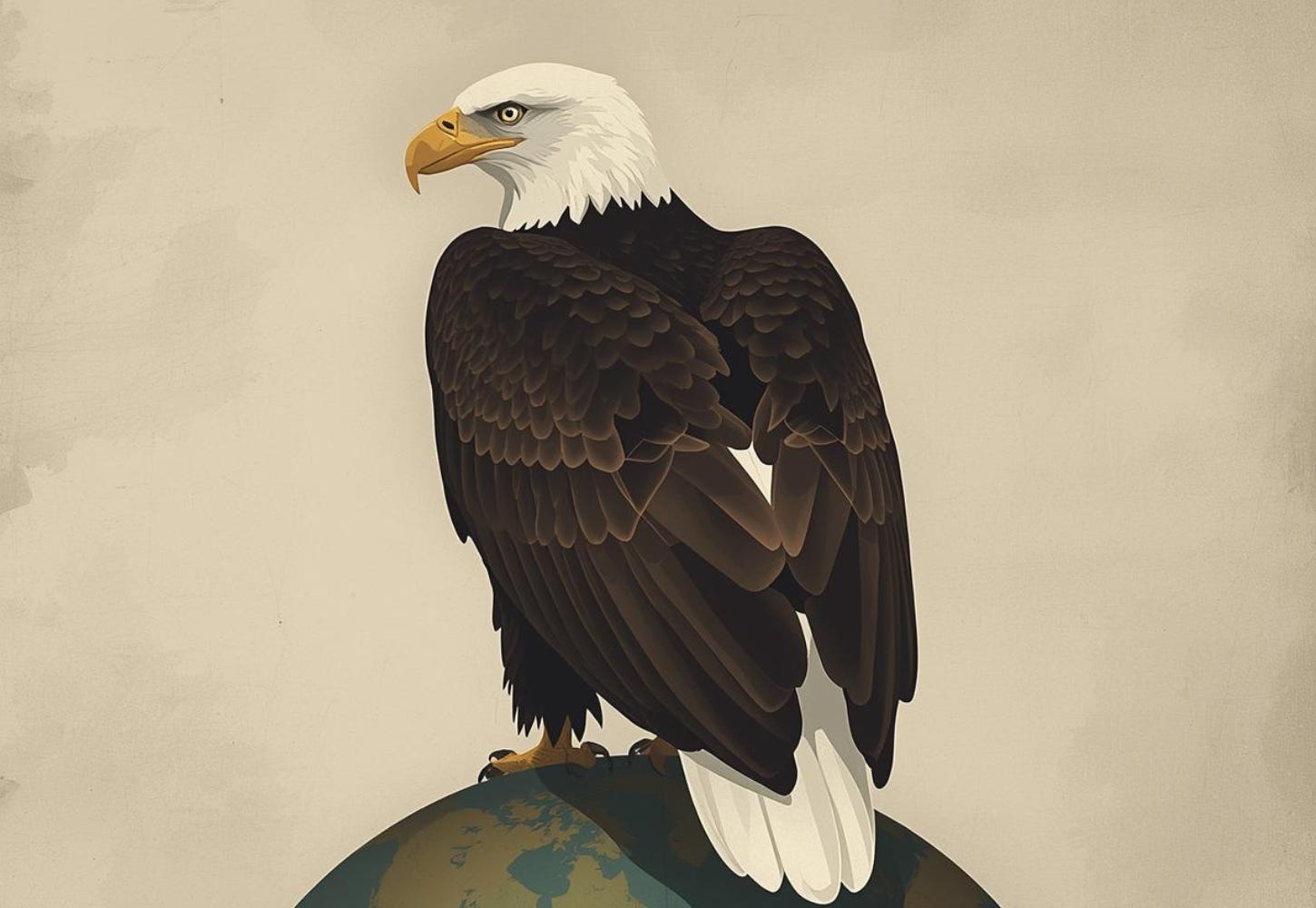
Since its publication last Friday – launched without fanfare in the early hours of the morning – the United States’ (US) new National Security Strategy (NSS) has unnerved European allies and encouraged Russia in equal measure. It is true that the NSS marks a significant departure in terms of recent American statecraft, but many of the deeper underlying and structural elements of the NSS have been emerging, across successive American administrations, for some years. In this ‘Reframer’, we ‘disrupt’ orthodoxy and ‘reframe’ emerging narratives surrounding the new US strategy.
With the NSS, isn’t the US becoming isolationist?
No. The NSS is in no way isolationist; it is simply more selective regarding the theatres in which the US will focus its power and resources. Over the past few years, the destabilising activities of non-state actors, such as drug cartels, and the increasing encroachment of Chinese economic and geopolitical influence, have undermined America’s position in its own hemisphere.
For these reasons, the NSS prioritises Central and South America, where – using language that might make James Monroe or Theodore Roosevelt blush – it asserts ‘absolute American pre-eminence’ will be re-established. While this may appear to be a departure from recent US statecraft, America has always kept a keen eye on events in its own backyard.
The shift, therefore, is not that the Western Hemisphere is now America’s primary focus, but that the resources required to secure US interests there have grown. This necessitates a degree of retrenchment in American force posture elsewhere. Without dominance in the Western Hemisphere, the US cannot project power without placing its homeland at unacceptable risk. This mirrors the United Kingdom’s (UK) ‘NATO [North Atlantic Treaty Organisation]-first’ approach; Britain has always prioritised the defence of the Home Islands, but the quantity of resources required to secure them has ebbed and flowed depending on the level of the threat.
This does not represent an abrogation of other regional interests; the new US strategy is clear that America retains strong interests in a number of regions, particularly the Indo-Pacific. Instead, it is a reaction to hemispheric neglect, which threatens Washington’s ability to pursue its wider objectives.
Okay, but surely the NSS is hostile to the rules-based international order?
Yes, to an extent. The NSS explicitly rejects previous American attempts to create an integrated, inclusive, multilateral world system during the post-Cold War era. Even more forcefully, the new strategy argues that this agenda – sometimes known as ‘globalism’ – weakened the US national powerbase and empowered potential adversaries. The NSS recognises that hostile nations, notably the People’s Republic of China (PRC) and Russia, have exploited the current order to the point of capture, and now seek to reconfigure it in their own image.
But to end support for a specific vision of order is not to terminate the quest for all order. Rather, the NSS seeks an international order that is more exclusive, one which prioritises America and its allies and partners more than its competitors and adversaries. It is very clear on this:
The United States must work with our treaty allies and partners...to counteract predatory economic practices and use our combined economic power to help safeguard our prime position in the world economy and ensure that allied economies do not become subordinate to any competing power.
Moreover, by framing the PRC not merely as a geopolitical rival but as an economic predator, the NSS frees the US to use tools that were previously considered taboo. It calls for American ‘reindustralisation’, ‘energy dominance’, and financial and technological supremacy. It signals a shift from accepting predatory geoeconomic practices within the global order to threatening to marginalise those – particularly the PRC – whose practices are not in line with US interests. And it marks a transition from seeing the economy as distinct from state direction to its inclusion as an explicit element of statecraft. To countries used to an America that long championed the virtues of free trade, this change in approach is being interpreted as hostile.
Whatever; the NSS turns America into an untrustworthy ally!
Does it? The US has often been accused of selfishness and unreliability: the British were deeply unhappy with the McMahon Act which terminated nuclear sharing in the aftermath of the Second World War, just as they were furious with America’s economic blackmail during the Suez Crisis. Any country’s actions, even an ally’s, can appear to make it ‘untrustworthy’ when it embraces policies that may not be in keeping with another ally’s national interests. And when the ally in question gives plenty of warning of its long-term intentions, and when it states that the cost of the common defence is egregiously lopsided, can it really be described as untrustworthy?
In the case of the NSS, Britons and Europeans can hardly claim ignorance that American policy was evolving and that the post-Cold War consensus would not continue indefinitely. For many years, the US has warned its British and European counterparts that they have wider priorities than the Euro-Atlantic. Robert Gates, as Secretary of Defence in 2011, told Europeans – forcefully and clearly – that he was the last of the genuinely Atlanticist generation of Americans, and that future generations would prioritise other issues and geographic theatres. The UK has done little to prepare for this change; similarly to European countries, it has held defence spending down and allowed its capacity for autonomous action to weaken.
But doesn’t the NSS seek to undermine Europe?
That remains unclear – but Europeans have questions to answer. From the perspective of European capitals, the NSS appears remarkably soft on Russia. Rather than pinning the blame on the Kremlin for launching the worst European conflict for 80 years, it talks of re-establishing ‘strategic stability’ and calls for an ‘expeditious cessation’ of hostilities.
Worse, the NSS targets the European order – especially the European Union (EU) – which it blames for undermining European national self-confidence. Critics might reasonably argue that the strategy merely reflects the interests of US ‘Big Tech’, which often appears to see the EU, in particular, as nothing more than a regulatory obstacle.
But more is at play here. The NSS is not anti-European: it explicitly states that ‘Europe remains strategically and culturally vital’ to the US and it wants European allies with ‘economies and militaries strong enough to remain credible allies.’ Here, the Americans have a point. During the Cold War, America’s British and European allies were both far stronger and did relatively more in support of the common defence effort.
As such, the NSS throws down the gauntlet to Europeans. The EU has stagnated – as the Draghi Report itself identified in 2024 – and its share of economic output has declined markedly in recent years. Since 2005, the EU’s share of world economic output has plummeted from almost 30% to approximately 17% – one of the steepest declines of any region in history. It is perhaps a point of irony that the greatest proponents of the old order, European countries, are those who have weakened most under it.
So, far from seeking to undermine Europe, Washington in fact desires meaningful allies and partners, not satrapies and security consumers. While the language is abrasive, the NSS seeks to jolt allies out of their complacency. The positive American approach to Poland, with a growing economy and defence effort, reflects this.
Right, but isn’t it time for Britain to throw its lot in with the EU?
Is that the only option? One British response to the new NSS would be for the UK to double down on the EU and the existing European order. But, many European countries have hardly been dependable allies: Germany was slow to react to Russia’s full-scale invasion of Ukraine, and France has been stubbornly resistant to broadening the EU’s defence industrial base to include British-based companies, despite their centrality to the defence of Europe. Indeed, it was the financial flows and geopolitical complacency of several European states that enabled Russia to modernise its military, fostering the Kremlin’s conviction that a full-scale invasion of Ukraine would go unpunished. Since February 2022, European countries have also sent Russia more than three times as much money in hydrocarbon payments as they have sent to Ukraine in aid.
Would support for this struggling order in Europe serve British interests? In this sense, America’s NSS should be seen as an opportunity for the UK: what Britain needs now is a geopolitical ‘third way’ that dusts off the assertive realism of Ernest Bevin. Of course, as the NSS indicates, Britain can no longer harness America’s awesome power through North Atlantic Treaty Organisation (NATO) to smother geopolitical competition in Europe in the way it has previously.
Instead, the UK should lend its weight to the creation of a new order that it proactively leads. This will require re-imagined coordination with the US, renewed investment in the UK’s instruments of power, and the re-invigoration of the British national powerbase. The AUKUS security partnership should be seen as the perfect template: it draws in the US in a way that is supportive of American interests; benefits the UK’s defence industrial base; and shapes the international order in harmony with British preferences. Could a new vanguard for NATO be fashioned from the Joint Expeditionary Force with a number of additional ‘enhanced partners’?
To sum up, in some ways, America’s NSS echoes Britain’s own National Security Strategy, which calls for ‘a hardening and sharpening of our approach’, as well as for enhanced forms of ‘economic statecraft’. While not entirely on the same page, both powers are increasingly cognisant that their economic and strategic wellbeing requires a more exclusive order – one capable of blunting the ambition of hostile states.
William Freer is Research Fellow (National Security) at the Council on Geostrategy.
James Rogers is Co-founder and Director of Research at the Council on Geostrategy.
To stay up to date with Britain’s World, please subscribe or pledge your support!
What do you think about this Reframer? Why not leave a comment below?
This is an interesting take, however it comes across as an attempt to cope with a pro-Kremlin Trump administration. While the points on US increasing anger over European (including UK) sheltering under US military and funding strength are well taken, the language around 'cultural decline' and the explicit exhortation to meddle in European politics - fairly explicitly pointing to supporting far right populist pro Russian (or at least sympathetic to Russia) parties - is both chilling and a weird effort to impose MAGA's rascist lens on its erstwhile partners. The authors' contention that the NSS is only hostile to the rules based order to a degree is a misreading: nowhere is Russia criticised for its invasion of Ukraine, Russia is not presented as an adversary, and Europe instead is targeted: this is a clear sign that the USA is now an unreliable partner at best, a Kremlin puppet at worst. The notion that Russia can be ignored and the focus can be on China is nonsensical (Russia and China are working closely across military, economic and cyber against democracies). The one positive one can say about this is that it at least is clear. That's good. The rest is bad and ugly. It seems currently fashionable to articulate the position that ethics, morality and values such as human rights are at best 'nice to have' or 'in reality' superfluous to realpolitik, but Trump and cronies will very soon discover that true strength lies in relationships, trust, and joint effort - all of which have been dismissed by Trump and his sycophants. There is a very interesting analysis by Warren Buffet on the EU's trillion dollar rearming initiative and the implications this has for the US both in terms of its dominance in arms AND its influence over its clients. Trump has waved that goodbye. The UK needs to wake up the fact that the special relationship DOESNT exist with a MAGA USA, and wont be the same after even if there is a half way sensible US President following Trump (and he may throw democracy out of the window and go for a 3rd term). Better by far to now rejoin the EU, play an active role in Europe's defence, build out relationships with traditional Commonwealth partners like Canada, Australia, NZ and Asian democracies like S Korea and Japan (1000s of abducted Ukrainian children have been sent to indoctrination camps in N Korea to be filled with anti Japanes and anti S Korean ideology), and MOST OF ALL SUPPORT UKRAINE TO WIN (which it is doing) against Putin. The mere fact that Trumps weird fantasy football "Peace Process" never invoves Europe, NATO, or Ukraine is such strong context to this malign document that it is a real lacuna of the authors not to take into account. I'll just finish with the observaton that Vance who clearly inspired if not authored the NSS is a devotee along with Project 2025 crew of the philosopher Carl Schmidtt, the "Crown Juror" of the Nazi party in the 1930s, who seems to have found new life inspiring the likes of Thiel, Miller, Musk et al in their vision of a world where the little people can be managed by technology, and the usual b***ocks around race (white) culture (evangelical christian) should be promoted. The NSS in my opinion is geopolitical suicide for the USA. Everyone has to stop trying to explain these things as strategies by Trump - he has no strategies he just wants to be an oligarch and make money. Lets face facts - UK needs Europe more, needs to be independent from the USA, and needs to bolster its relationships with Australia, NZ, Canada, Japan and S Korea through standing up to Trump
I appreciate the more balanced take to the NSS compared to many commentators. I was not reading this as a critique but rather how it affects us in the UK and to an extent Europe. In some ways I agree
However the NSS suggestion of supporting “patriotic” parties across Europe is startling. This appears to have been glossed over here. Especially with many MAGA crowd interventions in British politics. Especially concerning when JD Vance accused the UK as some “random country” that hasn’t fought in decades yet British servicemen and women died fighting in several of American wars (on that America is the only one to ever call on Article 5).
One of the quotes from there really left a bad taste “growing numbers of strong, traditional families that raise healthy children”.