

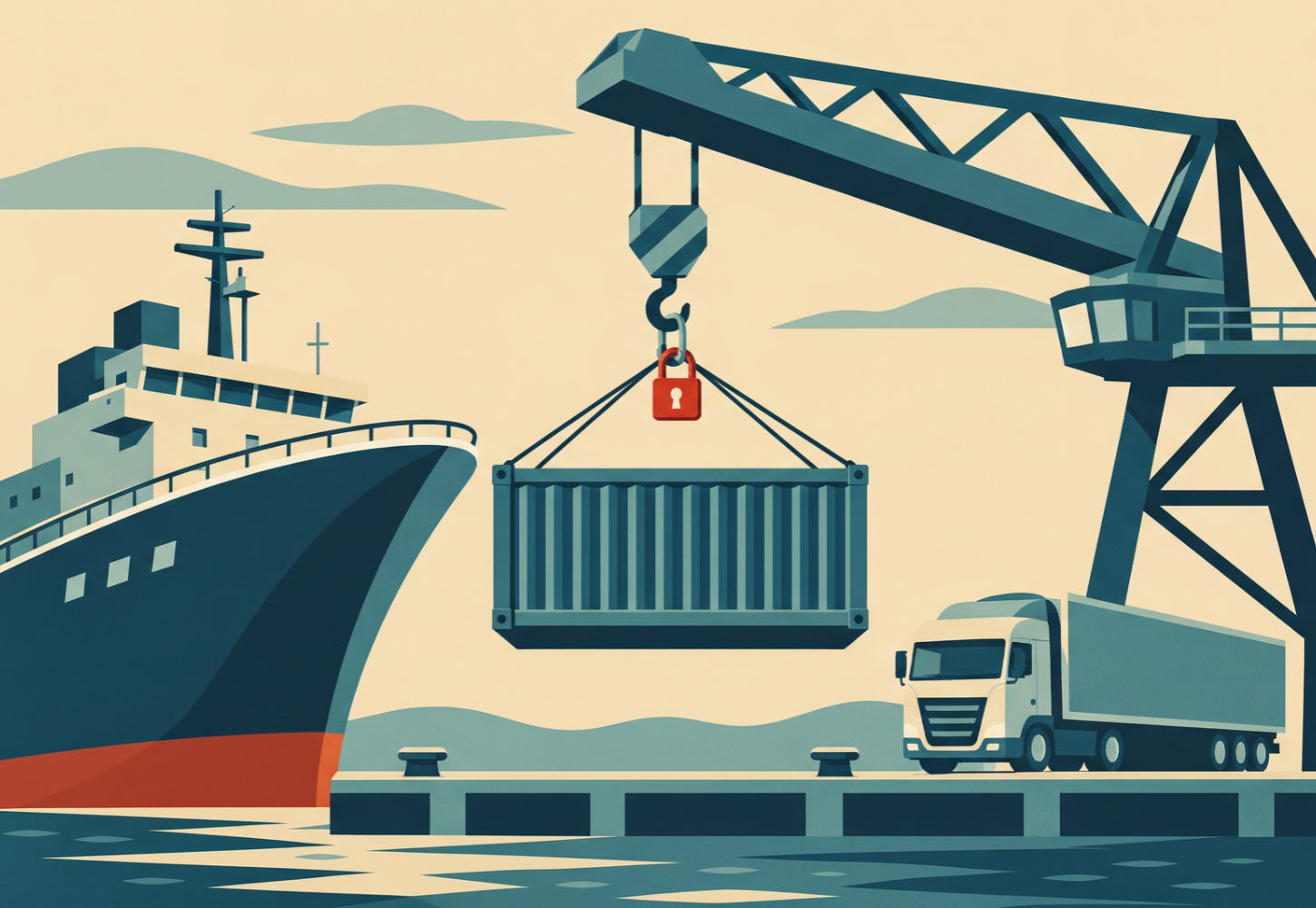
Picture the following scenario: an order reaches a port in the United Kingdom (UK). The receiving headquarters can authenticate it. The ship is ready to unload and the onward transport plan has been approved. Yet, a commercial terminal cannot validate the release instruction. The haulage contractor cannot reach its usual identity service. A supplier’s inventory shows a shipment that another system considers still in transit.
No military communications link has failed, but the cargo has not moved.
This is a hypothetical exercise, not an account of a British deployment. Its importance lies in a neglected distinction: a commander’s ability to communicate does not necessarily establish the ability to execute a reinforcement. When much of the work between an order and a delivery belongs to commercial providers, operational continuity depends on institutions that do not sit inside the British Armed Forces’ communications architecture.
That being said, the UK has an opportunity to make this distinction a practical contribution to the North Atlantic Treaty Organisation (NATO) rather than another abstract warning about vulnerable infrastructure.
Identifying the dependency
NATO’s 2026 Resilience Baseline Requirements are unusually explicit. They require countries to support reinforcement through civil transport, keep transport information and operational technology resilient, identify alternative systems, and notify the alliance of disruptions affecting its Reinforcement and Sustainment Network. They also call for border-crossing arrangements able to meet military movement timelines.
There is no case for pretending that NATO has forgotten civilian logistics. Its requirements recognise that a defence plan cannot be implemented by armed forces alone. However, the missing public test is narrower: when military communications remain available but parts of the civilian information chain are not, can a priority movement still be completed correctly and on time?
The alliance’s Digital Backbone eXperimentation (DiBaX26), held in Latvia from 19th to 30th October 2026, provided a useful point of comparison, testing resilient military communications including multiple networks and a connection to host-nation infrastructure. That is necessary work. The successful delivery of a Command and Control (C2) service, however, does not mean that a commercial port can release a container, or that a road carrier can validate a disputed movement instruction.
The difference here is not technical trivia. Cargo moves through successive approvals and handovers. Each element may depend on a different company, account, booking system, or set of records. A secure military order may reach a force that is physically ready to act while a civilian supplier lacks the verified information or authority needed to fulfil it.
Britain’s opportunity
The UK’s physical geography, role within NATO, and relationships with European partners place it in a position to test the handover between national military decisions and cross-border movement. Its security and defence partnership with the European Union (EU) identifies military mobility as an area for closer cooperation, including work associated with the EU’s Permanent Structured Cooperation (PESCO) project on Military Mobility. This does not mean that every allied reinforcement passes through Britain. Rather, it means that the UK has both a national interest and a diplomatic route for improving how forces move with partners.
The details are less glamorous than another digital command system. In February 2026, His Majesty’s Revenue and Customs (HMRC) published updated guidance on military mobility – including ‘NATO Form 302’, used for eligible military goods crossing relevant borders. This form is a legitimate procedure, not a comprehensive substitute for the commercial systems that schedule movements and manage custody. However, its existence nevertheless illustrates the range of processes that must work together: military authorisation, customs treatment, transport booking, custody records, and final receipt.
A useful British contribution would be a reinforcement-completion exercise involving a willing port operator, commercial carrier, logistics supplier, relevant civil authorities, and an allied receiving unit. The scenario would use harmless test consignments or synthetic records rather than real, mission-sensitive cargo. An authenticated military movement instruction would be issued, following which one or more civilian digital services would become unavailable while the principal military command link continued working.
The organisers would not merely ask whether each organisation had restored its network, instead asking whether the consignment reached the declared destination within the specified window; whether every handover remained authorised; which records had to be reconciled after reconnection; and whether anyone had inadvertently moved, duplicated, or released the wrong goods.
Testers would run an undisrupted baseline as well. Without it, ordinary delays could be misdiagnosed as cyber effects. The evaluation would count delayed essential consignments, time until trustworthy alternative processing, discrepancies in goods and records, and the workload of clearing the backlog. A ‘pass’ would be a completed movement under declared conditions, not a green dashboard.
Furthermore, no new multinational agency would be needed. The Joint Expeditionary Force (JEF) ministers’ statement of 2nd October 2026 calls for greater interoperability and shared industrial resilience, and notes the development of a multi-year exercise plan. The UK could propose an appropriately scoped pilot, either within an existing exercise or through NATO’s reinforcement and resilience planning, bringing in civil providers as partners rather than assuming military staffs can reproduce commercial operations on their own.
Measuring what matters when services fail
There exists a reasonable objection to bringing NATO into civilian logistics. Ports, carriers, and customs bodies already have business-continuity procedures. Adding an alliance-specific test might simply impose extra costs and expose commercially sensitive information.
The answer is to test only the movements whose interruption would materially affect a defence plan, and to agree in advance what operational outcome a public or private participant must demonstrate. Commercial operators need not publish proprietary routes, credentials, or customer data. Rather, they need to show that a designated alternative works when a critical dependency is unavailable. Where extraordinary wartime readiness goes beyond normal commercial obligations, allied governments must decide what they are willing to fund.
The design should also protect against a different mistake: treating any offline paperwork as trustworthy just because the primary system is inaccessible. Instructions, customs records, and goods receipts must be authenticated and later reconciled. An automated logistics assistant might continue advising from a cached manifest, but it should not present stale stock information as a fresh confirmation, nor acquire extra authority merely because a normal approval system has gone offline.
While the question of who would repair Britain’s undersea cables in a crisis concerns restoring a vital connection, the reinforcement question begins even where some connections survive: which commercial and military handovers still function, and which supposedly independent alternatives share one hidden dependency?
Conclusion
Ultimately, the strategic prize for the UK is a modest but valuable form of leadership. It would show partners a way to measure whether a coalition can execute a priority movement despite uneven civilian connectivity. This would complement British investment in interoperability without claiming authority over another ally’s logistics or demanding a single common software platform.
For the UK, the practical return would be threefold: evidence of whether its ports, carriers and customs arrangements can deliver allied reinforcements under stress; a stronger basis for directing resilience spending towards the civilian bottlenecks that actually delay movement; and a repeatable Britain-led exercise method that partners could adopt without sharing proprietary systems. The UK-EU summit statement of 20th November 2026 makes this especially timely. It identifies military mobility and logistics as vital, and welcomes progress on British participation in the PESCO Military Mobility and Network of Logistic Hubs projects. A completion-based pilot would turn that shared ambition into measurable British leadership in European deterrence.
The UK does not need to invent a new theory of digital war, and NATO has already set the resilience requirement. The task now is to show what fulfilling this looks like in a British port, with commercial partners and an allied unit waiting at the other end.
A command can cross Europe in seconds. That does not mean the cargo will follow.
Burak Oktenli is an independent researcher working on defence technology, cyber resilience, and assurance of autonomous systems. He holds a BS in computer science and engineering from the University of South Florida and an MBA, and is pursuing a Master of Professional Studies in Applied Intelligence at Georgetown University.
To stay up to date with Britain’s World, please subscribe or pledge your support!
What do you think about this Memorandum? Why not leave a comment below?