

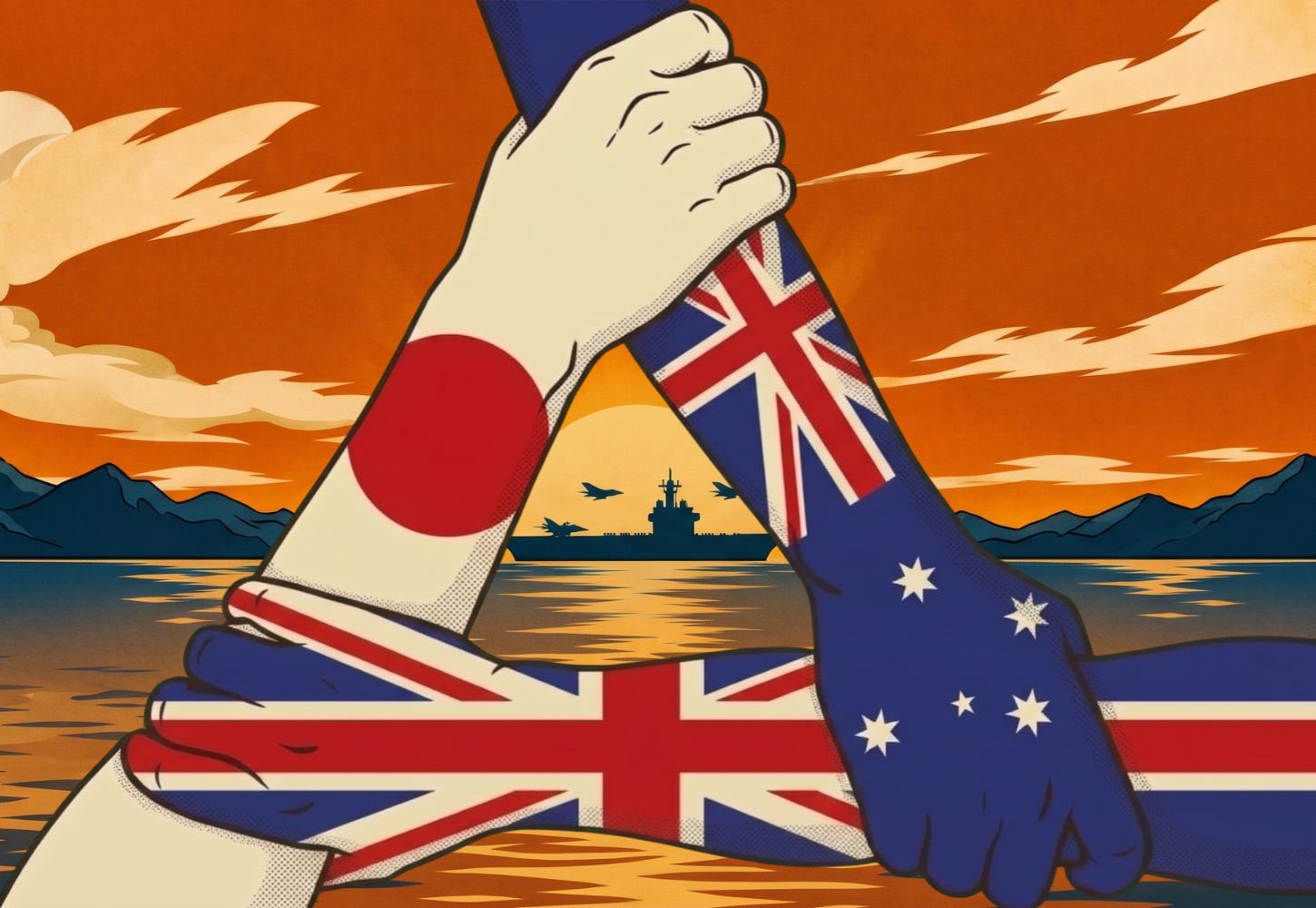
The currency of incidental interest-based minilateral cooperation has been appreciating for some time. Although remaining hostage to shifting dynamics, from regional to bilateral, the minilateral promise of enhanced cooperation through greater efficiency and targeting of efforts still holds.
This is largely because of the two driving forces of geopolitics today: responding to the actions of the People’s Republic of China (PRC) and the United States (US). Nations are reorientating their strategic and economic relationships with Washington as it becomes more unpredictable and strays from the logic originally underpinning such relationships. At the same time, Beijing continues its extensive military buildup, uses its navy for enacting exceptionalist maritime claims, and pursues mercantilist trade policies. These new geopolitical realities require greater cohesion among like-minded Indo-Pacific and Euro-Atlantic countries to reinforce shared interests.
Although differences exist, the United Kingdom (UK), Australia, and Japan all have a similar outlook. They are island nations exposed to geopolitical shocks and reliant on their security relationship with the US. It makes sense for them to enhance trilateral engagement in attempting to manage their shared legacy of overreliance on an order that no longer exists.
This is not an argument for a new trilateral initiative. Bandwidth is a scarce commodity and another high-level international itinerary is unnecessary. It is instead an argument for the harmonisation of commitments and programmes that already speak to each other across the three strong bilateral relationships.
Geography is not an issue here. The ‘indivisible’ nature of Indo-Pacific and Euro-Atlantic security is baked into the strategic thinking of many countries across both regions that have the capabilities to affect them. On top of this, current multilateral attempts to merge the security concerns of the two regions are resembling minilateral cooperation, most notably the North Atlantic Treaty Organisation (NATO)/Indo-Pacific Four (IP4) relationship. Enhanced trilateral cooperation between Britain, Australia, and Japan can act as a microcosm of this broader trend.
However, given limited bandwidth, where exactly are the areas for deeper trilateral cooperation?
Future combat aircraft
In the air domain, the requirements of the UK, Australia, and Japan bear remarkable similarities, as do their current inventories and evolving thoughts on the future of combat air. All three countries’ air forces are deeply intertwined with their American counterparts, and feature a significant amount of US-sourced equipment, including the F-35A Lightning II Joint Combat Aircraft. While none of the three will entirely move away from their relationship with Washington in this domain, they are moving towards diversification.
Alongside Italy, Britain and Japan are already working together on the Global Combat Air Programme (GCAP), which aims to introduce a sixth-generation aircraft in 2035. The programme is ambitious and costly, but following the collapse of the French-German-Spanish Future Combat Air System (FCAS) project, it is the only mature sixth-generation programme outside of the US and PRC.
GCAP will be large, meaning it will have long range, and it will be capable of commanding Collaborative Combat Aircraft (CCAs), among other cutting-edge capabilities: a list of requirements that are more than adequate for Australia’s needs. As the 2040s approach, Canberra will also be looking to replace its fleet of F/A-18 Hornet and E/A-18 Growler aircraft. While Australia has already taken on a number of high-cost defence programmes, and it may prove challenging to take on another, there are a number of reasons why it should look to move closer to GCAP.
Although it is too late for a significant buy-in for workshare or influence on requirements, Australia should follow Canada in pursuing observer status. It was not until March 2025 that Australia was given its first briefing on the programme. Observer status would help Canberra to establish oversight over areas where Australian industry might be able to plug into the supply chain and develop a deeper understanding of the potential fit the platform would have for its defence needs.
This would also open up the possibility of pairing Australia’s MQ-28 Ghostbat effort as the CCA of choice for GCAP, including for the Royal Air Force (RAF) and the Japanese Air Self-Defence Force, although the UK and Japan will likely want to favour their own companies for their CCA designs. Such a move would also build in a hedge for the Royal Australian Air Force, which is currently almost entirely reliant on American designs for its major platforms.
An additional avenue to cooperation in the air domain is in the co-development and co-production of air-to-air missiles, in particular extreme-range missiles. Britain and Japan have experience here already, having concluded research on air-to-air missile collaboration. The US (with AIM-174, AIM-424, and AIM-260), the PRC (with PL-17), and Russia (with R-37) have all developed extreme long-range air-to-air missiles. The UK, through the Meteor missile, has some experience in this field, but a successor with greater range and speed is needed. A potential joint effort with Australia and Japan could help to fill this gap, and the joint bargaining power of the three operators would bolster the case for integration on F-35 at a reasonable speed.
Maritime domain beyond AUKUS
In the maritime domain, there is a great deal of bilateral cooperation between the three countries. Britain and Australia are collaborating on AUKUS Pillar I and the maritime elements of AUKUS Pillar II (although movement here has been slow), as well as the Type 26 frigate. Australia and Japan have begun to cooperate on the Mogami class frigate, of which Australia will procure up to 11, with the first three to be built in Japan. The UK and Japan have been working together on access to repair sites for Royal Navy Offshore Patrol Vessels (OPVs) in the Indo-Pacific, as well as joint exercises during the Carrier Strike Group (CSG) deployment to the region – including cross-decking of F-35Bs. However, defence industrial collaboration in the maritime domain between Britain and Japan is less extensive.
There are a number of shared components and sub-systems used on platforms across the three countries that open up the possibility of trilateral exploration of future developments. For example, the Mogami and Type 26 both operate a Rolls-Royce MT30 gas turbine, BAE Systems’ Mk 45 Mod 4 five-inch naval gun, and the Mk 41 Vertical Launch System (VLS). The Mk 45 gun and Mk 41 VLS in particular open up the possibility of cooperation on future munitions for both systems. The Mk 45 already allows for airburst ammunition able to intercept cheaper and slower-moving airborne threats, but the next generation of Counter-Uncrewed Aerial Systems (C-UAS) munitions could be an area for future coordination.
The most promising area for cooperation is in the undersea domain. All three countries face adversaries with growing capabilities in this area. The PRC has invested heavily in its submarine force, an area where it once seriously lagged behind, as well as increasing exploration of Uncrewed Undersea Vehicles (UUVs). Russia’s Northern and Pacific fleets are also modernising, growing, and becoming more active.
Britain and Australia are already collaborating closely on AUKUS Pillar II, with the first Signature Project being for the development of cutting-edge payloads and enabling systems for UUVs. Australia and Japan have recently signed a research agreement to enhance strategic capabilities in robotic and autonomous systems for undersea warfare, and it would make sense to bring the UK into this partnership. As Mk 41 operators, another option could be jointly developing a next-generation long-range vertically launched torpedo. Japan already operates its Type 07 anti-submarine missile, which entered service in 2007, and the Royal Navy has begun initial exploration of a similar system.
Limitations
Expanded trilateral cooperation is not without limitations. Japan lacks a security clearance/classification system up to Five Eyes standards, currently limiting more comprehensive intelligence sharing and Japanese participation in AUKUS Pillar II. All three countries are extremely busy with a suite of new programmes – both standalone and those alongside allies and partners.
Any trilateral effort should not occur for its own sake, but be targeted in areas where collaboration could ease cost burdens, reduce duplication, expand shared supply chains, and help to reduce dependencies. There are clear avenues that fit this bill, some of which have been outlined in this article.
The argument made here is not for a shiny new initiative, acronym, or leader-level engagement, but for the three countries to increase support for efforts being made by the already close bilateral arrangements between them – a potentially beneficial recalibration in adjusting to shifting American priorities and enduring Chinese pressure.
William Freer is Research Fellow (National Security) at the Council on Geostrategy.
Patrick Triglavcanin is a Research Assistant at the Defence and Strategic Institute at the University of Western Australia and an International Fellow at the Council on Geostrategy.
To stay up to date with Britain’s World, please subscribe or pledge your support!
What do you think about this Memorandum? Why not leave a comment below?