

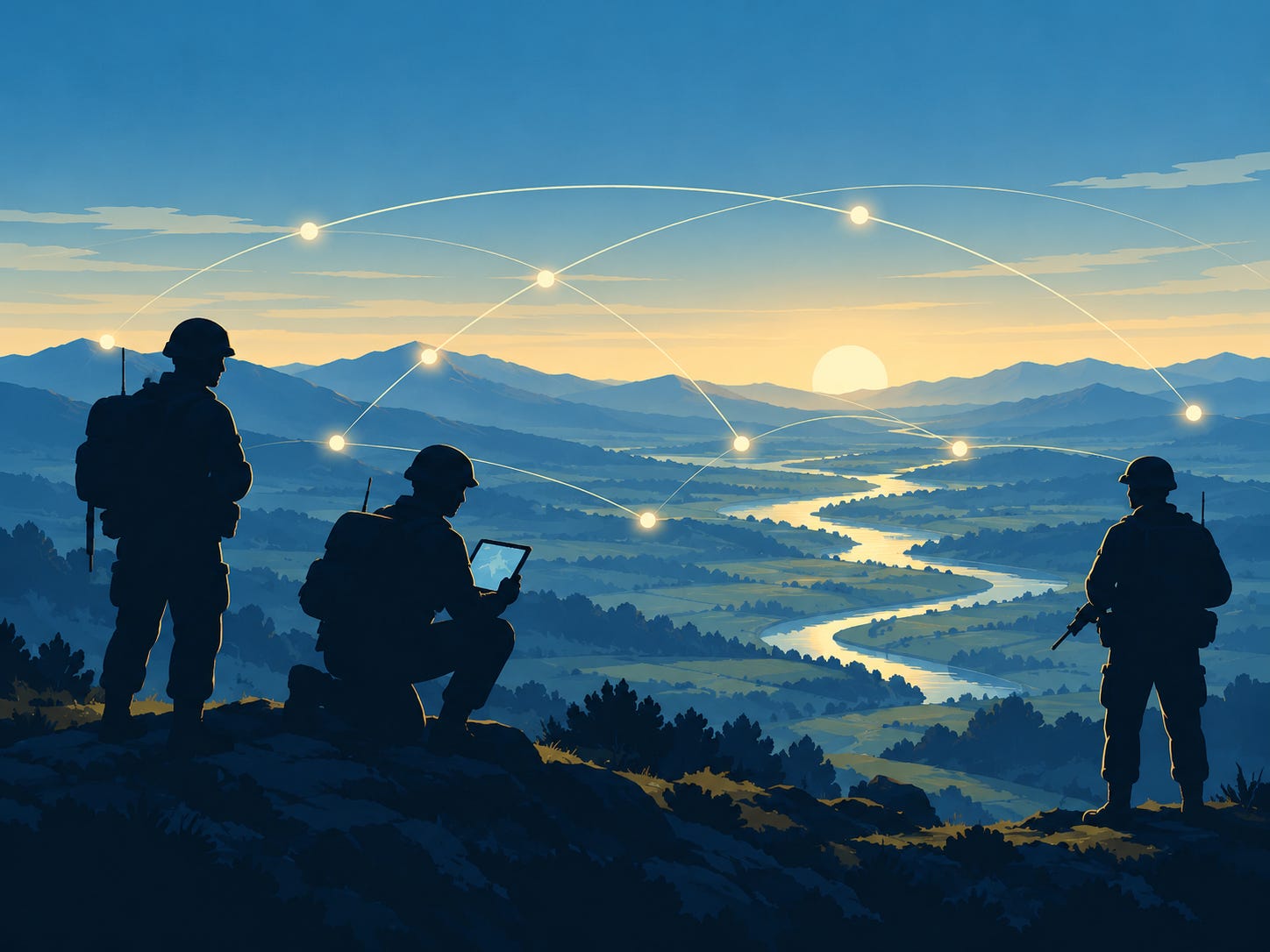
The United Kingdom’s (UK) most striking military Artificial Intelligence (AI) statistic of the year is a planning cycle rather than a model benchmark. At the Land Warfare Conference in June 2026, Gen. Sir Roly Walker, Chief of the General Staff, stated that ASGARD DECIDE had reduced a corps-level planning cycle from 72 hours to one, and increased the number of targets a corps could process in a day by roughly tenfold.
The operational result is impressive, although the strategic implication is larger. Sir Roly also described ASGARD as part of the data flows through which Britain is building its Integrated Force, and the system used during Exercise ARCADE STRIKE was linked to troops operating on Exercise SPRING STORM in Estonia. The British Army’s own account of the exercise says that the system is interoperable by design, and can bring different countries and languages into a common digital environment.
That means that the UK is testing more than a faster headquarters; it is testing a digital layer through which allied sensors, decision support systems, and military effects can increasingly be connected.
A targeting web is also a strategic network
His Majesty’s (HM) Government’s Strategic Defence Review (SDR), published in June 2025, already places the Digital Targeting Web inside a wider geopolitical design. It adopts a ‘NATO [North Atlantic Treaty Organisation] First’ posture, says that the Integrated Force must be able to operate inside NATO component commands by design, and makes a common digital foundation central to how British forces connect with allies and partners. The SDR sets 2027 as the goal for the wider Digital Targeting Web.
The point goes beyond moving the UK’s targeting data faster. A system that can connect sensors, deciders, and effectors across domains can also become the connective tissue between forces that own different platforms, operate under different national chains of command, and contribute different elements of a coalition operation. The Defence Science and Technology Laboratory (DSTL) describes the web in precisely those cross-domain terms: a way to connect the components that detect, decide, and act in a contested environment. The official programme description therefore has implications for alliance architecture as well as battlefield efficiency.
For Britain, this would create a form of strategic advantage that does not depend on owning every platform in a coalition. A country that helps to provide the digital layer through which partners combine their capabilities can shape interoperability standards, integration habits, and the tempo at which allied forces operate.
Dependence through interoperability
The same network that multiplies allied capability can create new dependencies. A coalition that relies on a common data fabric has to know what happens when one national service is degraded, a security boundary changes, an update is delayed, or one ally cannot share the same information as another.
NATO’s Alliance Digital Strategy, published in January 2026, recognises this challenge. It calls for secure, resilient, and interoperable digital capabilities; federated identity and access management; common data standards; and cross-domain command enabled by sensor-to-effector data flows. This is compatible with the UK’s direction, but it also makes clear that a national targeting web cannot simply become alliance infrastructure by being technically impressive.
The strategic test is whether partners can plug in without becoming locked in. An allied formation needs to benefit from British data and decision support while retaining the ability to operate when the British node is unavailable, when communications are contested, or when national policy prevents a particular use of shared information.
Layers beyond Britain
The geopolitical setting matters, as the UK is not building into an empty field. In March 2025, NATO’s Communications and Information Agency acquired the Maven Smart System NATO, an American commercial AI platform, for Allied Command Operations at Supreme Headquarters Allied Powers Europe (SHAPE), in one of the fastest procurements in the alliance’s history. NATO’s operational command architecture now includes a major American commercial AI layer. A British targeting web that reaches allied land forces will either federate with that layer or sit beside it, and the choice is strategic rather than technical – deciding whether the UK will contribute a sovereign node that European allies can rely on when the United States’ (US) priorities shift, or a second dependency stacked on the first.
This is also where the web touches the wider European debate. Britain now sits outside the European Union (EU) but remains the leading European naval and air power, and European defence firms and officials – particularly in France and Germany – have raised concerns about dependence on American technology and data sovereignty.
A British layer that is interoperable with the alliance standard, exportable to partners, and demonstrably able to operate when the transatlantic link is contested would give the UK something few European allies can offer: a hedge that is neither American nor Brussels-made. Whether the Digital Targeting Web is designed to be that hedge, or only a national accelerator, is a decision that HM Government has not yet made in public.
The necessity of visible national authority
This is where the mission command problem in the original ASGARD debate becomes a coalition problem. Different allies bring different rules of engagement, legal authorities, risk tolerances, and national caveats. A common operational picture does not erase those differences, nor does faster decision support create a common right to act.
A British headquarters may be able to see an ally track a target, recommend an effect, and route the request in seconds, but that does not mean that the British commander owns the allied decision. The architecture therefore has to distinguish between sharing evidence, proposing an action, and possessing the authority to approve it.
This distinction matters for trust. Allies are more likely to integrate deeply with a system when they can see where their national authority begins and ends, when interventions are attributable, and when connecting to the network does not silently transfer control upward or across borders. In this sense, mission command is not only a British Army doctrine issue; it becomes part of alliance cohesion.
Coalition resilience: The harder test
ASGARD has already demonstrated speed. The next strategically relevant evidence is different: how quickly can an allied unit join the environment, can national restrictions survive translation into the shared workflow, can the alliance continue when the common picture fragments, and can a partner disconnect or operate locally without losing the ability to fight?
These questions matter because the web already reaches NATO’s eastern flank, where the UK’s forward land forces in Estonia are meant to convert from a ‘tripwire’ into a credible invasion-stopping capability; a targeting layer that allies trust there is a deterrence asset, and one they cannot rely on is a vulnerability advertised in advance. They also matter because the SDR does not imagine the Integrated Force fighting alone. It explicitly designs it for NATO, coalition, and sovereign configurations. The value of the Digital Targeting Web will therefore depend on how well it moves between those configurations without confusing technical connectivity with political or military authority.
ASGARD’s compression of 72 hours into one is an operational achievement. For the UK, the larger strategic question is whether that capability becomes something allies choose to rely on because it makes them faster without making them less sovereign or less resilient. If it can do that, the Digital Targeting Web would be more than a British command tool. Rather, it could become alliance infrastructure: a way for the UK to contribute not only weapons and formations, but the digital architecture to help allied forces combine them.
If it cannot provide this reliance, Britain may still gain a faster national headquarters, but the wider strategic promise will remain unproven. Ultimately, the decisive measure is whether allied forces can connect to the web, retain their own authority, and keep operating when the connection is no longer there. How many targets it can process will only be of secondary concern.
Burak Oktenli is an independent researcher based in Washington, DC, focusing on authority, assurance, and governance in autonomous and Artificial Intelligence (AI)-enabled systems. He holds an MBA and is completing a Master of Professional Studies in Applied Intelligence at Georgetown University.
To stay up to date with Britain’s World, please subscribe or pledge your support!
What do you think about this Memorandum? Why not leave a comment below?