

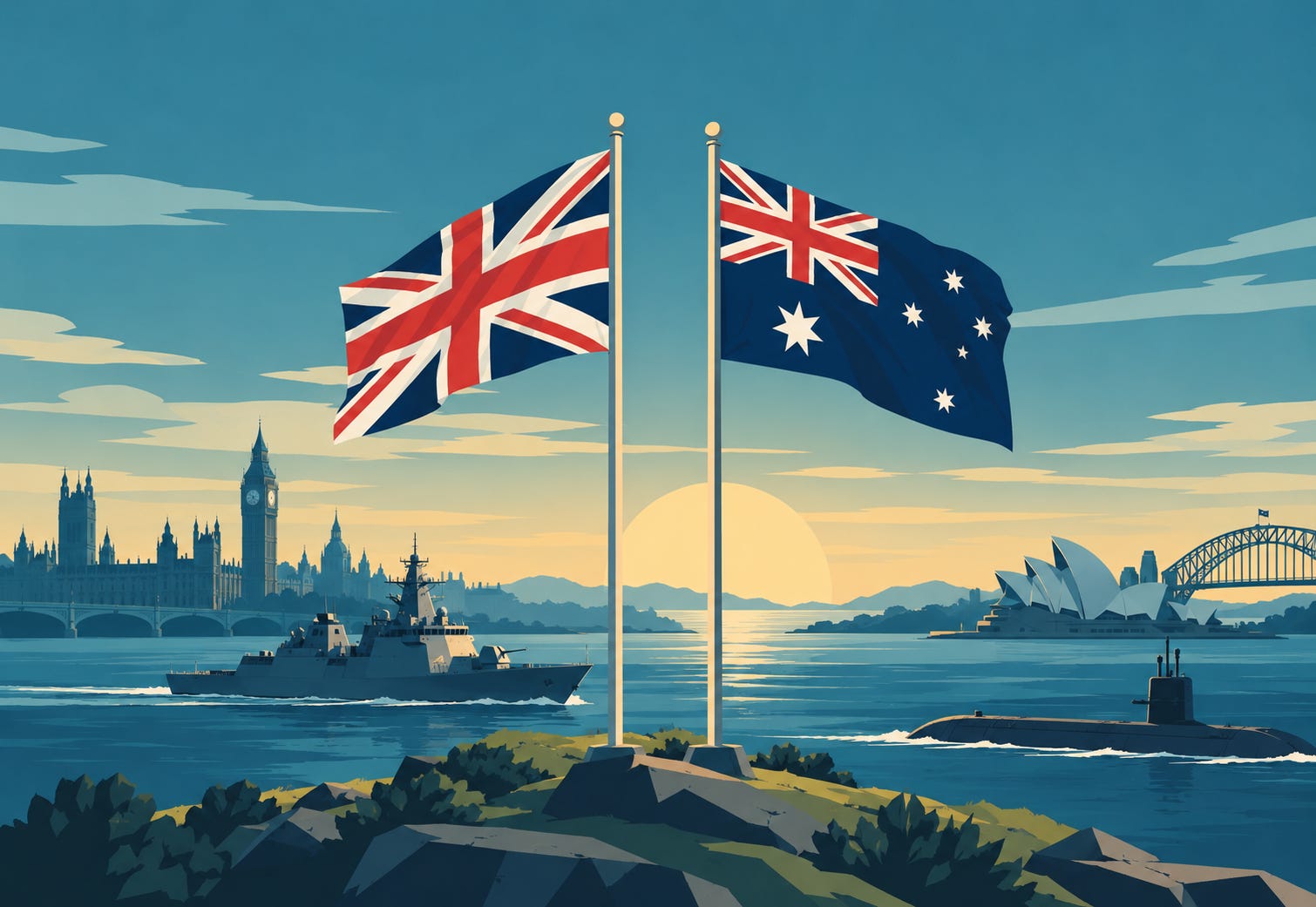
Australia’s defence and security relationship with the United Kingdom (UK) has been defined customarily in terms of historical links and close cultural affinity rather than as a formal alliance with binding obligations. However, this is changing under the impetus of a partnership that is increasingly interests-driven to suit a more threatening and unpredictable global environment, in which shared values no longer constitute a sufficient base, or engine, for a relationship of this importance and potential.
The intensified government-to-government defence and security relationship also needs a wider base to enable further alignment of British and Australian deterrence strategies and defence priorities. With some justification, based on deep personal connections, Australians and Britons instinctively feel that they know each other well – often better than they do Americans.
However, with cultural and linguistic proximity comes an attendant ‘familiarity trap’. Geographic separation places structural constraints on the bilateral defence security partnership, especially given the UK’s diminished capacity to project power as a global defence actor, the result of decades of underinvestment, and the Australian Defence Force’s more limited regional focus.
Neither country should take the other for granted, or entirely on trust. For all they hold in common, London and Canberra need to understand each other with fewer preconceptions, and less sentiment. This will necessitate opening up the relationship to greater scrutiny, both political and public, and assessments of added defence value that are free of conjecture.
A decade of political churn and lacklustre economic performance have sapped international confidence in Britain’s leadership abilities and defence competence. Beyond repeating the official mantra of ‘indivisible’ security linkages between the Euro-Atlantic and Indo-Pacific, His Majesty’s (HM) Government should maintain a convincing consistency of physical military presence in Australia’s local region and transparency about the recapitalisation of its defence industries at home, as well as avoiding sending mixed signals on its defence commitments to Australia.
Equally, Australians should not reflexively underestimate the UK’s ability to deliver nor belittle its international security contributions just because this has become a satisfying, cultural dig. Rather, Canberra should assess an enhanced British presence on its merits, not on perception. As the saying goes: trust, but verify.
The key fact driving this need for a wider bilateral defence and security base is that British-Australian defence ties are now more consequential for both countries than at any point in the last 50 years. The UK’s reinvigorated importance as a strategic defence partner for Australia means that there is much more riding on the relationship than previously in terms of national interests, particularly Britain’s responsibility for delivering the Royal Australian Navy’s future frontline capabilities in the form of a new joint class of nuclear-powered attack submarines (SSNs) and Hunter class frigates based upon a British design. As well as building SSNs together, the two countries are collaborating on a raft of advanced strategic technologies with the United States (US) – their common ally – via AUKUS Pillar II.
Firm but informal foundations
Until comparatively recently, the British-Australian defence relationship was largely informal. A basic bilateral defence and security treaty was signed in 2013, which included a commitment to mutual consultations on threats to international peace and security. To codify their deeper joint commitments under AUKUS, London and Canberra signed a new defence cooperation agreement in 2025: the Geelong Treaty. It incorporates a status of visiting forces element that the relationship had previously, and surprisingly, lacked, as well as commitment to ‘strengthen their combined military capabilities, boost their collective industrial capacity, and enhance their ability to promote stability and security in the Indo-Pacific and beyond’. This suggests that the core bilateral partnership – even if it is not officially termed a military alliance – is very close to that status.
Elsewhere, the UK and Australia continue to cooperate under the aegis of older, and enduring, minilateral arrangements, such as the Five Power Defence Arrangements (FPDA), which commit both countries to regular military exercises and defence consultations in Southeast Asia, alongside Malaysia, New Zealand, and Singapore. The deepest anchor of security cooperation, and one that naturally lends itself to cyber cooperation and sharing secret information, is both countries’ common membership of the Five Eyes intelligence-sharing framework.
Britain maintains an enabling Indo-Pacific presence through a number of UK-run defence support facilities, including in Singapore, Brunei, and Diego Garcia – at least for now. After a prolonged hiatus in significant British deployments to the region earlier last decade, the UK’s expeditionary maritime and air deployments to the Indo-Pacific have maintained a regular drumbeat since 2018, including two visits and one maintenance period by Astute class SSNs to Western Australia, and separate visits by an amphibious and aircraft carrier task group to Darwin. Britain has also committed to deploying an SSN to HMAS Stirling in Western Australia, under Submarine Rotational Force – West (SRF-West), which will commence operations from the end of 2027.
Towards a broader bilateral defence relationship
Australia has officially identified the UK as a key strategic partner for several years. The 2023 Defence Strategic Review highlighted Britain’s importance to Australia, stating that ‘engagement with the United Kingdom in the Indo-Pacific must be enhanced’. This requirement has been carried over into the biennial National Defence Strategy, couched in terms of ‘deepening...collective deterrence networks’, as well as cemented further in the Geelong Treaty.
New areas of bilateral defence cooperation have opened up, including coordinated naval demonstrations of freedom of navigation in the South China Sea. Lower-key, but still important, defence and security coordination is ongoing in the Southwest Pacific, taking advantage of the UK’s expanded defence attaché network in the region, as well as the presence of two British roving patrol vessels, HMS Tamar and HMS Spey, permanently deployed to the Indo-Pacific since 2021.
Australia, for its part, has repeatedly deployed surveillance assets and military personnel into the area covered by the North Atlantic Treaty Organisation (NATO), and participated in Operation ORBITAL, the UK-based training initiative for the Armed Forces of Ukraine, which began in 2014. In September 2026, it signed a new bilateral security agreement with Kyiv, indicating that Canberra reciprocally values its broader strategic connections to European countries.
Britain and Australia have a compatible military culture and an extensive history of operational cooperation in multinational coalitions. Yet, until a few years ago, the Australian Defence Force operated very little British equipment, nor was there any meaningful defence industrial collaboration. This began to change when Australia opted to select a British design for the Hunter frigate programme in June 2018. The real acceleration started from September 2021 with the announcement of AUKUS. More speculatively, should Australia in future opt to participate in the tripartite Global Combat Air Programme (GCAP), most likely through observer status, this would add a third major weapons programme with substantial bilateral involvement.
While both countries’ defence industrial bases are now collaborating to a much greater extent, and they jointly subscribe to the close security interconnection between the Euro-Atlantic and Indo-Pacific, greater alignment between their respective deterrence strategies and defence priorities is not assured. It will require a sustained and concerted investment of effort and detached analytical rigour on the part of both governments, including a clear-eyed assessment about the threats they face, their respective capacity to deliver on AUKUS, and other aspects of defence and security cooperation.
The UK and Australia face a common challenge from the People’s Republic of China’s exceptionalist maritime claims, its coercive behaviour, and its unparalleled military build-up, including its nuclear forces. Both countries’ contribution to deterrence in the Indo-Pacific lies partly in their ability to play a concerted role in regional defence engagement, but just as much in their combined influence in Washington at a time of rising doubt about the US’ commitment to regional security. Influencing the Trump administration is a challenge even for close allies.
There is a tendency in Australia to view AUKUS through the prism of its alliance with the US, and to perceive the UK as a weak link, or to disregard it altogether. This underestimates London’s role in strengthening Canberra’s bargaining power in Washington, a critical factor in helping to overcome entrenched sectoral resistance in the US to opening up its defence industrial base and selling Virginia class SSNs to Australia. Indeed, coordinated lobbying in Washington certainly helped to preserve American backing for AUKUS.
Public commentary in Australia also overlooks the fact that Britain bears responsibility for delivering the bulk of value within Pillar I (AUKUS’ submarine pillar), in the form of SSN-AUKUS. When the UK is mentioned, it is often accompanied by extreme scepticism about its ability to live up to these industrial and operational commitments. Evidence-based scepticism can be useful, but blanket dismissal is not. Familiarity should not be allowed to breed contempt.
Commentary on AUKUS in Britain lacks the controversy that it stirs in Australia, although there is a corresponding scepticism in the UK’s strategic circles about whether it can – or even should – divert its strategic focus from the Euro-Atlantic when Russia’s ‘grey zone’ and conventional military threats are so acute and the US’ security commitment to Europe under the Trump administration is wavering far more obviously. Both Britain and Australia should accustom themselves better to one another’s domestic AUKUS narrative, allowing them to inject political confidence into the agreement through more targeted messaging and in-depth public statements and debate, particularly when an official response would clear doubt and subdue misleading representations that otherwise thrive in an information vacuum.
Conclusion
For all its growing importance, neither government appears particularly motivated or comfortable exposing the British-Australian bilateral defence and security relationship to wider public scrutiny. However, it needs a broader base than government-to government-relations alone; both London and Canberra should take seriously the current opportunity to actualise their converging interests and operational arrangements. This would enable pushing the partnership, previously based around shared values and culture, beyond the normative comfort zone and deeper into the operational realm.
AUKUS is a notable fillip in this direction, but questions still remain around operational and doctrinal harmonisation. Cultural proximity sometimes goes against the strategic grain. There is simply too much riding on this relationship, now and in the future, to leave it to its own devices.
Dr Euan Graham is an Expert Associate at the Australian National Security College and an Adjunct Fellow at the Council on Geostrategy.
Patrick Triglavcanin is a Research Assistant at the Defence and Strategic Institute at the University of Western Australia and an International Fellow at the Council on Geostrategy.
To stay up to date with Britain’s World, please subscribe or pledge your support!
What do you think about this Memorandum? Why not leave a comment below?