

Russia’s full-scale invasion of Ukraine in 2022 permanently altered the strategic landscape of the Euro-Atlantic. It exposed an aggressive revisionist power willing to deploy high-intensity conflict and sub-threshold coercion to perpetuate its great power status – as well as brazen enough to demand that the North Atlantic Treaty Organisation (NATO) withdraw from Eastern Europe.
While the Kremlin’s immediate military focus remains on NATO’s eastern front, its long-term ambition to dominate the Arctic and North Atlantic presents the most direct maritime threat to the United Kingdom (UK) and its regional allies. Through the deployment of Yasen class nuclear-powered attack submarines (SSNs), specialised undersea warfare assets of the Main Directorate of Deep-Sea Research (GUGI), and attempts to territorialise the Northern Sea Route (NSR), Russia seeks to control emerging maritime spaces and hold European Critical National Infrastructure (CNI) at risk.
Existing security institutions are ill-equipped to address this northern challenge alone. NATO’s 32-member structure suffers from sluggish decision-making, while the United States’ (US) changing geopolitical priorities diminishes Washington’s strategic bandwidth for Euro-Atlantic defence. Additionally, the European Union (EU) lacks both the institutional mandate and military instrument to project decisive naval power. To fill this void and challenge Russian aggression in Northern Europe, Britain should take the lead in transforming the ten-nation Joint Expeditionary Force (JEF) into the primary vanguard of security in the North Atlantic and Wider North.
Transforming the JEF
The JEF’s members number among the highest defence spenders in Europe by proportion of Gross Domestic Product (GDP), share a common perception of the threat posed by the Kremlin, and possess the combined resources required to deny Russian aggression. However, it currently falls short of its strategic potential, largely remaining a flexible concept rather than a permanent security provider. This is not to say that this potential cannot be unlocked though, as a number of steps can be taken to strengthen the group’s position in the Wider North.
The UK should lead the establishment of a large, permanent JEF headquarters, complete with a dedicated secretariat and planning staff. Crucially, this headquarters should be located in a central regional nation – e.g., Norway or Denmark. Distancing the administrative hub from London distinguishes the JEF from existing European minilateral security arrangements, which appear to serve little purpose beyond being ‘vanity projects’ for the framework nations. Doing this also demonstrates a genuine British commitment to regional burden-sharing while also allowing the UK to step back administratively – cementing its leadership via operational military strength rather than bureaucratic dominance.
The JEF’s strategic focus also requires adjusting for the new age of geopolitical confrontation. The Cold War-era emphasis on defending the Northern Gap (between Greenland, Iceland, and the UK) from Russian naval incursions should be superseded by concentrating on the ‘Bear Gap’ between Northern Norway and the Svalbard archipelago, correcting the widespread belief that committing to the Northern Gap signals a lack of commitment to Svalbard or Eastern Greenland. Additionally, explicit affirmation from the JEF that NATO Article 5 applies fully to Svalbard would reassure northern allies, deter adversarial opportunism, and reinforce free and open European nations’ control over maritime Arctic approaches.
Naval posture in the Wider North
To counter the Russian Northern Fleet and the Kremlin’s declarations of ownership over the NSR, the JEF should develop an economic and military playbook for the Wider North. Collaborating with allies with regional interests (particularly France, Germany, and Canada – becoming the ‘JEF+’) would bolster the JEF’s ability to deny the Kremlin’s attempts to coerce shipping companies transiting the NSR and strengthen naval capabilities in the region.
The military necessity for an upgraded JEF posture is underlined by the balance of High North naval forces. While the Russian Navy retains significant numerical submarine strength, the combined naval power of the ‘JEF+’ possesses clear operational overmatch:
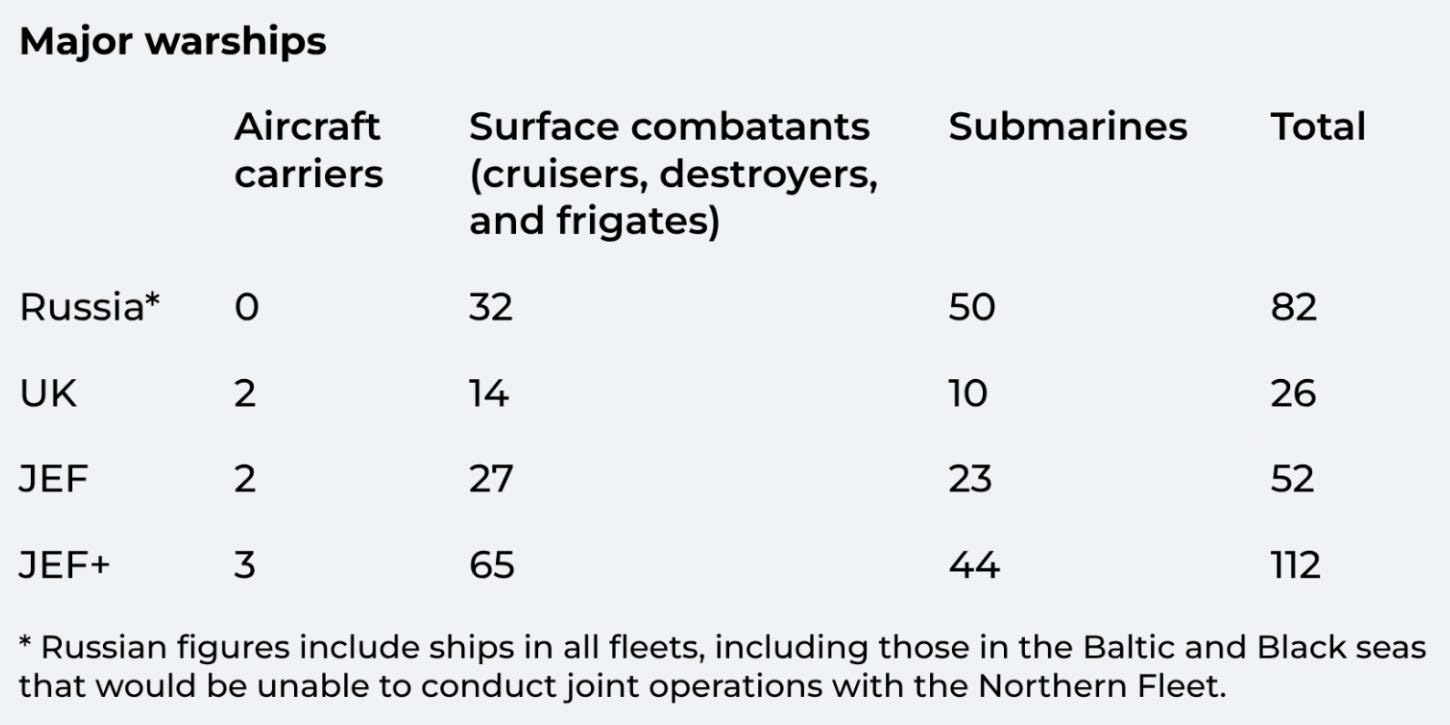
Although massed uncrewed systems represent the long-term operational future, current defence postures must employ existing legacy platforms – e.g., aircraft carriers, fast combat aircraft, and attack submarines. The JEF should maximise the utility of these platforms and construct its strategy accordingly while advancing the transition towards autonomous warfare. Here, integrating Royal Navy assets would enable Britain to boost its power projection without requiring a prohibitively expensive investment in a standalone dedicated Arctic fleet.
Operationalising warfighting capabilities
In the demanding operating environment of the Arctic, geography dictates that the best defence is a potent forward offence. The Cold War showed that the most effective way to prevent Northern Fleet submarines from surging into the Atlantic is to threaten their home ports on the Kola Peninsula, forcing the Kremlin to use its strategic assets on defensive postures.
Systematic integration of the Royal Navy’s Carrier Strike Groups with JEF air forces – cohering British F-35 Lightning II Joint Combat Aircraft, Swedish early warning aircraft, and Finnish F-18 Hornets (as well as Dutch air defence frigates) – provides the best means for holding the Kola Peninsula at risk. While the deployment of the UK’s Carrier Strike Group 2026 under Operation FIRECREST is a welcome first step in this direction, the scale and scope should be enlarged.
Regular intense exercises – held every other year as during the Cold War – involving 2-3 European carriers and coordination with Nordic air forces will rebuild atrophied Arctic warfighting expertise and foster interoperability under Arctic conditions, as well as reassuring allies and deterring adversaries. Doing this sits within the remit of a transformed JEF, as NATO currently appears too sclerotic to conduct such activities.
The New Hybrid Navy framework is also critical to operationality in the Wider North. Uncrewed systems reset the regional risk calculus in Britain’s favour and shift the environmental burden onto adversaries. Complementing high-tech weapons systems with low-cost, high-volume strike drones will present a persistent threat against Russia’s Kola Peninsula assets. Additionally, these drones can be deployed by Arctic-trained Royal Marines in an unpredictable manner.
Adopting Uncrewed Surface Vehicles (USVs) to provide Intelligence, Surveillance, and Reconnaissance (ISR), as well as Extra-Large Uncrewed Undersea Vehicles (XLUUVs), will enable interception of Russian vessels attempting to break out of the Bear Gap while also projecting power into the Barents and White seas. Furthermore, the JEF should build offensive seabed warfare capabilities to hold Russian undersea assets at risk. Developing sea mining capabilities will disrupt the NSR, effectively impeding Russia’s Liquified Natural Gas (LNG) and oil exports and thus depriving the Kremlin of crucial economic arteries.
Building preparedness in the Wider North
Being ready to deploy the stated uncrewed capabilities requires preparation from the JEF. Its members should pre-position a network of redundant climate-controlled warehouses in Norway; institute Arctic exercises focusing on automation and resilience in both summer and winter conditions; and adopt specialised propulsion systems while investing in cold-weather explosives, energetics manufacturing, and rocket motors. Here, it is most cost-effective to tailor specific equipment rather than instituting a blanket Arctic capabilities requirement across all systems.
Routine JEF freedom of navigation exercises, hydrographic surveys, and ice-hardened patrol ship operations would maintain a peacetime presence in the Wider North. Independent Geographical Intelligence (GEOINT) and sea-ice monitoring capabilities would provide informational autonomy, while communications challenges can be met by deploying a JEF satellite constellation, utilising launch facilities in Norway or Scotland and complemented by mobile Long-Range Navigation (LORAN) beacons. The UK already possesses a technological edge in defence space; positioning British industry as the crux of JEF space capabilities translates this into long-term strategic indispensability.
Finally, human and industrial capital needs to be secured. Concentrated efforts within the Royal Navy and Ministry of Defence (MOD) to recruit and retain Arctic experience – including assisting Small and Medium-sized Enterprises (SMEs) to navigate Arctic requirements – would guarantee Britain’s position at the forefront of the JEF’s operational capabilities.
Conclusion
The JEF provides the UK with essential tactical mass and geographical access to the Wider North, although its members remain reliant upon high-end British sovereign capabilities. By transforming the grouping into a fully fledged regional vanguard for defence, Britain can ensure that adversaries are deterred and allies are reassured as the Wider North becomes ever more significant in an era of growing geopolitical competition.
Dr Marc De Vore is Senior Lecturer in the School of International Relations at the University of St. Andrews and an Adjunct Fellow at the Council on Geostrategy.
Dr Rachel Pawling is Principal Consultant at K39 Consulting Pty Ltd.
H I Sutton is an independent writer, illustrator, and analyst; and an Adjunct Fellow at the Council on Geostrategy.
This Memorandum is an abridged version of a longer Point Paper commissioned by the Royal Navy. It is reproduced with the Royal Navy’s permission. Any similarity with His Majesty’s Government or Royal Navy policy is purely coincidental.
To stay up to date with Britain’s World, please subscribe or pledge your support!
What do you think about this Memorandum? Why not leave a comment below?