

The Defence Investment Plan (DIP), published in June, turns the Strategic Defence Review’s (SDR) broad vision into a funded programme of capability development. Across the maritime and air domains, its decisions follow a consistent architecture.
The Royal Navy is becoming hybrid, pairing crewed frigates and destroyers with uncrewed missile platforms, submarine-hunting sensors, and Extra Large Uncrewed Undersea Vehicles (XLUUVs), with the whole arrangement commanded through new Common Combat Vessels (CCVs) built to direct dozens of autonomous assets from a single hub. The Royal Air Force (RAF) is pursuing the equivalent transformation through Collaborative Combat Aircraft (CCA), developing autonomous fighters to operate alongside crewed aircraft, with a demonstrator targeted for 2030.
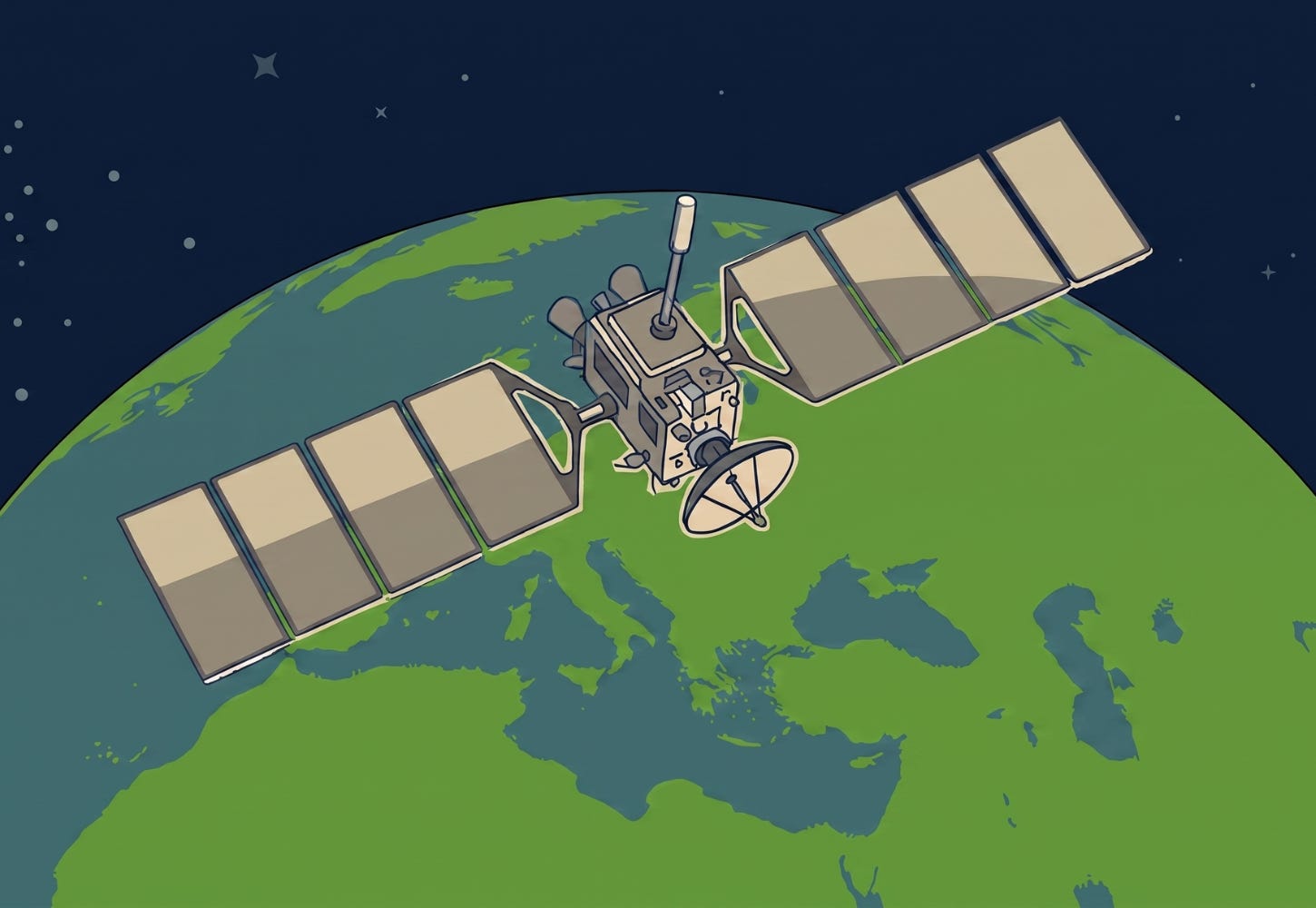
In both cases, the underlying design is the same: a small crewed core, a large autonomous mass, and a command structure built to direct both as a single system. The DIP contains no comparable programme for autonomous space systems, and that gap deserves more attention than it has received: the argument for autonomy applies with greater force in orbit than it does at sea or in the air.
The Royal Navy’s shift to a hybrid model rests on two propositions. Firstly, concentrating combat power in a small number of expensive, crewed platforms creates a single point of failure; and secondly, that autonomous systems can sense, track, and respond faster than a human chain of command operating under fire.
Both of these propositions carry more weight in space than at sea, where a satellite cannot be reinforced mid-engagement, and there is no recovering a damaged spacecraft and returning it to service within the timeframe of a live conflict. The latency between a threat appearing in orbit and a ground-based operator authorising a response routinely exceeds the time the threat takes to resolve, which means that where autonomy improves resilience at sea and in the air, in space it is the only mechanism by which resilience is achievable at all.
The United Kingdom’s (UK) current satellite architecture predates this reasoning, and depends on a small number of high-value spacecraft. Each of these is reliant on continuous, secure communication with the ground; a dependency that Russia’s campaign against Starlink over Ukraine has shown is exploited not by destroying the satellites, but by attacking the links that connect them to their operators. This is conducted through jammed frequencies, hacked terminals, and overloaded ground stations, so that the spacecraft survives while the capability it was meant to provide does not.
The Hybrid Navy concept, even in outline, supplies the template that space requires, because the CCV does not attempt to perform every function itself. Instead, it commands a distributed set of autonomous platforms, each carrying out a narrower role, so that the loss of any single asset degrades the system without collapsing it.
A British space architecture built on the same logic would pair a smaller number of capable command and sensing satellites with a larger constellation of autonomous platforms able to detect threats, manoeuvre independently, and continue functioning when the link to the ground is degraded or severed. The autonomous mission intelligence systems already in development at British space companies, built to let spacecraft interpret their environment and act without waiting for instruction, are the direct orbital counterpart to the uncrewed sensing and missile platforms now being procured for the Royal Navy.
Thus, the capability exists. The DIP has now settled the immediate funding question, although not entirely in space’s favour. It commits more than £5 billion to autonomous systems over four years, while allocating £3.2 billion to space: £2.3 billion for satellite communications and £880 million for space-based Intelligence, Surveillance, and Reconnaissance (ISR) and space control. A further £9 billion is planned between 2030 and 2035. This is substantial, but still modest beside the domain underpinning roughly a fifth of the UK’s Gross Domestic Product (GDP) and the majority of the critical infrastructure that the British Armed Forces protects.
The SDR named the growth of autonomy as the central lesson of the conflict in Ukraine, and applied that lesson explicitly to land, maritime, and air domains. The DIP has since recognised space as the ‘central nervous system’ of high-intensity warfare. Yet, its £5 billion autonomous systems programme remains concentrated in the land, maritime, and air domains. The next step is to carry the same logic into orbit, where autonomous, proliferated systems will be vital to resilience, speed, and operational advantage.
To remedy this, the UK should commission a space equivalent of the CCV programme: a small number of sovereign command and sensing satellites networked with autonomous platforms capable of independent threat response, procured through the accelerated model now being applied to uncrewed naval and air systems. The interoperability standards being developed for CCA should extend to allied space programmes with France, Germany, Australia, and Japan, so that a British autonomous satellite and an allied one operate under shared rules of engagement rather than parallel national doctrines.
The £5 billion commitment should now serve as the benchmark for the next phase of space investment, not as a boundary beyond which autonomy stops. The DIP makes a forceful case for autonomy across the maritime, land, and air domains, but without identifying a comparable programme for autonomous space systems. Space is the domain in which that case is strongest. The DIP has recognised its strategic importance; the next task is to apply the logic of autonomy to orbit.
Graeme Ritchie is CEO of Shield Space, a defence technology company developing control and counterspace capabilities. He spent over two decades in special forces and operational command before leading Ministry of Defence programmes in autonomy, Counter-Uncrewed Aerial Systems capabilities, and defence space.
To stay up to date with Britain’s World, please subscribe or pledge your support!
What do you think about this Memorandum? Why not leave a comment below?