

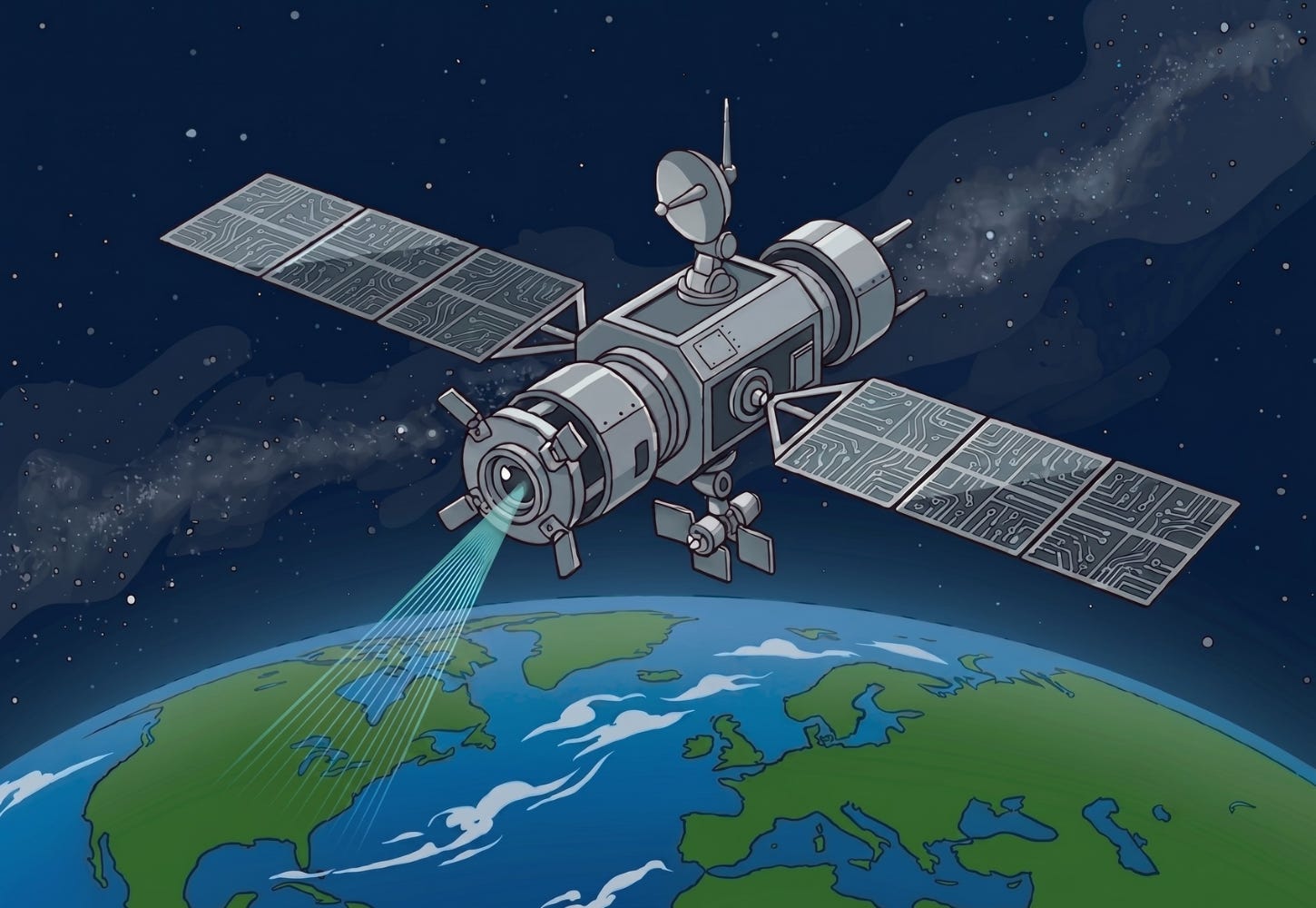
The past decade has witnessed a growing number of incidents in space that would once have seemed extraordinary. Russian satellites have conducted increasingly sophisticated rendezvous and proximity operations, most recently against an ICEYE Synthetic Aperture Radar (SAR) Earth observation satellite allegedly used by Ukraine. The People’s Republic of China (PRC) has also demonstrated comparable capabilities while notably expanding its counterspace portfolio. Electronic interference with satellite navigation and communications has not only become more frequent, but it has also become endemic in some parts of the world, such as in the Baltic region and the Persian Gulf. Meanwhile, cyber operations against commercial and government space systems have become a routine feature of international competition.
Collectively, these activities are commonly described as examples of ‘grey zone’ warfare; hostile actions deliberately calibrated to remain below the threshold of conventional armed conflict. The phrase has become part of the contemporary strategic lexicon, particularly in discussions of space, where outright military confrontation carries enormous risks of escalation.
Yet, the growing popularity of the term raises an uncomfortable question. What if grey zone warfare is not the problem at all? What if it is simply the latest expression of something far older?
The United Kingdom’s (UK) challenge is not that Russia and the PRC have discovered a revolutionary new way of competing. Nor is it that Britain lacks capable armed forces, intelligence agencies, or commercial space companies. Rather, the greater danger is political. After more than three decades in which many assumed that major power rivalry had become increasingly constrained by globalisation, international institutions, and economic interdependence, the UK risks misinterpreting the normal condition of international politics. Space merely exposes that misunderstanding perhaps more clearly than other domains.
The idea that strategic competition exists somewhere between peace and war is itself somewhat misleading. History offers remarkably few examples of prolonged periods in which great powers simply coexisted without persistent rivalry. Throughout the 19th century, the Cold War, and indeed much of recorded history, states continuously sought to advance their interests through diplomacy, intelligence, economic pressure, technological competition, proxy conflicts, and military signalling. Open warfare was only one manifestation of a broader strategic contest.
If anything, the historical anomaly was the three decades following the end of the Cold War. The overwhelming predominance of the United States (US), combined with expanding global markets and international institutions, encouraged the erroneous belief that geopolitical competition had become progressively less central to international affairs. The expectation emerged – sometimes explicitly, often implicitly – that strategy itself had become less important than economic integration and crisis management.
As the late Colin S. Gray often reminded us about strategic affairs, bad times have an unfortunate habit of returning. Space illustrates this return with unusual clarity because it has become indispensable to modern civilisation. Military operations, financial markets, global communications, navigation, weather forecasting, and Critical National Infrastructure (CNI) all depend upon space-based services. At the same time, these systems remain deeply interconnected. The destruction of satellites risks generating debris that threatens all space users, while attacks on strategic space assets carry profound implications for conventional military operations and potentially nuclear deterrence.
Britain’s adversaries therefore increasingly seek political advantage without provoking outright war. Cyber operations, electronic warfare, co-orbital satellite manoeuvres, growing commercial dependency, legal ambiguities, and intelligence collection offer opportunities to influence an adversary’s behaviour while managing escalation risks. This is not evidence that the character of strategy has fundamentally changed. Rather, it reflects the enduring logic of competition adapting to a domain in which the costs of direct military confrontation are exceptionally high.
Most analyses of these developments focus upon satellites, launch vehicles, or counterspace capabilities. Important though these are, they are not the true object of strategic competition. The real target is political judgement.
Persistent competition in space rarely seeks immediate military victory. Instead, it seeks to influence how political leaders interpret risk, assess escalation, and exercise strategic choice. A co-orbital satellite manoeuvre may reveal technical capability, but it also tests political resolve. Electronic interference with navigation systems imposes practical costs, but it also normalises behaviour that might previously have been considered unacceptable. Ambiguous actions create uncertainty not simply within a military headquarters, but within governments themselves.
Viewed individually, such incidents often appear too limited to justify a significant response. Viewed collectively, they reveal something rather different: a sustained strategic campaign designed to shape political decision-making over time.
This distinction matters because the UK does not principally suffer from a deficit of military capability. British military and intelligence organisations possess an increasingly sophisticated understanding of the challenges posed by adversarial space operations. Moreover, commercial space innovation is accelerating and, in turn, increases the attack surfaces by which adversaries might compete. Indeed, the UK has recognised space as a critical operational domain within the Defence Investment Plan (DIP) and is planning to invest accordingly.
The more difficult question lies at the political level, where there appears to be a persistent tendency to interpret strategically coherent campaigns as isolated tactical incidents. The instinctive response has often been one of restraint: to avoid unnecessary escalation, to preserve diplomatic space, to take what might be described as the strategic high road.
Restraint is not in itself a weakness. Indeed, it is often a hallmark of responsible statecraft. The difficulty arises, however, when it is not accompanied by an equally coherent strategy for shaping an adversary’s behaviour. Adversaries probe, responses remain cautious, political thresholds become clearer, and further probing follows. Over time, the cumulative effect is not dramatic defeat but something considerably more subtle: the gradual erosion of strategic freedom of manoeuvre.
This process extends well beyond space. It is visible in cyberspace, maritime coercion, economic statecraft, information operations, and technological competition. Space simply provides perhaps the clearest illustration because the political consequences of apparently minor technical actions are often immediate and globally palpable.
The objective of persistent strategic competition is therefore not necessarily to compel surrender or achieve decisive military victory. It is the progressive narrowing of an opponent’s range of politically acceptable choices while preserving one’s own. Success is measured not by territory captured or forces destroyed, but by the gradual reduction of strategic freedom.
This should concern Britain because strategic freedom should be one of its greatest national assets. The UK’s influence has historically rested not only upon military capability but upon the ability to combine diplomacy, intelligence, commerce, alliances, and technological innovation into coherent statecraft. The challenge posed by contemporary strategic competition is not that these instruments have disappeared, but that they risk being employed reactively rather than proactively.
The language of grey zone warfare is therefore useful only up to a point. It describes certain activities, but it risks obscuring the larger strategic reality. The challenge facing Britain is not to prepare for an occasional category of conflict that sits somewhere between peace and war. Rather, it is to recognise that persistent strategic competition has always been the historical norm, and that space is simply the latest arena in which this enduring logic is being expressed.
The UK does not need to rediscover strategic thinking because space has become contested. It needs to rediscover strategic thinking because bad times – history – have returned.
The greatest danger is not that Britain’s competitors have developed a revolutionary new form of warfare. It is that they have remained students of strategy while the UK has, at times, behaved as though sustained geopolitical competition were an interruption to normal, benign international politics rather than its enduring competitive condition. The most immediate task is therefore not to develop a new vocabulary for competition, but to recover an older strategic understanding: that rivalry among major powers is continuous, that political judgement remains the decisive instrument of statecraft, and that the ultimate purpose of strategy is to preserve a state’s freedom to choose its own course in an increasingly contested world.
Dr John B. Sheldon is a Founding Partner of AstroAnalytica Ltd., a boutique space strategy consultancy headquartered in London.
This article is part of the Council on Geostrategy’s Strategic Defence Unit.
To stay up to date with Britain’s World, please subscribe or pledge your support!
What do you think about this Memorandum? Why not leave a comment below?
Hope that others adhere to the same rules, or international laws, is comparable to appeasement. The increasing number of states run by a recognised non-democratic process use international norms as their leverage to operate deniable operations, knowing full well that the soft West will be unlikely to prove their concerns or complaints. Naivity is a continuum and political failures will continue.