

On 28th July, the Pentagon launched a six-month review of the United States’ (US) military footprint in Europe. This is likely to be the most consequential reassessment of American force posture on the continent for a generation. Although the Trump administration has stated that Europe remains ‘strategically and culturally vital to the United States’, this does not mean that the current force posture will endure. Gen. Alexus Grynkewich, Commander US European Command (EUCOM), has already warned allies to expect force reductions.
Washington is trying to resolve a key strategic dilemma: how to maintain credible deterrence against Russia while reallocating military resources to prevent Chinese military dominance in the Indo-Pacific, but without undermining the North Atlantic Treaty Organisation’s (NATO) political cohesion – its centre of gravity.
The US has described its preferred end-state as ‘NATO 3.0’, under which European allies assume primary responsibility for their conventional defence while America concentrates on strategic enablers and deterrence, and frees up its forces for employment elsewhere.1 This reflects Washington’s assessment that European allies already possess a substantial conventional military advantage over Russia. Additionally, the US would continue to provide extended nuclear deterrence.
A thorough review may well lead to a more acceptable division of transatlantic labour. However, although Pete Hegseth, US Secretary of War, told the Ankara summit that the review results were not predetermined, he also linked the review to what he characterised as European resistance to unrestricted American access to air stations during operations against Iran. Furthermore, if pledged European military investment fails to keep pace with probable US force reductions, any precipitous American posture change risks weaker deterrence, increased scope for Russian coercion, and a decline of US influence in Europe.
This is not the Trump administration’s first attempt to reduce the US military presence in Europe. In 2020, during his first term, Donald Trump, President of the US, ordered plans to withdraw approximately 12,000 personnel from Germany, although the decision was subsequently reversed by Joe Biden during his presidency. Trump’s current initiative represents less a radical departure from the past than the revival of a longstanding objective, albeit in a markedly different strategic environment. Waiting for Trump’s current term to end in the hope for a change in American direction is unwise; Washington’s shift in focus towards the People’s Republic of China (PRC) is generational and bipartisan.
Russia’s full-scale invasion of Ukraine prompted the largest reinforcement of US forces in Europe since the end of the Cold War. EUCOM today comprises more than 80,000 military and civilian personnel, divided between around 65,000 permanently based in Europe (mainly in Germany) and the remainder rotated in and out for operations and training. This has decreased from a peak of around 100,000 in the immediate wake of the Kremlin’s commencement of its invasion.
Grynkewich told the Senate Armed Services Committee that he has three priority missions: to secure the strategic approaches to the continental US, in particular the Atlantic and Arctic; to project combat power in and beyond Europe; and to position NATO to defend and deter against external aggression. Each mission is undertaken in conjunction with America’s European allies. His overlapping responsibilities show why the review must extend beyond simplistic arguments about troop numbers. It must determine which of these priority missions, in whole or in part, European allies can assume, and which will continue to require unique US capabilities.
Recent operations against the Russian ‘shadow fleet’, Iranian nuclear facilities, and Daesh affiliates in Africa all relied on American bases in Europe and close cooperation with European allies. The review must consider not only how many troops and facilities are to remain in the European theatre, but also which capabilities must remain there if the US is to continue to project combat power into neighbouring theatres.
Before the review was launched, Washington began adjusting its force posture. A rotational US Army Brigade Combat Team (BCT) returned to the US at the end of 2025 without replacement. The Pentagon cancelled the planned deployment of another BCT to Poland, although Trump reversed that decision. The administration also announced the withdrawal of 5,000 personnel from Germany, a move widely interpreted as a response to Berlin’s criticism of Washington’s operations against Iran. Even more strategically significant was its decision to cancel its previous commitment to deploy long-range missiles to Germany periodically, including ground-launched Tomahawk cruise missiles.
These reductions illustrate a wider problem: European allies are being encouraged to assume greater responsibility for their own defence, but their planning is complicated if US deployments can be announced, cancelled, or reversed with little or no consultation.
Before his re-election, Trump’s officials briefed that as part of a planned radical reorientation of NATO, the US would maintain its existing airpower and bases in the UK, Germany, and Turkey, as well as its naval forces. Any reductions would be focused on land warfare capabilities such as infantry, armour, logistics, and artillery.
The most likely outcome of the review is a leaner American presence based on nuclear deterrence, strategic enablers, intelligence, Command and Control (C2), strategic mobility, rotational deployments, and naval, air, and special forces. This posture would allow the US to contribute to deterrence and surge forces in a crisis while projecting power further afield. The review is therefore likely to reduce those conventional capabilities that European allies can plausibly replace over the next decade while preserving those capabilities that remain uniquely American.
If this logic is followed through, an adapted US force posture would re-balance its capabilities as follows:
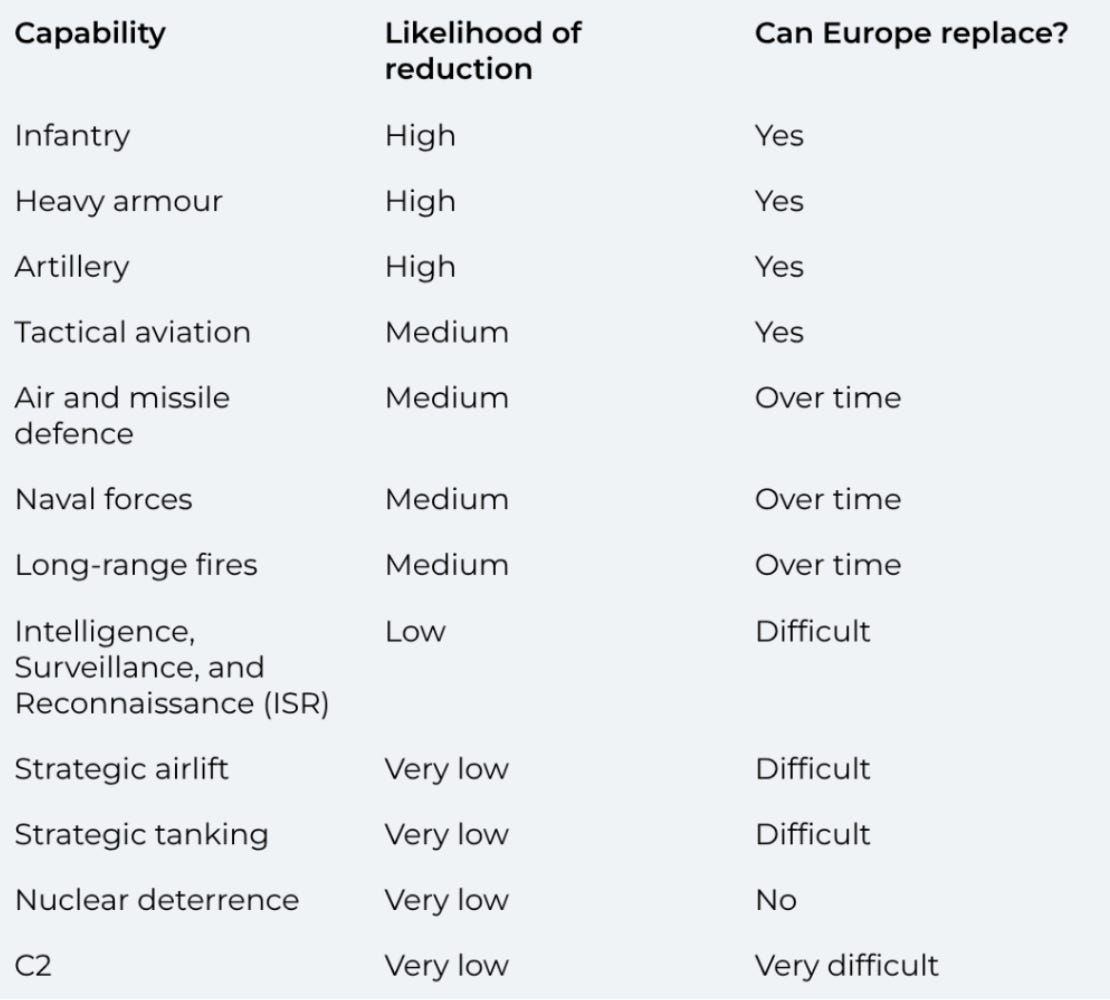
However, the axe may go deeper. Before Ankara, Trump mused about cutting troops in Europe by a third before settling on a review. This would reduce force levels to those before Russia’s annexation of Crimea in 2014, as urged by some American think tanks.
There are several strategic risks. Members of Congress have expressed concern about any reduction of a ‘robust’ US troop presence in Europe while the conflict in Ukraine continues and also about the risk of nuclear proliferation by allies due to a perceived weakening of the American commitment to European security. Congress has prohibited use of Department of War funds for reducing troop levels below 76,000, selling or handing back EUCOM sites, or relinquishing the role of Supreme Allied Commander Europe (SACEUR). Similar provisions are in the draft 2027 National Defence Authorisation Act, currently stalled in the Senate.
Signalling retrenchment of conventional US support in Europe to incentivise America’s allies to spend more is one thing. However, as David Blagden, Associate Professor of International Security and Strategy at the University of Exeter, has argued, the US has ‘turned actively predatory’. It has issued threats over Greenland, imposed tariffs, insulted allied contributions to US-led operations, and harmed European economic security while simultaneously demanding that its European allies must be subordinate to Washington and continue to buy American equipment. If the US remains predatory and European governments cease to believe American commitments to continental security are credible, they will begin to hedge away from the US – ‘the reaction to belittlement is likely to simply [sic] be more defiance’.
In sum, the central question for the review is not how many American troops remain in Europe, but which military functions the US should continue to perform itself and which Europeans must provide for themselves in the future. If the review produces a coherent division of labour, underpinned by sustained European investment and credible American strategic commitment, NATO can emerge stronger despite a smaller US footprint. If reductions become strategically incoherent or are used to coerce allies politically, however, Washington risks encouraging the strategic hedging away from America that it seeks to avoid.
John Foreman CBE is an independent consultant specialising in Russia, Ukraine, and Euro-Atlantic security. He served as UK Defence Attaché to Kyiv (2008-2011) and Moscow (2019-2022).
This article is part of the Council on Geostrategy’s Strategic Defence Unit.
To stay up to date with Britain’s World, please subscribe or pledge your support!
What do you think about this Memorandum? Why not leave a comment below?
‘NATO 1.0’ refers to the alliance during the Cold War and ‘NATO 2.0’ refers to the post-Cold War alliance.
In my view European countries including the UK must pivot away from purchasing more US defence equipment and being over reliant on US intelligence capabilities. The ongoing US military campaign against Iran is just once recent example (amoungst many) of US conduct
undermining our economic stability and security.