

A combination of global instability and the belief of Andy Burnham, Prime Minister, in hard power-backed reindustrialisation presents the North East of England with a generational opportunity to expand its footprint for defence manufacturing. Defined in this article as Northumberland, Tyne and Wear, County Durham, and Teesside, the North East hosts around 2,000 direct industry jobs backed by Ministry of Defence (MOD) expenditure; roughly 1% of British defence industry Full-Time Equivalent (FTE) jobs. Set within the larger 23,200 total number of MOD-supported military and civilian roles, it is clear that the region’s defence industry holds a disproportionately small share.
Amid this local context, the Defence Investment Plan (DIP) has reiterated the centrality of the Hybrid Navy concept to the Royal Navy, comprising a mixed crewed/uncrewed fleet, modular payloads, autonomy, and scalable production. This article therefore recommends that the MOD develops a North East ‘Hybrid Hub’ to support uncrewed systems development, training, and deployment in the North Sea to support national priorities while focusing the region’s underutilised defence industrial potential.
Currently, the North East receives roughly £180 million in direct spend – a fraction of the £4.7 billion, £6.6 billion, and £7.9 billion in the North West, South West, and South East respectively. With a stated goal of reaching 3.5% of Gross Domestic Product (GDP) on defence spending by 2035, a Burnham administration should use this opportunity to address the stark regional imbalance in defence spending.
North Sea security threats
This approach to defence expenditure should be targeted, with spending to be made in terms of a region’s recognised strengths and industrial potential. Arguably, the North East’s biggest asset (and vulnerability) is its geography, with the rivers Blyth, Tyne, Wear, and Tees all feeding directly into the North Sea. As an increasingly contested environment playing host to Russian combatant and ‘shadow fleet’ transits, the North Sea has already been the suspected host to sub-threshold activity, albeit further south. It is not outside the realm of possibility, however, that North East MOD sites – including Royal Air Force (RAF) Boulmer and RAF Spadeadam, alongside North Yorkshire’s RAF Leeming and RAF Fylingdales – could face similar hostile action in future.
As demonstrated across Europe, Critical National Infrastructure (CNI) also faces rising pressure from Russian sub-threshold attacks. In the Baltic region, suspected Russian sabotage of undersea cables has elicited several coordinated allied responses, including the North Atlantic Treaty Organisation’s (NATO) BALTIC SENTRY mission. Such threats may also apply to the North Sea, in which critical renewables and hydrocarbon sources provide a significant share of British energy. Should the Burnham administration choose to expand North Sea oil and gas extraction, the need to secure it will only intensify.
Potential vulnerabilities also face the North East’s land-based CNI, which ranges across ports, undersea cable landings, chemical plants, airports, and upcoming Artificial Intelligence (AI) data centres. The Port of Tyne in particular has demonstrated its importance to overseas deployments, with the 7th Light Mechanised Brigade departing North Shields aboard a civilian Roll-On, Roll-Off (Ro-Ro) ferry to move 1,400 personnel to participate in Exercise RHINO STORM earlier this year.
A ‘Hybrid Hub’
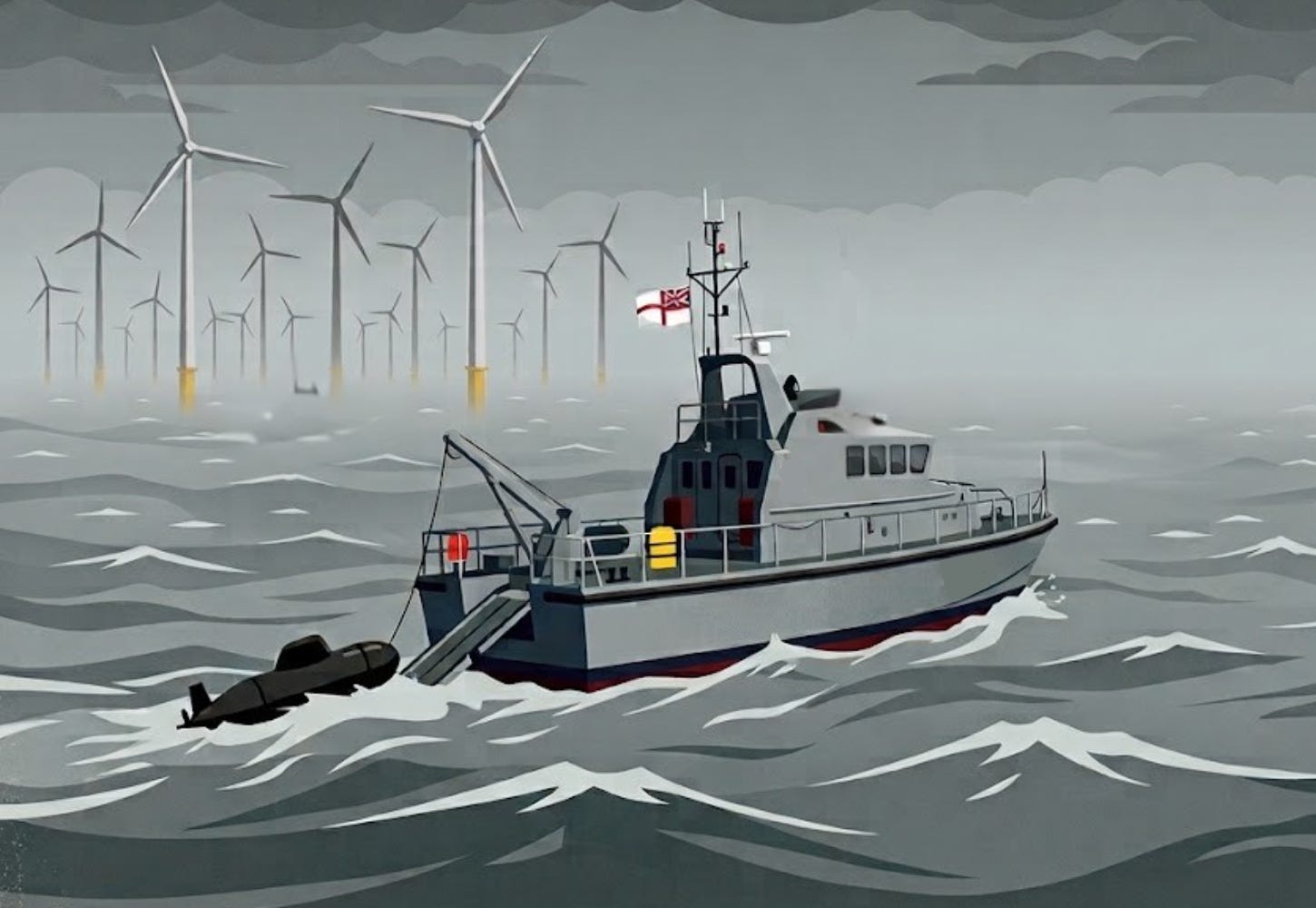
As a frontline region facing these threats, the North East is ideally positioned to provide a portion of the Royal Navy’s presence through attritable and autonomous uncrewed vessels, which are foundational to the Hybrid Navy concept. The North East should therefore host a ‘Hybrid Hub’ on the River Tyne to enable the development, training, and deployment of Uncrewed Surface and Undersea Vehicles (USVs and UUVs) directly into the North Sea.
In doing so, the Royal Navy would not be starting from scratch. HMS Calliope, a stone frigate on the River Tyne’s south bank in Gateshead, currently hosts up to four P2000 Archer class patrol/training vessels. Although a reservist training facility, a recent – yet unconfirmed – report has suggested that it is set to be expanded into a ‘shadow fleet command centre.’ This points to a notable evolution in testing, training, and deployment opportunities available for the region.
P2000s have already proven their integration with both USVs and UUVs, acting as a ‘mothership’ for tactical command. By expanding this in the North Sea, with its notably rough conditions, maritime traffic, and offshore energy, the Royal Navy could better prepare systems and crews for challenging environments, including the High North. This ultimately presents the MOD with a scalable opportunity, enabling expansion geared towards deeper support for larger crewed and uncrewed vessels, as envisioned by the Royal Navy.
A Hybrid Hub would also mark a contribution to shared international priorities, particularly with the Joint Expeditionary Force (JEF), for which North Sea security is an evolving imperative. With a shared objective of boosting interoperability and interchangeability, the JEF could further use the North Sea as a joint proving ground to support further training, development, and presence-enabled deterrence.
Industry
A North East Hybrid Hub would also create significant opportunities for local industry and raise broader avenues for inward investment. This would build upon an established supply chain which includes autonomous maritime, Artificial Intelligence (AI), and space capabilities, all of which will need to be leveraged to meet strategic requirements. Despite this alignment, the North East’s defence sector is, in part, held back by the MOD’s investment of only 4% of the defence budget in Small and Medium-sized Enterprises (SMEs) nationally.
Of the £180 million spent by the MOD in the North East, 35% goes to local SMEs (the highest percentage nationally by a significant margin). The region therefore receives the largest slice of the smallest pie. Although there is increasing space-centric investment in the region from primes such as Lockheed Martin, Airbus, Raytheon, and Leonardo, the North East would undoubtedly benefit should the Burnham administration decide to accelerate plans to provide further support for SMEs.
A Hybrid Hub, in convening industrial and strategic focus, could leverage the region’s more than 27,000 defence-related jobs, including in the space, cyber, AI, and advanced manufacturing sectors. This would draw upon a network including local Members of Parliament; the region’s two combined authorities; the North East Regional Defence and Security Cluster (NERDSC); the North East Technology Park (NETPark); and the region’s five universities, of which three are founding members of the Defence Universities Alliance.
Acting upon this could enable greater engagement with national programmes such as the Global Combat Air Programme (GCAP) and AUKUS, in addition to deepening bilateral industrial ties with partners like Ukraine. For the Royal Navy specifically, it could enable a scalable expansion of Project BEEHIVE autonomy trials to complement (not replace) Portsmouth-based uncrewed system testing. With a recent trial already demonstrating the utility of the North Sea for the world’s first USV airdrop, there is a clear rationale for the region to host and support similar activity in future.
Conclusion
In contributing towards Burnham’s regional growth agenda, expanding the MOD’s presence to a North East Hybrid Hub is just one option for British-made hard power reindustrialisation. A convergence of political priorities and the growing need to secure the North Sea provides the North East with an opportunity for generational change, reminiscent of its proud heritage of shipbuilding. As the future of European security adapts to the decisions made at the Resolute Desk, (itself fashioned from the remains of a ship built on the River Tyne), His Majesty’s Government should empower the North East to ensure that no region is left behind in responding to the challenges ahead.
Benedict Baxendale-Smith is an Adjunct Fellow at the Council on Geostrategy and PhD Student in Defence Studies at King’s College London. His research focuses on British and Australian maritime strategies in the Indo-Pacific amid American-Chinese strategic competition.
To stay up to date with Britain’s World, please subscribe or pledge your support!
What do you think about this Memorandum? Why not leave a comment below?