

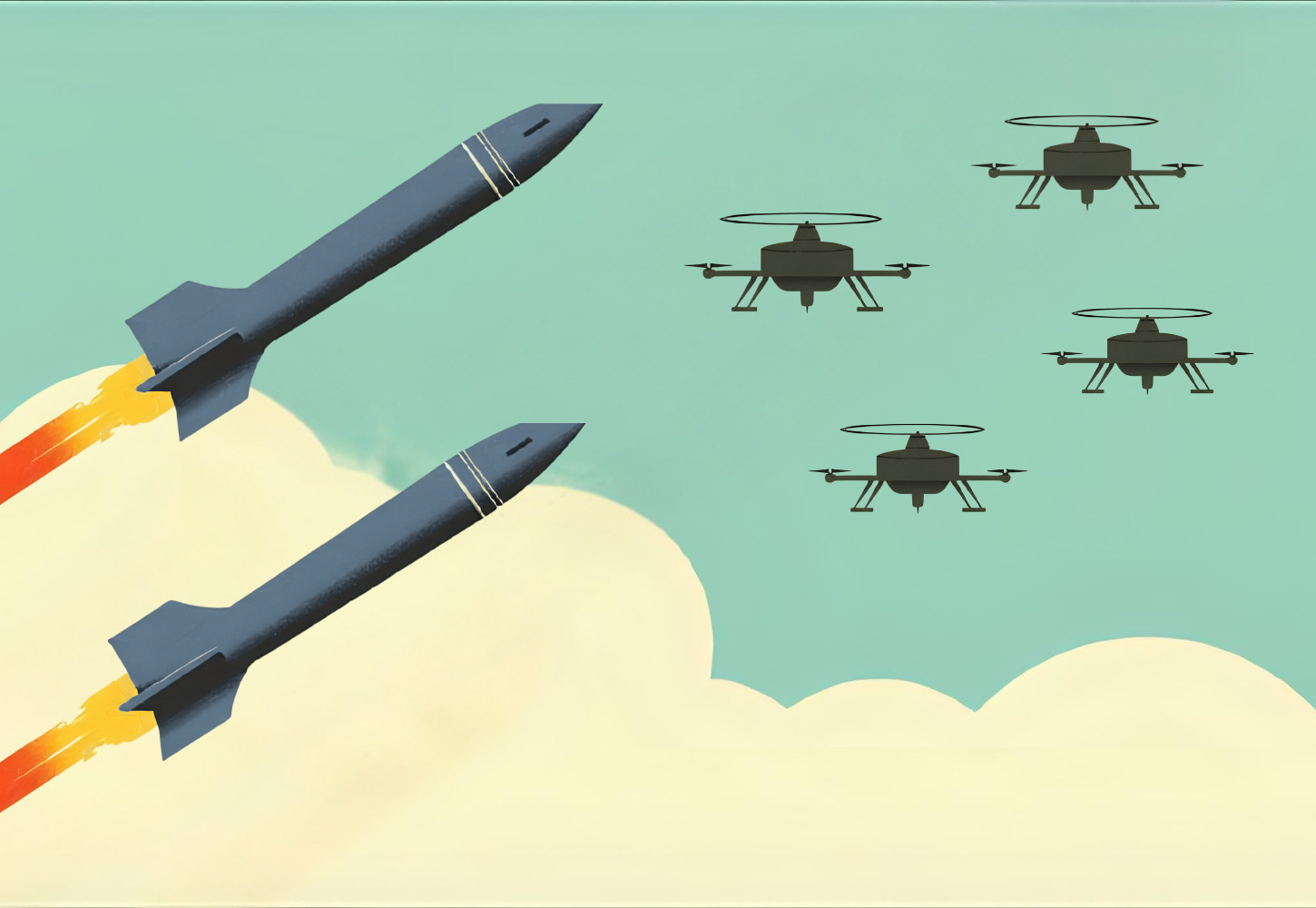
Adm. Sir Tony Radakin KCB ADC, the outgoing Chief of the Defence Staff, has proposed an ambitious target: stockpiling 7,000 cruise missiles. At first glance, this figure is impressive, particularly given the current shortfalls in the United Kingdom’s (UK) arsenal. It will push the country’s magazine depth from days to weeks, or even months, of high-intensity conflict.
Numerous new weapon procurement programmes are now underway, adding credibility to Radakin’s comments: diverse systems to hit targets deep behind enemy lines, launched from ground, air and sea. What they have in common, however, by and large, is that they are for exquisite weapons. These fit the ‘high’ category; what is missing is the ‘low’ category.
The strategic question is not simply one of quantity, but of composition and cost. What types of missiles make up this stockpile? What is the balance between capability and affordability? A force built exclusively of high-end, expensive systems may prove unsustainable. Conversely, a smart mix of high-performance and lower-cost drones and missiles could deliver greater depth and resilience. What if, for the price of 7,000 premium weapons, Britain could instead field 20,000 in a diversified high-low mix, gaining not only volume, but also flexibility?
The UK should adopt a high-low mix of both sophisticated and lower-cost systems, particularly in deep strike. This would improve resilience in larger-scale or longer attritional wars and create contingencies.
Britain is rearming, but is it the right mix?
The argument over whether the UK should adopt a high-low mix of both sophisticated and less sophisticated weapons is not new. But it is no less relevant today, especially as Britain embarks on a period of reinvestment in defence.
The UK’s arsenal will expand to several new categories of weapons. There is investment in the new trend in mini-cruise missiles, with the Spear family of weapons. Britain is joining the wave of countries acquiring tactical ballistic missiles with Project NIGHTFALL. There is also a more ambitious hypersonic missile programme (with the United States [US], of course); meanwhile, Storm Shadow cruise missile production is resuming with the French. Storm Shadow’s replacement, the Future Offensive Surface Weapon (FOSW), is already under development with France too. The list goes on, and it is all welcome.
British firms and experts are greatly helping Ukraine, but by-and-large the UK’s defence procurement is still overlooking them. So, we know that we can do it, we just need to do it more.
Some defence planners may argue that the above programmes should not be criticised as exquisite, and there are indeed nuanced arguments to be made, but it is clear that none of them are ultra-low cost, quick to develop, low-tech programmes. None of them resemble, in any sense, the drones being used by Ukraine or Russia. So it leaves out a significant slice.
There are admittedly exceptions to the UK’s current weapons acquisitions, but as ever the exceptions prove the rule. Under Project ASGARD, His Majesty’s (HM) Government awarded Modini Aerospace £4.5 million for small jet-powered strike drones. The Modini drones neatly fit the ‘low’ category, and not just in terms of unit price. Modini Aerospace is one of a growing number of smaller British firms at the forefront of the drone revolution. British firms and experts are greatly helping Ukraine, but by-and-large the UK’s defence procurement is still overlooking them. So, we know that we can do it, we just need to do it more. And not just in small corners of defence planning, but across the board.
Rethinking quantity versus quality
The logic of the high-low mix runs deep in British defence. It is more than a formula; it is a mindset. For decades, the UK has relied on comparatively small, yet excellently equipped and trained, armed forces – quality over quantity. There is the notion, not without merit, that Britain cannot compete on numbers, even if it is a country of over 60 million people. But, there is a flaw in this argument going forwards. Quantity will no longer be tied to the number of people under arms; it is a question of how many drones a country’s armed forces have.
All cruise missiles, even the most advanced available at a point in time, are liable to being shot down. While figures are not available, it is immediately apparent that even Storm Shadow – which today is still a competitive design and worthy of continued purchases – suffers losses to air defences.
In the deep-strike arena, we can get a sense of the new normal. Airstrikes on the Houthis in Yemen, and Russia’s ongoing full-scale invasion of Ukraine, show that deep-strike weapons are used up quickly. On 7th September, Russia launched over 800 deep-strike missiles and drones at targets in Ukraine overnight. This is a lot, but such numbers no longer even capture headlines. It is the new normal.
The UK may not aspire to emulating Russia’s offensive deep-strike strategy, focusing as it does on largely civilian targets, but the numbers deserve contemplation. Russia can sustain this in part because it is not only launching exquisite cruise missiles. It currently launches around 20 Iranian Shahed drones for each high-end cruise missile it shoots at Ukrainian cities. And even within the waves of Shaheds, maybe as many as 40% are actually decoys – cheaper still.
Shaheds can be launched from inexpensive truck launchers, but even that has proven over-specification. In practice, they are seen being launched from simple catapults, or even from the roof of a moving pickup.
There is also another consideration: the launch platforms. Many of the exquisite strike options being invested in suffer from another, less clear disadvantage, in that they are tied to expensive launch platforms. Storm Shadows need fast jets, as will the new, smaller, air-launched cruise missile. These systems offer many advantages on paper; they address the requirements as they were laid out. But in wartime, these fast jets will be in scant supply and facing competing demands for a whole range of other important tasks. A low-cost option should therefore avoid the trap of being tied to precious launch assets. It should be the sort of system which can be launched from anywhere.
This can be seen with lower-cost strike drones. Shaheds can be launched from inexpensive truck launchers, but even that has proven over-specification. In practice, they are seen being launched from simple catapults, or even from the roof of a moving pickup. Even Ukraine’s Flamingo heavy cruise missile, which boasts a 3,000 kilometre range and is as close to exquisite as Ukrainian strike drones come, is launched from a simple rail off the back of a truck.
The Flamingo is interesting in other ways too. It has a jet engine first used in the 1960s, and leverages a ubiquitous aerial bomb as its warhead. Its wings do not fold, and have to be put in place by the ground crew before launch. It is hard to imagine a British missile with these features. Such a system would invariably have a freshly designed engine, bespoke warhead and pop-out wings to allow a sealed box launcher. All these features would be justified by requirements, but they drive up costs. Before we know it, we are no longer talking about an inexpensive, low-tier option. It is also sobering to reflect that the UK does not have anything in the arsenal which can hit as far, or as hard, as the Flamingo.
So what should Britain do?
Within the UK’s rearmament, it should seek a high-low mix of deep strike capabilities. The high-end systems being developed or acquired should remain in approximately their current numbers. However, they should be joined by ultra-low cost strike drones, which cost a fraction as much. These can be used as decoys and distractions to help the top-tier weapons reach their targets, or they can be used as a primary strike package in their own right.
These low-cost drones would typically be ground launched, have ranges of hundreds or thousands of kilometres, and use many of the communication, navigation and guidance technologies being fielded in Ukraine. Unit costs, leveraging modern production and commercial off-the-shelf (COTS) components would be below £10,000, compared to millions for cruise missiles. Their software may need periodic upgrades, but their relevance would remain, and as they get less competitive, they would still be valuable decoys to soak up enemy defences.
Warheads may be smaller, with lower performance and survivability, but they can still have a strategic effect by threatening targets deep behind the lines. Their greatest effect, however, is increasing Britain’s magazine depth.
H I Sutton is a writer, illustrator and analyst who specialises in submarines and sub-surface systems.
This article is part of the Council on Geostrategy’s Strategic Advantage Cell.
To stay up to date with Britain’s World, please subscribe or pledge your support!
What do you think about this Memorandum? Why not leave a comment below?
The problem with too many senior officers is their desire to retain "exquisite" systems which are unaffordable in the numbers needed - the world has changed, with clear evidence for years. The carriers are one example, along with an "exquisite" air wing, lacking a sufficiency of RFA and escorts - such aspects are never factored into the 'good ideas'.