

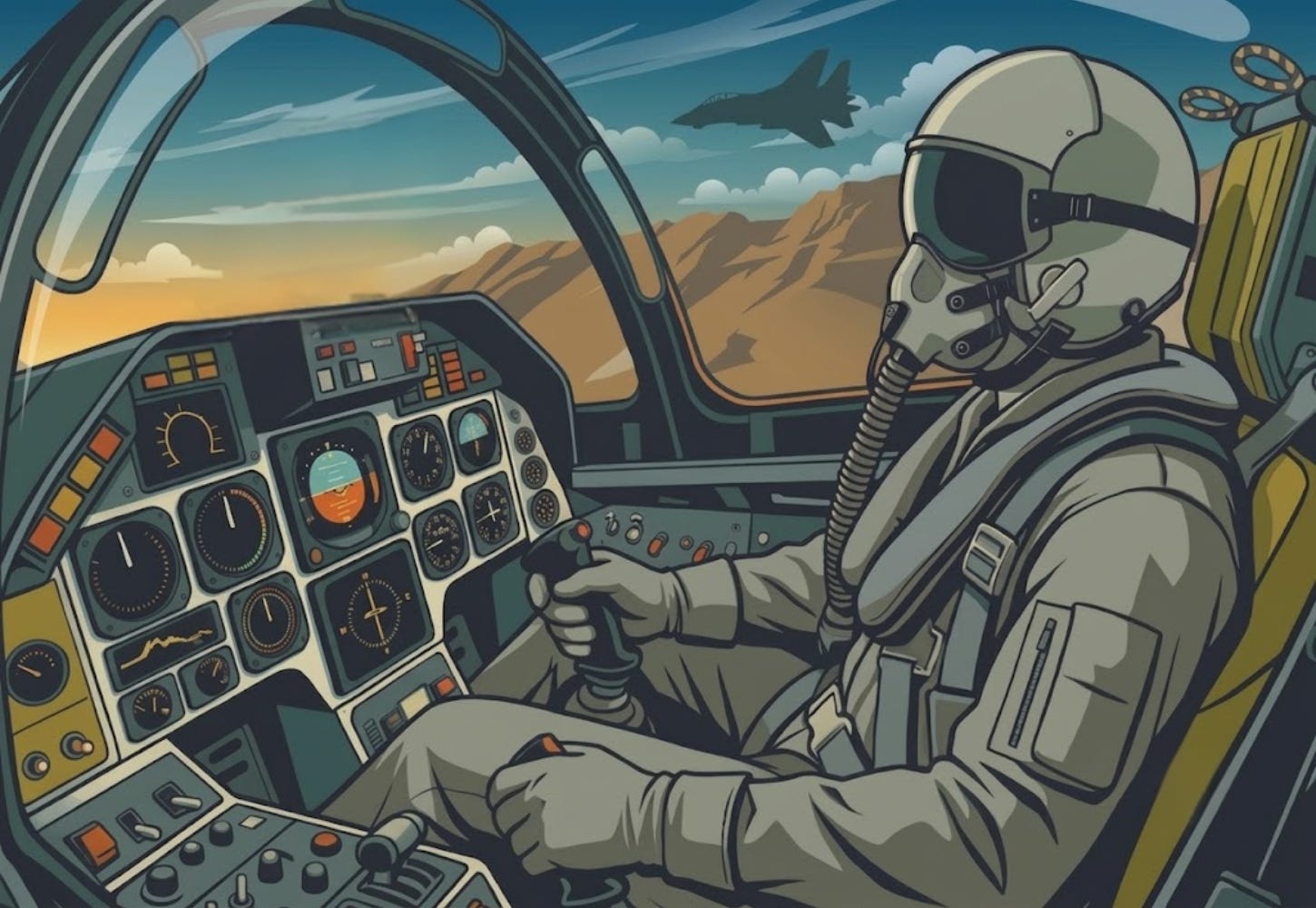
For decades, fighter aircraft have been the ultimate concentration of combat power, speed, and flexibility. A four-ship of Typhoons is complex and expensive, but for an urgent, difficult problem, fighter pilots knew they were probably the right answer. However, in recent conflicts, low-cost autonomous Uncrewed Aerial Vehicles (UAVs) – drones –have dominated numerically, and largely superseded crewed combat aviation at the battlefront. Now Artificial Intelligence (AI) is changing warfighting, from planning to execution. As AI makes its way into autonomous systems, must fighter pilots – including the author – lament the end of their era?
Fighter pilots on the bench
Drones now cover all combat air roles. The defining system of this era – the Shahed – has been reproduced and modified by Iran’s allies and enemies alike. Autonomy and low cost have now been augmented with AI, starkly demonstrated by American and Israeli drones hunting individuals using facial recognition and behavioural tracking. With sufficient creativity, deep strike missions such as Ukraine’s Operation SPIDER’S WEB in June 2025 can also be executed with stunning value for money. With AI creeping up the targeting chain, even planning and prioritisation are being prised from fighter pilots’ grip.
Fighter pilots also have a new worry: nobody wants to be sat in a 9G supersonic fighter when their opponent is an AI-guided swarm of 25G hypersonic robots. The response to such a threat must be AI-guided, and the response will come sooner than we think. The fusion of AI, autonomy, mass manufacture, and precision is likely to drive the dominance of low-cost systems. Such systems are perfect proving ground for the technologies, not requiring the assurance that crewed platform adoption or integration requires. The bleeding edge of autonomy and AI sits at the cheap, expendable end of the spectrum.
This is where military forces will get most from coming investments. The relatively low cost of disposable systems, often in the low tens or hundreds of thousands of pounds or dollars, allows constant testing, driving up maturation, and driving down cost. In addition, the diversified design and manufacturing base for autonomy and AI is bringing fresh ideas, capturing some of the potential of the civilian sector (i.e., dual-use). Design, manufacture, and maintenance will improve, as will tactical performance.
Iceman’s children
The pendulum of combat advantage now swings towards smaller, disposable systems. However, as technology matures, it will inevitably swing back to the larger and more complex platforms. They will go faster, further, and deliver more weapons. Another new fighter pilot problem thus arises: if Iceman flew ‘ice cold, no mistakes’, the uncrewed systems – Collaborative Combat Aircraft (CCAs) – will be liquid nitrogen. They will be tactically excellent, with consistency and endurance beyond human reach.
In the United States (US), Anduril and General Atomics have perhaps the most advanced of these programmes. The first tranche of the Dark Merlin is expected in 2029, costing an estimated US$30 million (£22.4 million) each. Boeing in Australia also has a mature platform; the Ghost Bat, at a unit price of US$10-$15 million (£7.5-£11.2 million). Helsing in Germany has a similar platform in Europa. The People’s Republic of China has demonstrated its GJ-11 ‘Sharp Sword’, integrating with fourth- and fifth-generation combat aircraft. Neither Ukraine nor Russia has ignored CCAs. The Kremlin has operationally tested its S-70 Okhotnik, while Kyiv has committed to purchase 150 Saab Gripens from Sweden – already proven with AI-control, and effectively an optionally piloted fighter. These are all AI-enabled uncrewed combat aircraft, built to integrate with fifth-generation systems, and with extensive autonomous capabilities.
Don’t retire Maverick just yet
The rapid progress of autonomous and AI-driven programmes is not pricing combat pilots out of the market. Ethics will keep humans in the loop, and invaluable contributions can be made in imagination and original thought. To survive in their aircraft, however, pilots will need to command formations of autonomous teammates carrying sensors, jammers, decoys, and weapons.
Even the ‘legacy’ fourth-generation platforms have extremely well-engineered airframes and engines that can carry tonnes of fuel and weapons, and generate enough electrical power for significant compute. The way in which they deliver their roles must change fundamentally, but great value can be extracted from previous investment in existing fleets, albeit with some modernisation. This will bring extended utility from the equipment but, more importantly, also from the people operating and maintaining the systems.
Fighter pilots often say that today’s generation has less flying skill than their predecessors. This is, broadly speaking, true. Modern combat air is built on automation, making aircraft easier to fly as systems better fuse pilot inputs into more desirable outputs. However, if technology made poorer pilots, it made more capable warfighters. Freed of handling demands, combat pilots now control sensors, software, and weapons, and can manage much more tactical information, stretching to formations of dozens or hundreds of aircraft. This is not decline – it is evolution. Indeed, this same trend now stretches out of the crewed cockpit to formations of uncrewed systems.
Combat air will use uncrewed systems for reach, persistence, mass, and to take most of the physical risk. The human commander supplies intent, escalation control, the most difficult judgements, and – most importantly – imagination. Neither crewed platforms nor CCAs are cheap, but their thoughtful development and integration can extract significant value for many years to come. The scale at which they can operate can grow exponentially.
‘Top Gun’ class of 2027
Autonomy and AI are also adding new pressures to the existing model of command. At one level, it is an extension of mission command: intent from above, decentralised execution below, applied to software-controlled teams. However, with these technologies, commanders will not simply direct more units, but different kinds of units, with different tempos and varying levels of delegated authority and logic transparency.
AI will also offer novel tactics that commanders must be able to filter. It returns inevitably to the human, where military competences will need to evolve just as they have for fighter pilots, and add commanding both human and non-human subordinates, as well as controlling and responding to AI-driven systems.
The first generations of these systems seem likely to be able to operate through several layers or decision points of warfare, but not able to manage all its tactical and strategic dimensions. Humans will need to guide the machines and make many critical decisions. It would be unwise to surrender these functions. Low-cost systems will build tactical and technical competence. Large and complex systems will come, but humans should hone skills now on the accessible and affordable ones.
Autonomy and AI are rapidly proliferating through low-cost platforms and transforming all aspects of warfare, from design and manufacture, to how we train, plan, and fight. This phenomenon is highly visible in small and disposable systems, but it is premature to conclude that large, crewed fighter aircraft are no longer useful.
Iteration will mature the technology and the techniques, but these will be given new power and reach when integrated into larger and more sophisticated platforms. Fighter pilots will lament the twilight of the sweaty, cramped 9G cockpit, but this is the dawn of commanding distributed, intelligent systems across domains. The mental and physical challenges will be just as demanding, and the skills, initiative, and intellect to thrive will echo those possessed by history’s best fighter pilots.
Wg. Cdr. Ben Goodwin MBE is an Adjunct Fellow at the Council on Geostrategy and a fighter pilot with experience in Iraq, Syria, Afghanistan, Eastern Europe, and Central Africa. He has been posted to the Ministry of Defence and the North Atlantic Treaty Organisation in Brussels. Previously, he worked at the trading arm of a large bank, focused on foreign exchange and government bonds.
This article was written by the author in a personal capacity. The opinions expressed are his own, and do not reflect the views of His Majesty’s Government or the Ministry of Defence.
To stay up to date with Britain’s World, please subscribe or pledge your support!
What do you think about this Memorandum? Why not leave a comment below?