

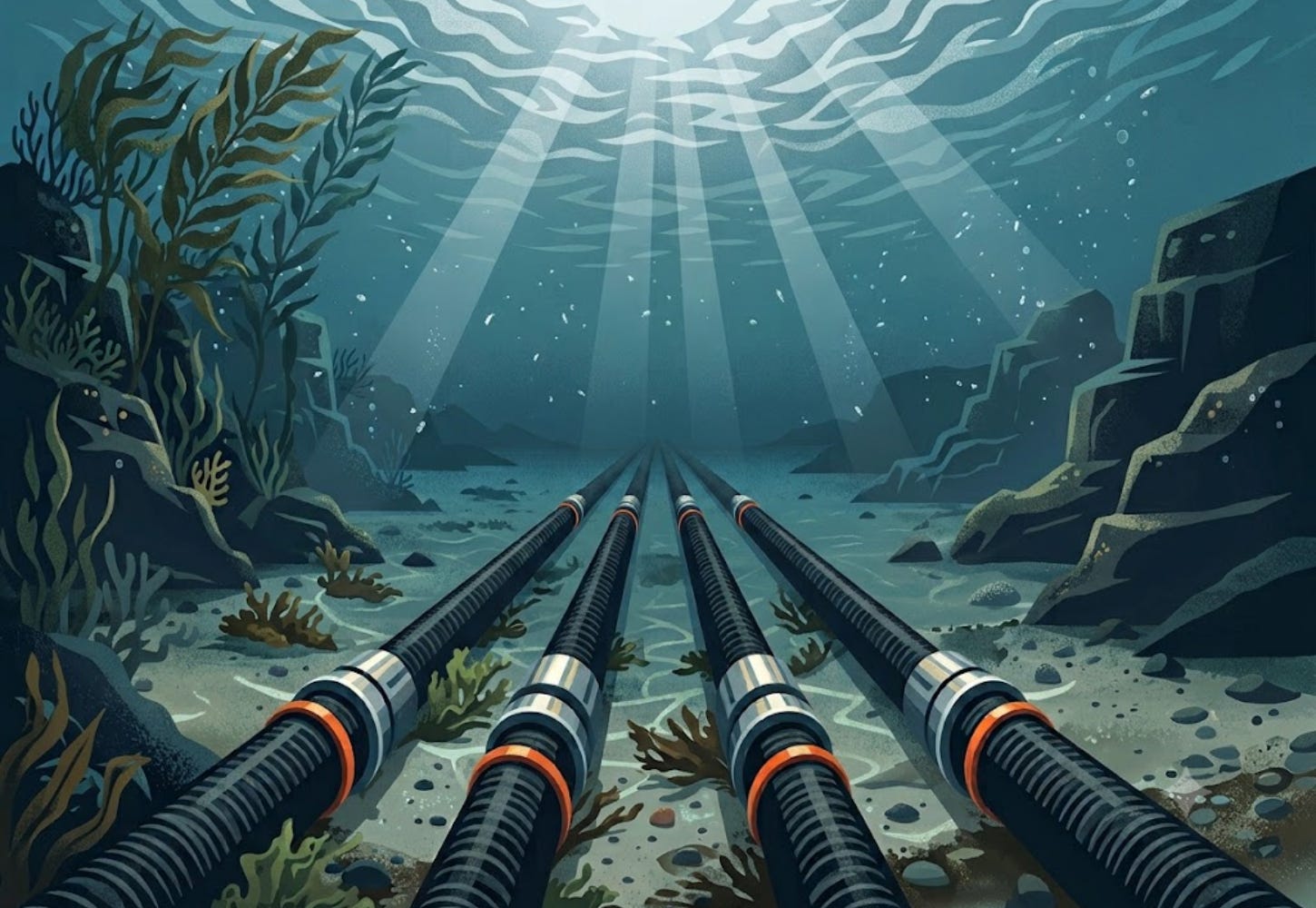
The United Kingdom’s (UK) macroeconomic stability is directly tied to the security of vulnerable seabed cables and pipelines in the North Atlantic and North Sea. However, the Royal Navy hulls and surveillance platforms required to monitor these assets face severe operational overstretch, and Ministry of Defence (MOD) funding allocations have not kept pace with the evolving threat profile. As hostile states expand capabilities to map and probe this infrastructure below the threshold of open conflict, the subsea domain reveals a structural gap between His Majesty’s (HM) Government’s stated strategic ambitions and available frontline resources.
This fiscal friction culminated in June 2026 with the resignations of John Healey as Secretary of State for Defence and Al Carns as Parliamentary Under-Secretary of State for the Armed Forces, who formally cited HM Treasury’s unwillingness to resource the Defence Investment Plan (DIP) appropriately against escalating North Atlantic and European threats.
Britain’s reliance on a concentrated network of undersea data cables and energy pipelines presents a systemic vulnerability. Hostile actors can exploit this infrastructure through deniable seabed activity designed to avoid triggering the North Atlantic Treaty Organisation’s (NATO) Article 5. The UK’s current capabilities for underwater surveillance, rapid attribution, and physical intervention remain unscaled to the value of the assets at risk. Furthermore, current force generation trajectories provide insufficient organic capacity to sustain seabed monitoring as a core, enduring mission. Absent a ringfenced uplift in maritime security funding within upcoming expenditure reviews, the capability gap will widen.
Recent allied initiatives – including new NATO coordination cells and Joint Expeditionary Force (JEF) task groups – improve regional situational awareness, but do not yet constitute a credible maritime deterrence posture. Britain is currently on track to become a net consumer of allied security in the North Atlantic, rather than the leading framework contributor.
Addressing undersea vulnerabilities requires explicit fiscal trade-offs. HM Government should either lift the defence spending ceiling or curtail out-of-theatre commitments to fund domestic maritime surveillance, Uncrewed Underwater Vehicles (UUVs), and commercial sector resilience integration.
Financial data flows, international cloud services, government communications, and a significant portion of the domestic energy mix rely on seabed routes. Yet, policy oversight of these assets remains fragmented across the Cabinet Office, the Department for Energy Security and Net Zero (DESNZ), the Office of Communications (Ofcom), the MOD, and private commercial operators. This decentralisation prevents the generation of a unified operational picture.
The geography of the UK’s continental shelf compounds the security challenge. Critical data and energy corridors transit shallow, highly trafficked waters in the North Sea, making them accessible both to advanced military assets and dual-use civilian hulls. As these networks converge on a limited number of high-density landing corridors and coastal chokepoints, minimal operational effort can yield systemic economic disruption. While the data network possesses some inherent rerouting redundancy, the repair timelines for major gas pipelines or deep-sea fibre trunks do not match the speed at which a coordinated outage would generate severe political leverage during a crisis.
The primary threat to British undersea infrastructure is persistent, ambiguous interference in the ‘grey zone’ – the space below the threshold of armed conflict where attribution is difficult and the risk of escalation complicates decision-making. Foreign state actors – principally Russia – routinely deploy specialised hydrographic survey vessels, notably the Yantar. As noted by Healey in a personal statement to Parliament, the persistent loitering of the Yantar within the UK’s Exclusive Economic Zone (EEZ) and vital maritime corridors over the past two years underscores a deliberate, state-directed mapping campaign.
This physical probing is compounded by sophisticated cyber-physical targeting. Recent intelligence disclosures from Government Communications Headquarters (GCHQ) highlight that adversarial cyber actors are seeking exploitation vectors within the industrial control systems managing undersea landing stations, pairing physical reconnaissance with digital vulnerability mapping.
Hostile operations do not require the physical severance of a cable to achieve strategic effect. A pattern of unexplained telemetry dropouts, micro-damage to pipeline casings, or localised outages on secondary routes forces both HM Government and private operators to deplete finite operational and analytical capacity in simply diagnosing the incidents. Furthermore, operations conducted in international waters or under the guise of marine scientific research within EEZs exploit legal ambiguities, leaving Britain with few viable enforcement options short of escalating a civil maritime dispute into a state-level confrontation.
While the MOD has made tactical adjustments – notably bringing the Multi-Role Ocean Surveillance (MROS) ship RFA Proteus into service and participating in NATO’s Critical Undersea Infrastructure Coordination Cell – the volume of available operational assets is small relative to the geographic scale of threats. The Royal Navy faces a severe escort deficit. Its remaining Type 23 class frigates and Type 45 class destroyers, alongside the nuclear-powered attack submarine (SSN) fleet and the Royal Air Force’s (RAF) P-8A Poseidon maritime patrol aircraft, are committed to high-priority, non-negotiable missions. These dictate sustaining the Continuous At-Sea Deterrent (CASD), providing Carrier Strike Group escort duties, and monitoring Russian naval transit through the Greenland-Iceland-UK (GIUK) gap.
Adding continuous, proactive seabed infrastructure patrol to this list is thus non-viable with the current fleet size. Financial constraints mean that new procurement programmes face frequent delays due to funding competition from legacy hardware programmes.
The structural reality of this underfunding was laid bare by the dual resignations of the political leadership at the MOD in June 2026. In his departure statement, Healey explicitly warned that the backloaded DIP financial settlement ‘falls well short of what is required’ and forces choices that ‘reduce the readiness of our forces’. Carns echoed this deficit, stating that Britain is failing to provide the necessary ‘kit to do the job’. Within the subsea domain, this funding ceiling means the Royal Navy cannot transition from a reactive, event-driven posture to the persistent, proactive underwater presence required to deter adversarial sub-threshold actions.
If HM Government intends to mitigate these vulnerabilities prior to long-term budget adjustments, it must pursue low-cost capability shifts. Firstly, it should designate underwater infrastructure protection as a standalone, core statutory task for the Royal Navy and the National Cyber Force, supported by wider deployment of off-the-shelf, low-cost commercial autonomous vehicles for routine monitoring.
Secondly, it should mandate industry-government data integration, establishing a joint, real-time data-sharing hub where commercial acoustic telemetry and cable diagnostic data are fused with military maritime intelligence to accelerate sub-threshold attribution. This initiative should draw directly upon the modern regulatory standards put forward in the recent undersea internet cable strategy published by the Department for Science, Innovation, and Technology (DSIT).
Finally, Wes Streeting, Secretary of State for Defence, should leverage the UK’s leadership within the JEF to establish a strict geographic division of labour. Securing formal commitments from Nordic and Baltic allies to manage localised shallow-water monitoring would free high-end Royal Navy assets for Atlantic surveillance.
Ash Walker is a strategic intelligence analyst specialising in geopolitical risk, defence policy, and hybrid warfare, with a focus on critical minerals and supply chain security and operational resilience analysis.
To stay up to date with Britain’s World, please subscribe or pledge your support!
What do you think about this Memorandum? Why not leave a comment below?
Good article. Two friendly suggestions or future work/articles. Yes security the undersea frontier is critical for an island national like GB. But the range of undersea infrastructure, both public and private, extend beyond fiberoptic cables etc and we might considered an integrated approach. As we have seen in the current PG conflict and Ukraine infrastructure attacks, of all sorts, are increasing in the current period and likely to expand in the future. Further no country, much less GB can tackle the threats to securing the undersea domain along. More needs to be said bout bilateral, minilateral, and multilateral efforts within NATO, EU, and globally. Good shoe though and the Council on Geostrategy memos and so forth are rapidly becoming a must read.