

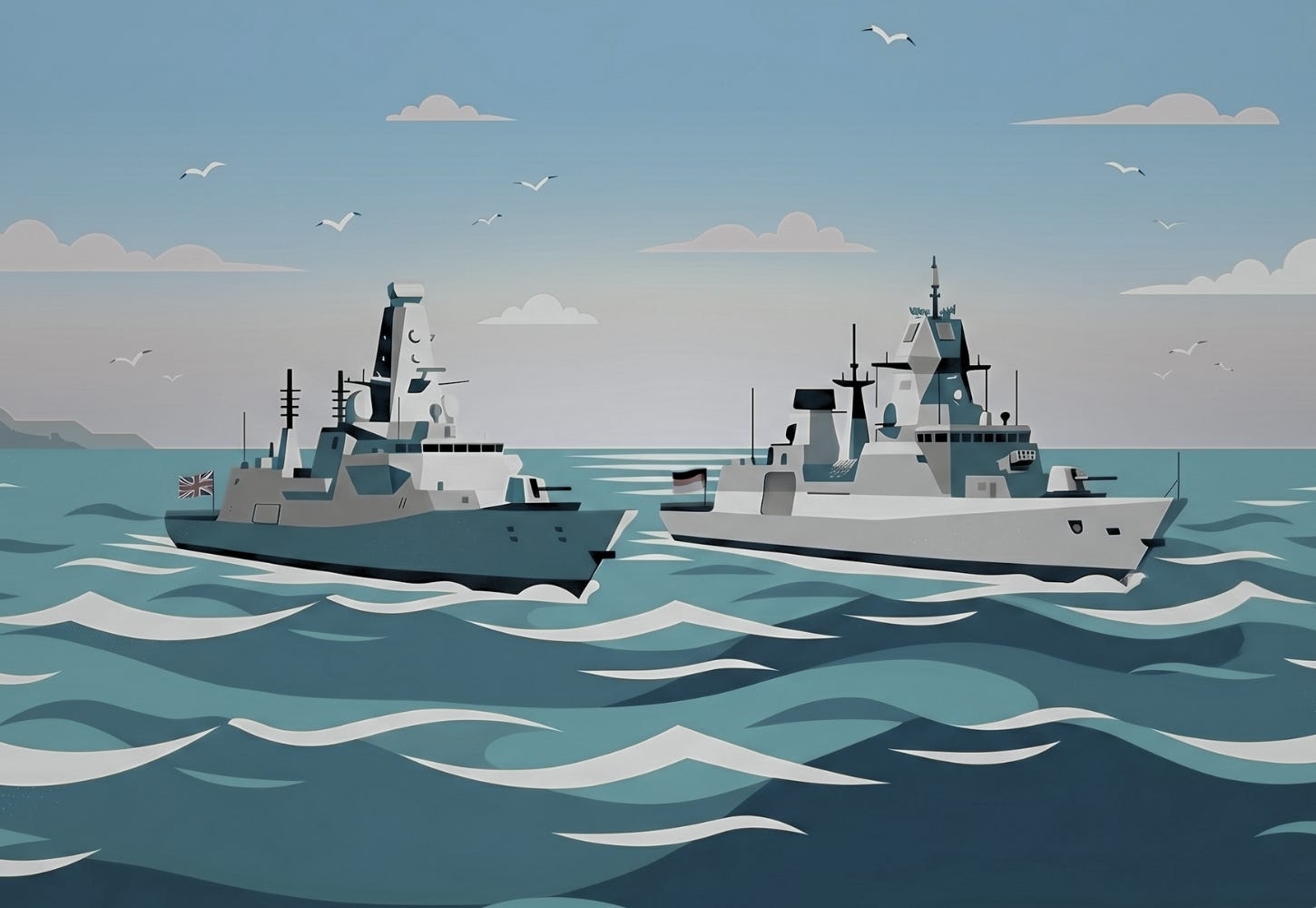
As the United States (US) considers reallocating naval assets to the Indo-Pacific, hemispheric defence, and the Middle East, the Euro-Atlantic faces a harsh reality. The Wider North – including the Arctic, Nordic, and Baltic areas – is increasingly exposed to Russian aggression. For the past two decades, European navies have shrunk, assuming that Euro-Atlantic maritime spaces would remain uncontested or perpetually underwritten by American power.
That assumption faces dislocation. The seas and oceans around Europe are contested once more: not only does Russia attempt to operate beneath the threshold of war, but its Northern Fleet – operating from bases on the Kola Peninsula – has modernised and threatens the North Atlantic Treaty Organisation’s (NATO) northern flank. Unless they wish to surrender control over this vital region to Russian encroachment, the United Kingdom (UK) and Germany – as European NATO’s two biggest investors in defence – should work together to reassert control.
The nature of the threat
By now, the Kremlin’s adversarial tactics are well known. The Russians seek to exploit the seams between peace and war to circumvent international law, distract and disorient European countries, and fracture NATO so that they might pursue their kleptocracy’s interests more effectively. At sea, since 2022, this has taken the form of surveying critical undersea pipelines to threaten sabotage and deploying uninsured shadow fleets to skirt sanctions. Given the drawdown in European naval forces since 2010, Russia knows European navies, including the Royal Navy, have limited surveillance capacity.
Meanwhile, the Russian Northern Fleet has come a long way since its post-Soviet slump. It is smaller, but more modern and far more active. Crucially, in relative terms, the balance of naval power in the High North has not been as bad from a NATO perspective since the 1970s due to the decline in peer combat-capable European NATO warships. Although not all would be able to operate simultaneously, the Northern Fleet has 26 submarines, including a number of the new Yasen class nuclear-powered attack submarines (SSNs) and 11 major surface combatants. It also has a potent geographic advantage, given the Russian naval bases and air stations in the Kola Peninsula, as well as a number of newer and upgraded facilities in the Arctic.
Together, depending on loadouts, the total offensive missile capacity of the Russian Northern Fleet comes to over 800 missiles – a formidable threat. Several more new submarines and surface combatants are planned with the Kremlin planning on spending ₽8.4 trillion (£84 billion) on naval construction over the next decade. This comes at a time when the Royal Navy, and other Northern European navies, experience an all-time low in their number of frigates.
Towards a British and German response
This challenge to NATO sea control in the North Atlantic requires a forceful British and German response. Not only do both nations, in their respective ways, possess highly globalised economies that depend heavily on the sea, but they rely increasingly on the wider maritime domain: undersea data cables, energy pipelines, and offshore wind farms are highly vulnerable to Russian sabotage or outright attack.
To counter this, a purely national approach would be inefficient. Consequently, the two largest defence investors in European NATO should transform their bilateral relationship from a series of high-level diplomatic agreements into a deeply institutionalised partnership for European maritime dominance. Coordinating this with France – a significant naval power, albeit one focused on the mid-Atlantic and Mediterranean – would amplify its effectiveness.
True, intensified British-German cooperation requires navigating distinct, and often clashing, strategic cultures. Historically, the UK has seen its navy as a genuinely national enterprise, from nuclear deterrence to global power projection. Conversely, German defence policy has long been defined by a terrestrial focus, a deep reluctance to deploy naval power, and binding the Bundeswehr’s capabilities to multinational frameworks. However, the geopolitical changes of the past few years have forced a strategic change in both London and Berlin.
Yet, with Russia’s resurgence, British strategists have realised that their home areas – the North Atlantic, the Baltic and Mediterranean seas, and even the British Isles themselves – are at risk, mandating a more focused geostrategic approach, which dovetails with German interests. Simultaneously, German planners have acknowledged that their country must step up and embrace a more active posture. The decision to forward deploy a German combat brigade to Lithuania represents a significant political leap, intended to deter Russia from further aggression. While the UK is traditionally faster to act, Germany’s pivot towards proactive deterrence reinforces the industrial and political gravity necessary to anchor NATO’s northern flank.
The diplomatic scaffolding for the coordination of geostrategic postures is now in place. The Trinity House Agreement of October 2024 sparked tangible operational ties, such as joint maritime surveillance out of Royal Air Force (RAF) Lossiemouth, while the subsequent July 2025 Kensington Treaty provided a broader, legally binding framework. At the same time, Britain, the leading naval power in Europe, has put in place the foundations for a new maritime posture in the North Atlantic – Atlantic Bastion, Shield and Strike, underpinned by the concept of a New Hybrid Navy; i.e., a navy integrating autonomous surface/subsurface combatants with crewed vessels – asymmetrically calibrated to reduce the threat from Russia’s potent and growing Northern Fleet.
The immediate test is whether these two powers can move beyond ambitious rhetoric and actually build a larger and more coordinated naval fleet to constrain Russian ambitions in the Wider North. The time has come for Britain and Germany to combine their naval potential, alongside their NATO allies in Northern Europe. Together, they would pose more than a match for Russia’s Northern Fleet. Their objective should be simple: re-establishing European maritime supremacy over the North Atlantic and Norwegian Sea, as well as the Baltic region, so that Russia cannot threaten British, German, and European interests.
Rebuilding European naval supremacy
Constraining the Russian Northern Fleet necessitates a coordinated naval buildup, from the surface to the sub-surface domain, and with capabilities suitable across the spectrum of sub-threshold conflict to open warfare. The Nord Stream sabotage proved that critical civilian infrastructure is a primary target in sub-threshold warfare. Both the British and German service-led economies rely utterly on the dense webs of cables and pipelines crossing the North Atlantic and North Sea areas, alongside the offshore wind infrastructure driving their energy transitions. The severe capacity limits of current European NATO fleets leave them dangerously exposed: the Royal Navy is down to a handful of operational frigates, while the Deutsch Marine has become a naval minnow since the end of the Cold War.
In any case, conventional, crewed vessels cannot comprehensively protect this vast, static network, and new technologies mean that crewed systems should be augmented – indeed, sometimes even replaced – by robotic and autonomous systems. As such, it makes sense for Germany to join British initiatives such as Project CETUS. The immediate hurdle is harmonising software architectures to ensure data flows seamlessly between national maritime operations centres. Bypassing sluggish five-year planning cycles, both navies should pool capital for autonomous mine countermeasures and Uncrewed Underwater Vehicles (UUVs).
However, the two nations also need to focus on high-end warfighting capabilities. As Russia’s Northern Fleet grows, it will become more capable of probing around the Svalbard archipelago and the Norwegian Sea. Undoubtedly, it will attempt to project out of its own bastions, which consist of Anti-Access and Area Denial (A2/AD) networks in the Barents Sea to protect its bases on the Kola peninsula and the Russia nuclear-powered ballistic missile submarine (SSBN) flotilla, leading to competition to exert control across the entire northern region.
This will require complex Anti-Submarine Warfare (ASW) and a sustained surface presence, precisely what the Royal Navy’s own bastions – Atlantic, Shield, and Strike – and New Hybrid Navy are designed to counter. As its own navy grows in strength, Germany should be more closely integrated with this effort alongside the Norwegians.
As Britain and Germany focus high-end assets on the North Atlantic, Northern European allies can help fill the deficit in the marginal seas. The First Sea Lord has already proposed the creation of a ‘Northern Navies initiative’. Regional Nordic navies – especially Sweden, Denmark, and Finland – are purpose-built for the complex littoral environments of the Baltic. Passing littoral burdens to these allies frees the limited number of high-endurance surface combatants, such as the British and Norwegian Type 26 class and German F126 class frigates, to focus their advanced sensor suites on wide-area ASW and air defence in the deep waters of the North Atlantic. London and Berlin should work together to coordinate this effort.
A similar division of labour is also vital between Britain and Germany, and Poland and the Baltic states. With the Suwałki Gap remaining a fragile overland corridor, reinforcing Estonia, Latvia, and Lithuania depends almost entirely on uncontested maritime communication lines to ports such as Klaipėda, Riga, and Tallinn. The Deutsche Marine offers regional command in the Baltic Sea from Rostock, but it cannot secure these supply lines while simultaneously meeting growing obligations in the North Atlantic; the logistical requirements fundamentally overstretch its current capacity. British intelligence, maritime strike, and logistical support act as an indispensable force multiplier for German command structures here. Deep interoperability means ensuring British munitions can be cross-loaded onto German vessels and pushing integrated intelligence feeds down to the lowest tactical level.
Finally, and critically, any credible strategy for dominance over the North Atlantic must account for the ultimate guarantor of European security, especially in an era where the US may be drawn into an Indo-Pacific contingency: the UK’s Continuous At-Sea Deterrent (CASD). Ultimately, the Royal Navy’s Vanguard class – and eventually the Dreadnought class – SSBNs hold up the European pillar of NATO’s security umbrella. Protecting these strategic assets requires a potent conventional shielding force as they transit from Faslane through contested waters to their patrol areas. With US Navy assets increasingly tied down in the Pacific to counter the People’s Republic of China (PRC), Britain and Germany, alongside other Northern European allies, must step up to undergird their ultimate insurance guarantee.
A joint British, German, and Baltic conventional naval screen must be built to secure these patrol areas. German P-8A Poseidon patrol aircraft and British Astute class SSNs ought to operate as a unified sub-hunting network. Establishing a formal European caucus within NATO to synchronise this conventional posture with broader nuclear messaging is a vital further step to reinforce deterrence against Russia.
Conclusion
The post-Cold War era of uncontested Euro-Atlantic sea control is over. Without a focus on execution, the current British-German defence arrangements will join a crowded list of well-intentioned but operationally hollow initiatives. If London and Berlin fail to forge a cohesive naval posture, NATO’s maritime flanks, especially to the north, will become more and more vulnerable to an adversary highly skilled at exploiting the ‘grey zone’ between peace and war, and pushing its luck when it senses weakness.
It falls to European NATO’s two largest defence spenders to reduce Russia’s ability to assert dominance; failure to do so would merely encourage the Kremlin’s aggressiveness. It is therefore time for the UK and Germany to coordinate and regenerate their naval forces, align their northern European allies into a northern powerbloc in support of NATO, and reassert European naval control over the North Atlantic.
James Rogers is Co-President (Research) of the Council on Geostrategy.
This article is the result of a half-day conference held on 21st April 2026 in partnership with the Konrad-Adenauer-Stiftung (KAS) UK and Ireland. This was the second in a series of events in 2026 that the Council on Geostrategy is organising with KAS to encourage closer defence cooperation between Britain and Germany.
To stay up to date with Britain’s World, please subscribe or pledge your support!
What do you think about this Memorandum? Why not leave a comment below?
The cables in the North Atlantic are mostly owned by the “Big Tech” and other American companies. Why wouldn’t the US want to defend these itself? And if it did, how would the German / UK force interface with the US force…assuming that NATO is no longer fully functional?
I don’t think that the threat is severing huge cables as people might imagine, but small acts of sabotage to create a permanent sense of instability and to increase costs. In this case the vessel need to do this would also be small or robotic and not the ideal target for a frigate.
Isn’t the best defence to start building critical internet infrastructure in the UK? We’re never going to replace all the American. companies but it’s worth remembering that probably at least half of what goes through those North Atlantic cables is junk, bots and social media stuff we don’t need, generating profit for American companies.
Perhaps the Russians can specifically target the cables feeding X and Facebook, and do us all a favour.