

On 30th May 2026, AUKUS defence ministers gathered in Singapore to issue a pivotal joint statement on the progress of their trilateral security partnership. Marking a significant acceleration for Pillar II of the agreement, the ministers announced their first signature project: the collaborative development of advanced payloads for Uncrewed Undersea Vehicles (UUVs). Crucially, the meeting also reaffirmed that the Pillar I submarine programme remains firmly on track. For the United Kingdom (UK), this means progressing toward a projected class size of up to 12 new SSN-AUKUS nuclear-powered attack submarines (SSNs), while Australia remains poised to procure at least five.
The AUKUS partnership has matured significantly since its historic unveiling by Joe Biden, then President of the United States (US), Boris Johnson, then Prime Minister of the UK, and Scott Morrison, then Prime Minister of Australia, on 15th September 2021. Originally negotiated in unprecedented secrecy during mid-2021, AUKUS was designed to facilitate the transfer of top-tier British and American nuclear propulsion technology to Australia, alongside a suite of advanced joint capabilities spanning cyber, artificial intelligence, and quantum technologies.
What began as a disruptive capability-sharing agreement has now solidified into a generation-defining pillar of British, American, and Australian statecraft. But what originally drove these three nations to establish AUKUS? What are the enduring geopolitical implications of the agreement? And where is this trilateral partnership heading next?
Strategic drivers
Australia sought closer relations with Britain and America because it wanted SSNs. In 2015, the Royal Australian Navy agreed to procure 12 diesel-electric attack submarines (SSKs) from Naval Group, a French defence company, which would have provided it with a modest capability enhancement.
Since then, however, Australia grew increasingly perturbed by the geopolitical revisionism of the People’s Republic of China (PRC) under the imperious leadership of Xi Jinping, General Secretary of the Chinese Communist Party (CCP). The final straws were the CCP’s handling of Covid-19, its implementation of ‘wolf warrior’ diplomacy, and particularly the outlining of ‘14 Grievances’ in 2020. Allied with the rapid Chinese naval build-up, Australia saw the PRC’s trajectory as a threat to its sovereignty and right to self-determination.
Given the vast distances involved to travel between Fleet Base West in Perth – Australia’s main submarine base – and potential stalking grounds surrounding the South and East China seas, French-designed SSKs would have limited endurance: 0-14 days in comparison with at least 70 for SSNs. This melded with escalating costs for France’s more limited boats, leading Canberra to turn to its more traditional and well-armed allies – London and Washington – for strategic assistance.
When Australia approached the UK, Her Majesty’s (HM) Government responded positively. AUKUS animated ‘Global Britain’, the idea developed in the 2021 Integrated Review that the UK would ‘tilt’ towards the Indo-Pacific, becoming ‘the European partner with the broadest, most integrated presence in support of mutually beneficial trade, shared security, and values.’ Subsequently, AUKUS has become essential to the new Labour government’s Strategic Defence Review, which stressed a ‘NATO first, but not NATO only’ geostrategic posture.
For Britain, AUKUS is a practical demonstration of the linkages between the Indo-Pacific and Euro-Atlantic areas. As Sir Stephen Lovegrove, the Prime Minister’s Special Representative for AUKUS, pointed out in April 2026, the partnership’s capacity to facilitate underwater naval expansion does not only empower Britain and Australia to project power into the Indo-Pacific; it also fundamentally strengthens Britain’s hand within the Euro-Atlantic theatre, giving the Royal Navy additional SSNs to deter Russian aggression.
Moreover, the UK also views the trilateral as an opportunity to energise the British defence industrial base – the Royal Navy’s nuclear submarines are probably closer to Australian requirements than US Navy ones. This is a point that Johnson was keen to stress in September 2021 when the deal was announced. The subsequent Labour government has also nailed its colours to this mast through the concepts of ‘securonomics’ and the ‘defence dividend’.
For the US, AUKUS greatly empowers one of its two closest Indo-Pacific allies (the other being Japan), while drawing its closest Euro-Atlantic ally permanently into the Indo-Pacific, thereby creating a stronger counterweight to Chinese power in the region. The conception of the partnership showed that, after the bungled withdrawal from Afghanistan, the US was not turning inward or becoming isolationist. Instead, it indicated that America in 2021 was doubling down on pursuing its more immediate geostrategic interest: moderating the rise of the PRC. It should not be a surprise, therefore, that the Trump administration, deeply sceptical of the PRC’s geopolitical intent, and keen to draw in allies and partners to ease the burden, has continued to support AUKUS.
AUKUS generated such debate because it seemingly came out of nowhere. However, for those familiar with Australian strategic policy, and Australia-UK-US relations more generally, the agreement was not a ‘bolt from the blue’. The three countries already had a very close relationship, and their ability to interoperate and interchange forces with one another is perhaps the most extensive in the world – a consequence of little-known and informal terrestrial, naval, and air spin-off agreements connected to the ‘Five Eyes’ intelligence grouping. At least for Britain, AUKUS built on the 2013 defence agreement between the UK and Australia, which allowed for the transfer of military technology between the two partners.
Geopolitical implications
As early as January 2022, AUKUS had already begun to have geopolitical implications. After Brexit and the messy US withdrawal from Afghanistan, it served as a timely reminder to those doubting British and American strength and determination that both nations still wielded considerable power and great creativity in realising their geostrategic goals. As Sir Stephen, then National Security Adviser, told the Council on Geostrategy the day after the AUKUS announcement in September 2021, the agreement represented ‘perhaps the most significant capability collaboration anywhere in the world in the past six decades.’
Australia, too, showed how important AUKUS was: having moved from ‘down under’ to ‘top centre’ in only a handful of years, the country centralised its role in maintaining a free and open Indo-Pacific. AUKUS will enable Australia to operate advanced SSNs – the SSN-AUKUS class – greatly empowering the Royal Australian Navy during a time when other countries in the Indo-Pacific (the PRC in particular) are engaging in a rapid naval build-up.
Moreover, the announcement of AUKUS also reverberated in Europe. The extraordinary and sharp French reaction to the agreement quickly became apparent, even though France was unlikely to (and did not) mount a lasting challenge. Although Paris used AUKUS to argue for the acceleration of European ‘strategic autonomy’, the sheer cost and politics of that endeavour was – and still is, even after Russia’s full-scale invasion of Ukraine – a politically insurmountable challenge. Later, France brandished its nuclear status across the continent, but frontline states in Northern and Eastern Europe viewed AUKUS as a boon to British – and by extension, European – security. This calculation was later validated by the vital UK support for Ukraine from 2022, as well as British moves to reinforce deterrence across NATO’s northern flank.
Indeed, these nations continue to look to the UK and the US, as well as those who provide the mainstay of troops, aircraft, and warships to the North Atlantic Treaty Organisation’s (NATO) Enhanced and Tailored Forward Presences they need for protection. Many even praised AUKUS, insofar as Britain’s participation indirectly binds Australia and America closer to Euro-Atlantic security, providing fresh animation to the emergence of an integrated Atlantic-Pacific region.
Despite the initial outcomes, the real geopolitical impact of AUKUS is to be felt over the longer term. Although it may never be central to a free and open Indo-Pacific in the same way that NATO is to the Euro-Atlantic, particularly given the geostrategic importance of India and Japan as well as the emergence of the Quadrilateral Security Dialogue, the three maritime democracies have confirmed with AUKUS that they are dissatisfied with existing multilateral arrangements, and that they are not prepared to wait indefinitely for regional stakeholders to take the necessary action in light of a worsening situation.
As a minilateral group, AUKUS – agile and nimble – swiftly created a new centre of geopolitical gravity and, despite British, Australian, and American attempts to dampen regional fears, it throws down the gauntlet to other countries and actors in the Indo-Pacific. The partnership reminds them that they cannot sit on the fence, or else the three nations will ultimately take measures into their own hands.
Finally, and perhaps most importantly, AUKUS makes regional geopolitics more complicated for systemic competitors, namely the PRC, but also Russia. As Map 1 shows, AUKUS ‘triangulates’ power between three geostrategic nodes: the British Isles, North America, and Australia. It extends to the Australians technology and resources that they would not otherwise have, while strengthening Britain’s position in the Euro-Atlantic. It should be no surprise that Russia and the PRC have framed AUKUS so negatively.
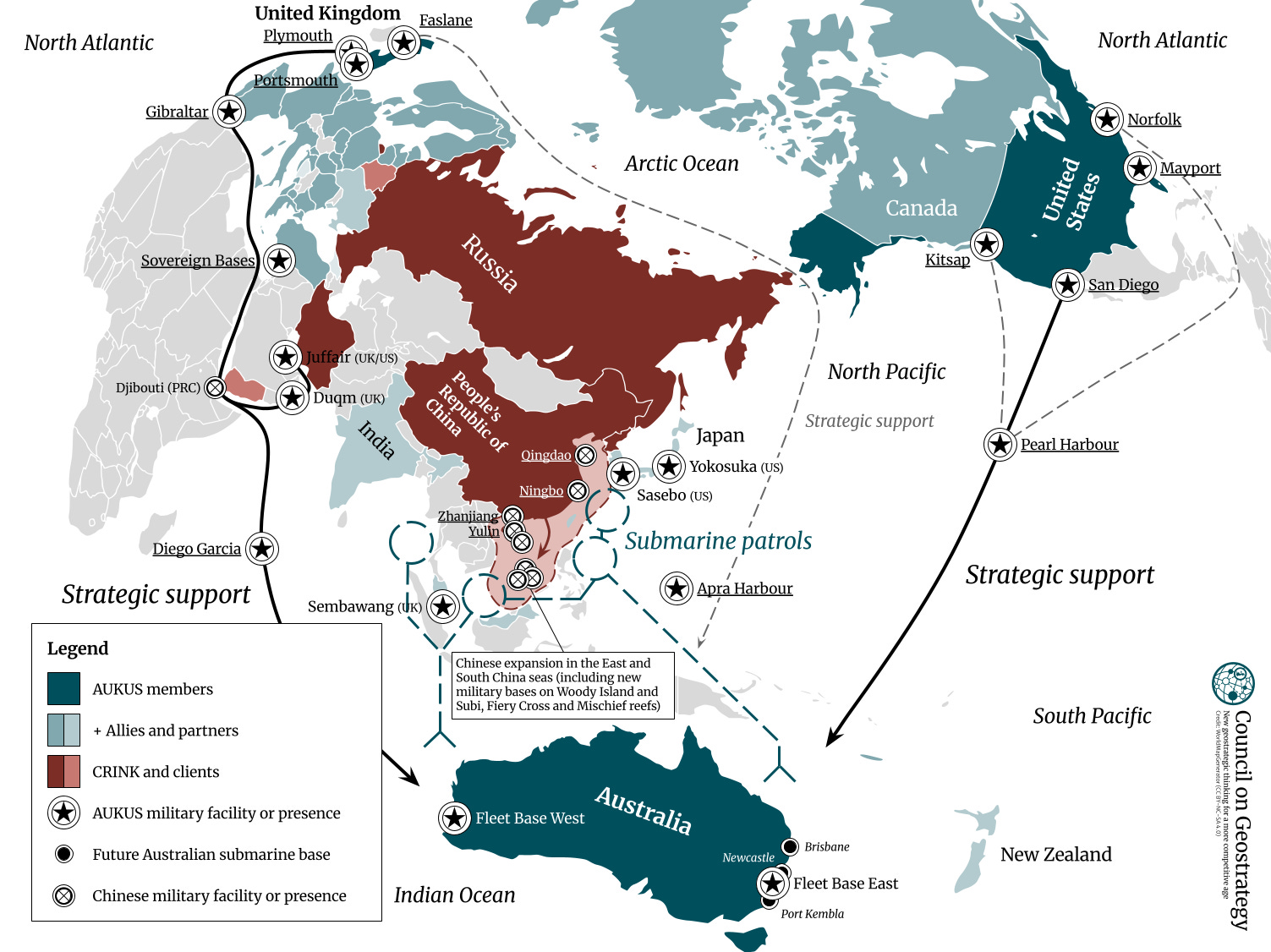
Map 1: The geopolitics of AUKUS
Through AUKUS, the UK and the US are showing that they can deter revisionists not only by sending their own strategic assets into the Indo-Pacific, but also by empowering a vital regional partner. At the same time, by simultaneously focusing on next-generation technologies, the three countries have combined forces to create a more potent ‘technology accelerator’ to compete with the PRC.
A centre of geopolitical gravity
Given the strategic drivers behind AUKUS, the future of the trilateral partnership looked bright in late 2021 and early 2022, and continues to do so in 2026 with the three defence secretaries’ announcement. Looking ahead, perhaps the biggest question is whether the arrangement will remain exclusive, or whether it serves as the beginning of a more systemic rearrangement of geopolitics in the Indo-Pacific, and even, the Euro-Atlantic.
Despite not being a formal alliance, AUKUS generates a centre of geopolitical gravity based on shared interests and deep trust to convene – even align – other UK, US and Australian allies and partners. Indeed, as early as October 2021, Gen. Sir Nicholas Carter, former Chief of the Defence Staff, indicated that AUKUS will not necessarily remain exclusive, even if future members decide not to partake in nuclear submarine cooperation – which, in any case, may turn out to be of secondary importance compared to future Pillar II collaboration.
Canada and New Zealand – the other Five Eyes partners – could almost certainly get involved in AUKUS, particularly in terms of Pillar II’s advanced scientific research, even if the New Zealanders are averse to the military application of nuclear technology. Other countries, particularly Japan, could also potentially align with AUKUS, not least because of the closeness between the US and Japan, as well as between Australia and Japan, but also due to the emergence of the ‘quasi-alliance’ between London and Tokyo.
Given how AUKUS will support Britain’s posture in the North Atlantic, it is conceivable that it will become central to the Joint Expeditionary Force and NATO, particularly as Gen. Gwyn Jenkins, First Sea Lord, develops the New Hybrid Navy, the Atlantic Bastion, Shield, and Strike concepts, and the Northern Navies Initiative, with key Northern European allies. Indeed, the technologies generated through Pillar II may become indispensable to deterrence in the North Atlantic.
Conclusion
AUKUS has successfully bridged the traditional divides between regional theatres, establishing a sophisticated regulatory and technological ecosystem that links the Euro-Atlantic and the Indo-Pacific. By connecting the industrial bases of the UK, the US, and Australia, the partnership does more than simply project naval power into the Indo-Pacific; it establishes an enduring bulwark designed to ensure that autocratic rivals do not dictate the rules of the 21st-century international order.
James Rogers is Co-President (Research) of the Council on Geostrategy.
A previous version of this article was published in January 2022. This is an updated version.
To stay up to date with Britain’s World, please subscribe or pledge your support!
What do you think about this Memorandum? Why not leave a comment below?