

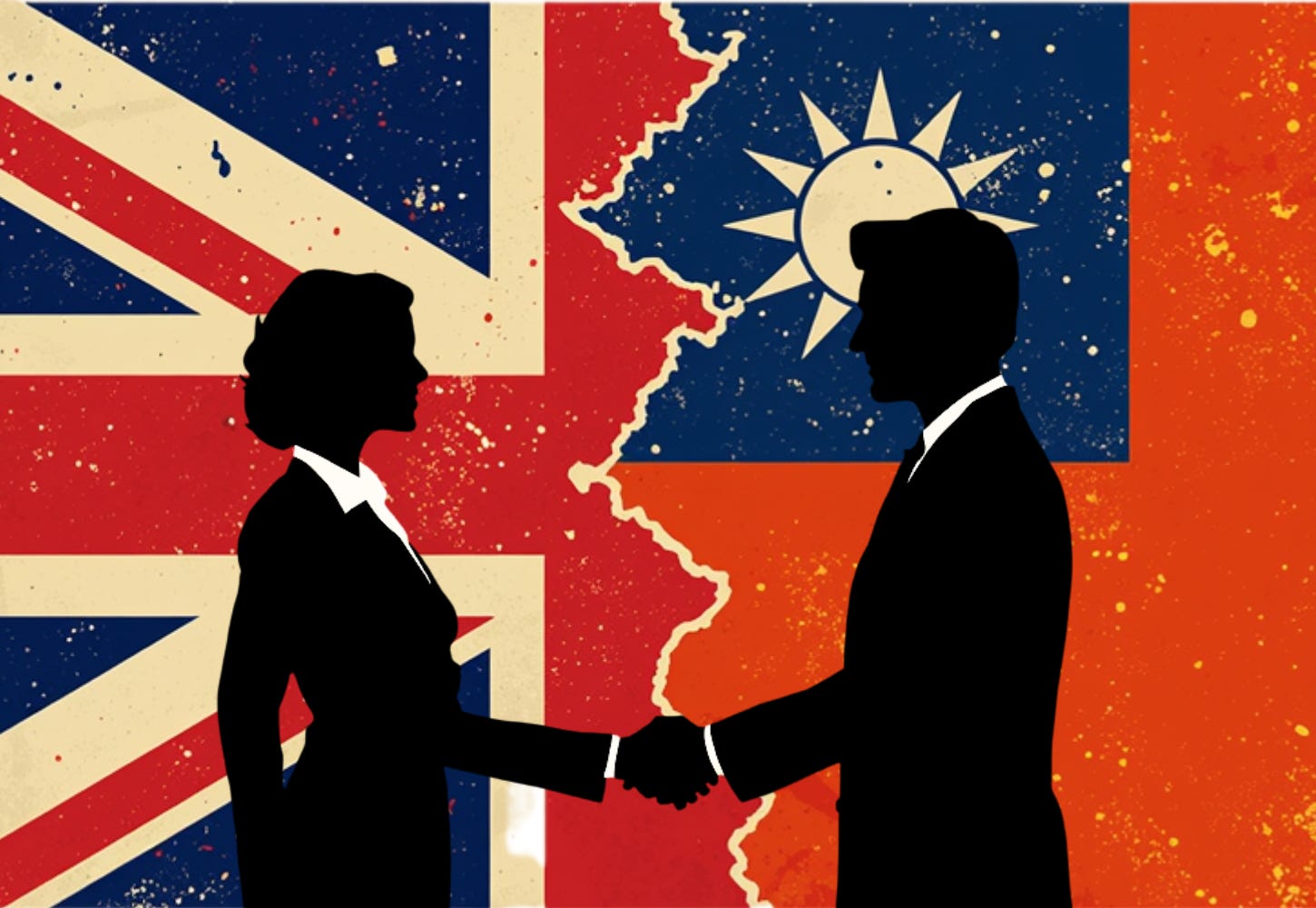
Ahead of the visit of Donald Trump, President of the United States (US) visit to the People’s Republic of China (PRC), Beijing signalled its intent to push him to ‘oppose’ Taiwan independence explicitly. Meanwhile, Marco Rubio, US Secretary of State, maintained that Washington would stick with its longstanding position – which has traditionally been: ‘we do not support Taiwan independence’ (although the Trump administration removed this particular wording from its website).
Given Trump’s highly personalistic and unpredictable approach to diplomacy and dealmaking, there was no guarantee that he would not go off script. As ever, the President chose his own words when speaking to Fox News: ‘I’m not looking to have somebody go independent…I want them [Taiwan] to cool down’ (and adding ‘I want China to cool down’, alongside other loose language on arm sales to Taipei).
…had Trump opted to utter ‘we oppose Taiwan independence’, Beijing’s efforts to shift the blame for cross-strait instability onto Taipei would have been bolstered, and unwarranted legitimacy would have been lent to the CCP’s expansionist territorial claims.
The distinction is a fine one, and a change of wording would not have altered anything on the ground: Taiwan would have remained independent. But had Trump opted to utter ‘we oppose Taiwan independence’, Beijing’s efforts to shift the blame for cross-strait instability onto Taipei would have been bolstered, and unwarranted legitimacy would have been lent to the Chinese Communist Party’s (CCP) expansionist territorial claims.
Indeed, many countries in Africa and Asia have put on record their opposition to Taiwanese independence (and given a green light for a Chinese war to annex the island). Yet, the US to one side, Taiwan’s other partners – including the United Kingdom (UK) – are not publicly pressed to alter their wording and ‘oppose’ Taiwanese independence. His Majesty’s (HM) Government standard line is:
We consider the Taiwan issue one to be settled peacefully by the people on both sides of the Taiwan Strait through constructive dialogue, without the threat or use of force or coercion. We do not support any unilateral attempts to change the status quo.
Without reading too deeply between the lines, it can be inferred that HM Government does ‘not support’ Taiwan independence – that is an act, such as revising the Republic of China’s constitution, that would make Taiwan de jure independent – because such action would have to be unilateral in practice. Beijing would never acquiesce to it.
Yet, at the same time, HM Government does not appear, in principle, to be opposed. Rather, with the emphasis on a final settlement being arrived at ‘peacefully’ the point does not seem to be the outcome, whether independence or unification, but on the process.
In 2022, Ben Wallace, then Defence Secretary, muddied the waters when he told the House of Lords International Relations and Defence Committee that ‘it is in China’s plan to reunify Taiwan to mainland China...[and] Britain wants a peaceful process towards that.’
Wallace quickly rowed back these words, in a letter to the committee’s Chair, and repeated HM Government’s familiar formulation that ‘the contested status of Taiwan must be resolved peacefully’. He wrote ‘My position is most emphatically not, as you believe my remarks suggested, that “Taiwan must expect to be absorbed into the PRC and, inter alia, has no independent legitimacy”.’ Yet, a few paragraphs further down, Wallace also spoke of the UK’s longstanding and unchanging policy on Taiwan being ‘reflected in the Cairo Declaration’…
This declaration – that, in 1943, pledged to restore Taiwan to China from Japanese rule – has, however, been noticeably absent from modern HM Government statements. In neither its 2000 submission nor its 2024 response to the House of Commons’ Foreign Affairs Committee did the Foreign, Commonwealth, and Development Office (FCDO) mention this wartime commitment in exposition on Britain’s Taiwan policy.
If the stipulation is that neither force nor coercion should be used, then is it not the position of HM Government that any fundamental change to the cross-strait status quo must be one that has the consent of the Taiwanese people?
Long may this remain so. The UK should not be in the business of carving up territory with little to no regard for the people living there. The signing over of Poland at Yalta, another Second World War deal of this kind, is rightly regarded as a highly embarrassing and regrettable episode in British diplomatic history. Moreover, any invocation of the Cairo Declaration today stands at odds with HM Government’s belief that cross-strait differences ‘be settled peacefully…without the threat or use of force or coercion.’
If the stipulation is that neither force nor coercion should be used, then is it not the position of HM Government that any fundamental change to the cross-strait status quo must be one that has the consent of the Taiwanese people? Indeed, they may (as polls consistently suggest) never opt for unification, but instead stick with maintaining Taiwan’s de facto independence indefinitely.
Going forward, the UK – definitively ditching the Cairo Declaration (lest Beijing seize on any regurgitated reference to this pledge) – should make this point clear: that it is ultimately up to the people of Taiwan, living as they do in a democracy, to decide their future.
While often unsaid, the will of the Taiwanese populace has long been a concern of British governments. On 11th May 1951, when pushed on how a settlement across the Taiwan Strait might be brought about, Herbert Morrison, then Foreign Secretary, told Parliament: ‘I think it is clearly desirable that the wishes of the inhabitants of Formosa [Taiwan] should be taken into account’.
Articulating such a view now would help to counter Beijing’s intensifying efforts to dictate the global narrative in which Taiwan is presented as an ‘internal matter’, the rights of the people there erased, and unification established as a historical inevitability. Such lines, if unchallenged, will only breed fatalism in Taiwan, aiding the CCP’s efforts to break the psychological will of the Taiwanese people and secure victory without a fight. Meanwhile, if this narrative takes hold, the costs of a conflict for Beijing will have been lowered – with an act of annexation unlikely to invoke the same global disdain as Russia’s full-scale invasion of Ukraine.
Fully articulating this point, about the wishes of the Taiwanese, is also a good reminder to the world that Taiwan is not a mere ‘problem’ or ‘issue’ (or, indeed, a bargaining chip) but a country of 24 million people.
At a time when the leader of the free world cannot be relied upon to articulate the rights and wrongs of an international dispute, it falls upon Britain and like-minded nations to step up and do so. The UK can continue not to support any unilateral alterations to the status quo. However, going forward, HM Government should assert that cross-strait differences must be settled peacefully, without the threat or use of force or coercion – and with the explicit democratic consent of the people of Taiwan.
Gray Sergeant is Research Fellow in Indo-Pacific Geopolitics at the Council on Geostrategy.
To stay up to date with Britain’s World, please subscribe or pledge your support!
What do you think about this Memorandum? Why not leave a comment below?
It is up to the Taiwanese people to determine their future, whether with the mainland or not - a referendum of such an important decision would b need a clear majority of the Taiwanese; this should be the British perspective. US bullying, especially by Trump's periodic hysteria, is not helpful to anyone but the CCP.