

On 13th October 2025, the container vessel Istanbul Bridge pulled into Felixstowe, the United Kingdom’s (UK) principal container hub, loaded with nearly 5,000 containers of Chinese goods. On the face of it, the arrival would appear unremarkable; just one among thousands of ships arriving in British ports each year from the People’s Republic of China (PRC). Yet, the voyage marked a meaningful shift: rather than following traditional trade lanes, Istanbul Bridge had traversed the Northern Sea Route (NSR). Skirting the Arctic coast of Russia, this is an emerging corridor that promises to change global shipping and trade.
With global economic pressures and shipping frequently restricted in the Red Sea, the temptations of the NSR as a shortcut to Europe will only become stronger. It is generally 30-40% quicker than sailing from East Asia to Europe via the Suez Canal, and even more so than sailing south around the Cape. To illustrate this, the voyage of Istanbul Bridge took just 20 days, compared to the traditional Suez route of approximately 40-50 days.
The UK, and its allies and partners in Europe, cannot afford to normalise the transit of merchant ships to and from its ports sailing via the NSR. Doing so poses a strategic risk which could play out against Britain in future.
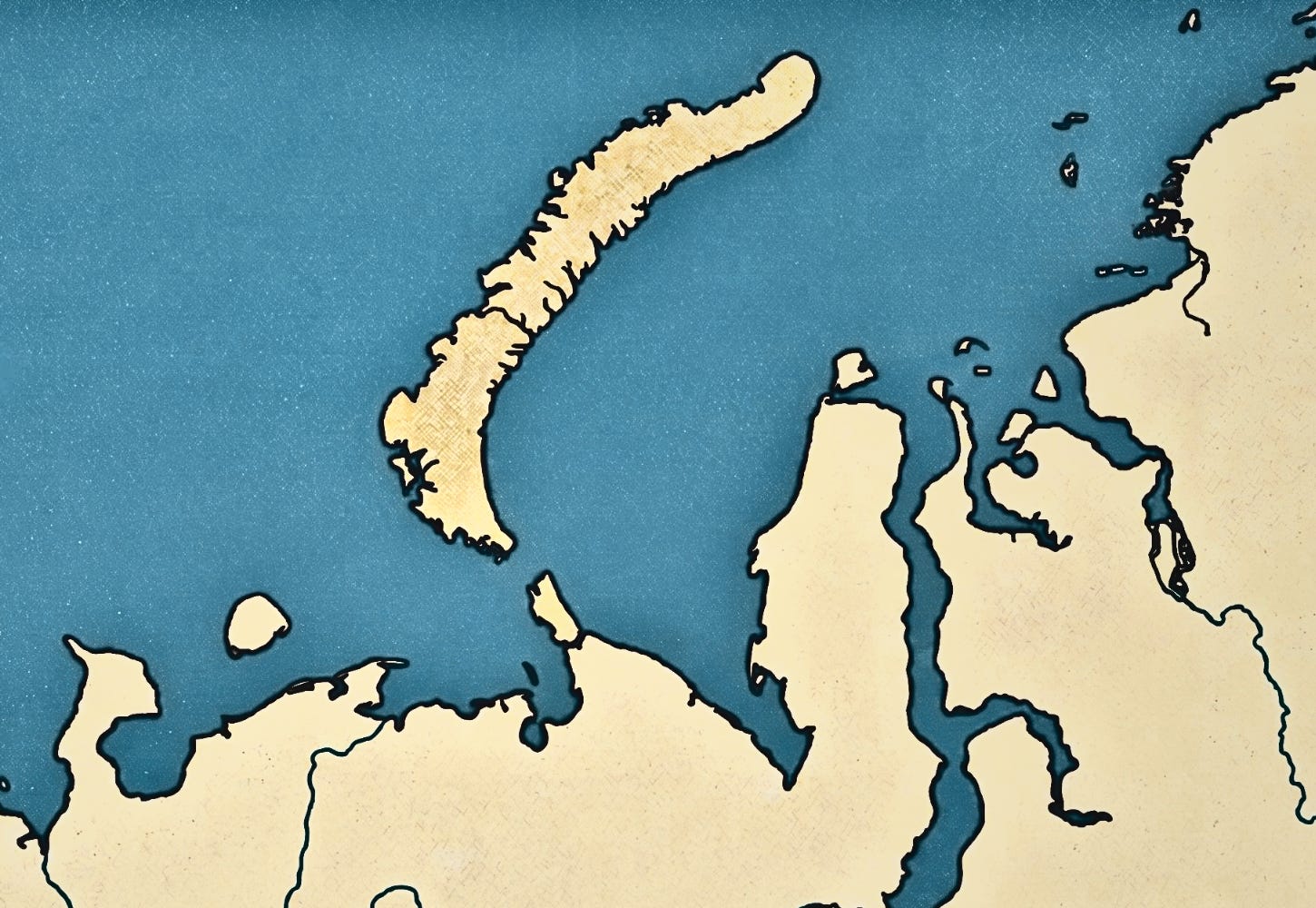
Sailing towards Britain and Europe, the NSR starts at the Bering Strait between Russia and Alaska, and travels across the top of Siberia via several natural chokepoints before arriving at the narrow waters of the Kara Strait to enter the Barents Sea. From there, Europe is just around the tip of Norway.
The potential similarities between what Iran can do to the Strait of Hormuz and what Russia can do to these chokepoints, particularly the Kara Strait, cannot be understated. The UK, and its allies and partners in Europe, cannot afford to normalise the transit of merchant ships to and from its ports sailing via the NSR. Doing so poses a strategic risk which could play out against Britain in future.
Geography of the NSR
The NSR is typically navigable from July to November, with the best ‘open water’ conditions (when there is essentially no ice on the route) in September and October. While climate change is making the route more viable, yearly variance remains.
The entirety of the NSR can be viewed as restricted due to the requirement for icebreaking and its several natural chokepoints as it passes between islands and the mainland. However, the Kara Strait at its western end poses a particular problem. This narrow channel is formed by the gap between the large and barely populated island of Novaya Zemlya and Vaygach Island – which lies mere kilometres (km) from the Russian mainland across the Yugorsky Strait – and connects the Kara Sea in the east to the Barents Sea in the west. It is just 56km wide and only about 100 metres deep in most places.
The Yugorsky Strait, parallel to the Kara Strait but further south, is an even narrower passage. It is only 3km wide in places, and even shallower – between 13 and 36 metres deep. It is ice-covered most of the year and, to the extent that it can be used as an alternative to the Kara Strait for smaller vessels, it has all the same downsides.
During the height of summer, some vessels may attempt to bypass the Kara Strait by rounding the northern tip of Novaya Zemlya. This offers only limited strategic advantages, however, as the route extends far deeper into the Arctic, exposes shipping to substantially harsher ice conditions – and remains no less vulnerable to Russian surveillance and interdiction.
Last year, just over 100 vessels transited the NSR, with 52 passages from east to west, and 51 going the other way. Virtually all the traffic was between Russian ports (including Kaliningrad and St. Petersburg) and the PRC and South Korea, with the voyage of Istanbul Bridge being an anomaly.
Vulnerability of the NSR
As the strangulation of the Strait of Hormuz and the Houthi disruption of the Bab-el-Mandeb Strait show, international shipping is particularly vulnerable to bad actors if it must sail through constricted waters. As the world sails away from global norms, the idea of a rules-based order, and freedom of navigation, shipping lanes which pass close to regional powers can be placed at their mercy. These chokepoints are devilishly easy to shut with the mere threat of military force, and fiendishly difficult to reopen.
Russia could, under circumstances of its choosing, throttle or block the NSR if European nations become addicted to cheap imports via this route, and the cost savings are quickly priced into their economies. Subsequent moves to constrict the flow of goods would have an immediate economic impact that would be felt by consumers.
More concerning still, any ships which were at that moment sailing across the top of Siberia would become hostages, trapped in the inhospitable and sparsely populated north where they could not realistically be rescued. The sense of urgency would grow as winter approached, forcing sailors to seek shelter in the handful of Russian ports on the Siberian coast.
Russia’s options in the NSR
Like the Strait of Hormuz, the Kara Strait is naturally vulnerable to naval mines and, as seen with Hormuz, very few mines would need to be sown. Additionally, any ship in the Kara Strait is within easy reach of Russian missiles and aircraft. While North Atlantic Treaty Organisation (NATO) assets could operate in the Barents Sea, geography would not be on the alliance’s side in trying to keep the Kara Strait open; it is over 1,000km from the nearest Norwegian port.
Russia could exert pressure via the Kara Strait even in peacetime. The legal arguments for Russian sovereignty over the NSR are already in place. There have been several declarations by the Kremlin regarding the route, including 2020’s ‘The Rules of Navigation’ which insist, among other things, that ships request a permit to be allowed to use the NSR. In Russia’s mind, the route is its private waterway, technically regarded as an ‘inland waterway’ in the same way as the network of rivers and canals which criss-cross the western side of the country.
With the NSR, Russia could, in the near future, be given an easy point of leverage over British and European foreign policy – for example, in a scenario in which it was placing pressure on the Baltic states, Moldova, or elsewhere.
The UK and other free and open nations should – and do – dispute this on legal grounds. However, it does present Russia with justifications which can be used to exert leverage over east-west trade using the NSR, regardless of whether they have any legal merit.
With the NSR, Russia could, in the near future, be given an easy point of leverage over British and European foreign policy – for example, in a scenario in which it was placing pressure on the Baltic states, Moldova, or elsewhere. A calibrated disruption, such as a partial closure of the Kara Strait or the detention of select vessels, could serve as a coercive signal, diverting attention and imposing economic friction while constraining operational freedom at a critical moment.
Risks for Britain
Speaking at the Defence Committee inquiring to defence in the High North, Dr Marc De Vore of the University of St. Andrews’ School of International Relations noted that ‘under those situations, Russia’s interest in the High North and North Atlantic is putting us in a position where we cannot react, and where we cannot support our Eastern European allies.’ As the UK looks to an uncertain future – but one where Russia is likely to remain a threat or potential threat for some time – handing the Kremlin such an advantage would be a grave error.
The Kara Strait is not the only lever available, but it represents a novel one, enabled by shifting trade patterns and the gradual normalisation of Arctic transit. Free and open nations could thus find themselves outmanoeuvred in new ways only possible by circumstances of their own making. Britain has a choice, but it must find ways to avoid becoming dependent on purely short-term economic interests arising from a situation that will be hard to retreat from.
H I Sutton is a writer, illustrator and analyst who specialises in submarines and sub-surface systems. He is also an Adjunct Fellow at the Council on Geostrategy.
This article is part of the Council on Geostrategy’s Strategic Defence Unit.
To stay up to date with Britain’s World, please subscribe or pledge your support!
What do you think about this Memorandum? Why not leave a comment below?
We need to reign in our national debt so we are able to take advantage of these sorts of opening opportunities without being so vulnerable to temporary trade restrictions. If we had a budget surplus as standard, and a total debt far below current levels, then a bit of Keyensianism could support living standards and give us more room for maneuver in a case like the one described.
Great article, very interesting
Hi All. Explaining NATO in plain language. 32 nations. Real world perspective.
Weekly issues. Daily updates.
Would love to connect with you