

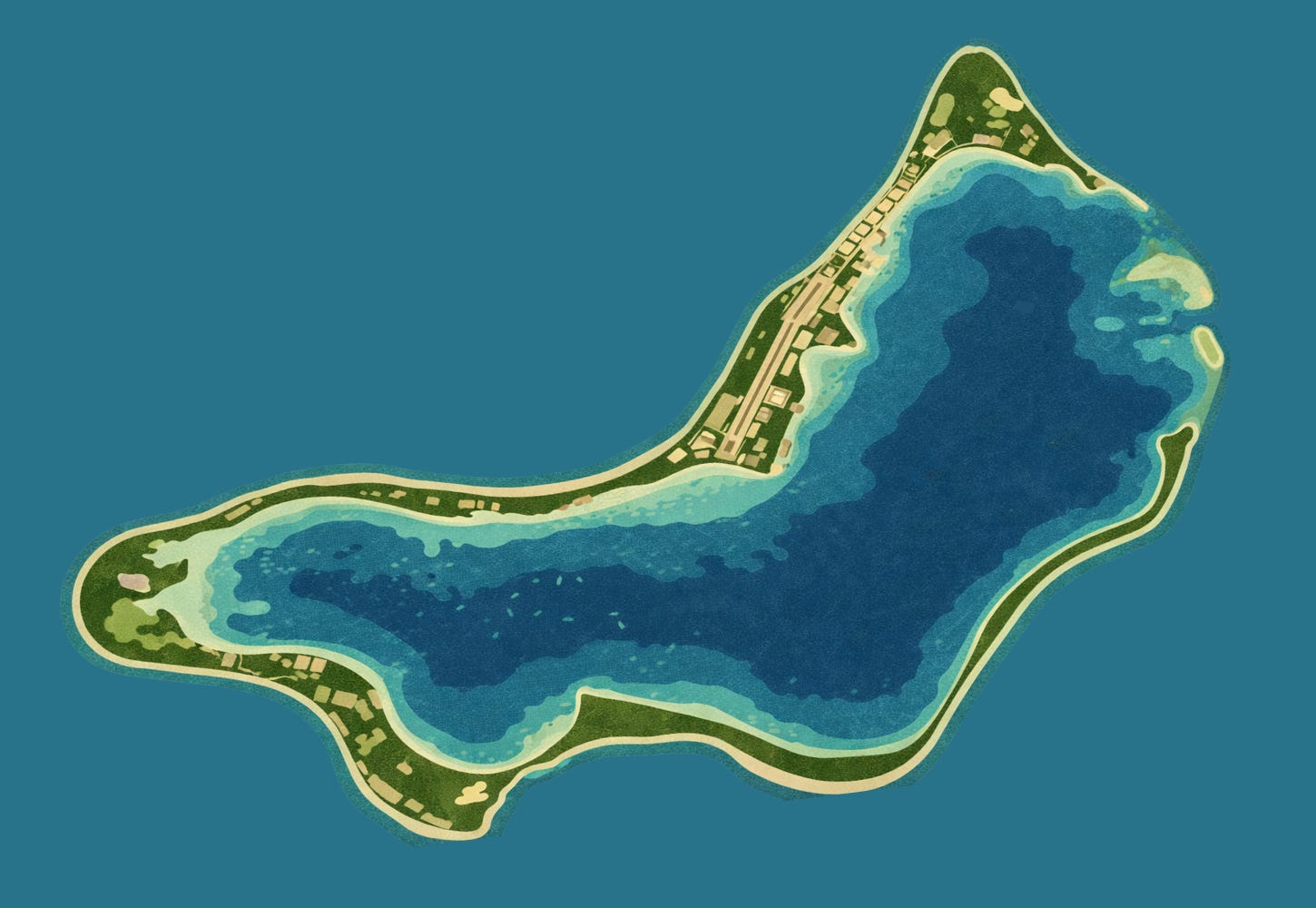
The British Overseas Territories are currently receiving an overdue public appraisal. Recent Iranian attacks on the United Kingdom’s (UK) territories in Cyprus and Diego Garcia follow in the wake of a contentious agreement to cede sovereignty over the latter. Critics of the British Indian Ocean Territory (BIOT) deal allege the UK’s strategic naivety, succumbing to lawfare and diplomatic statecraft spearheaded by Russia. These events are symptomatic of both a deteriorating global order and intensifying international competition.
Strategic choices
The precedent set through the recognition of Mauritius’ claim to the BIOT could undermine the position of other British territories, including the Sovereign Base Areas in Cyprus. Like the BIOT, these airfields were also retained upon the recognition of independence of a former Crown Colony. Unlike the American-operated base on Diego Garcia, however, they are home to British military and intelligence operations, and have performed a key staging role for the UK’s operations in the Middle East for decades.
In an era of renewed contest between states and an unreliable hegemon in the United States, the ability to defend norms, alliances, and claims of sovereignty requires both a reserve of strategic power and the capacity to wield it.
While the Cyprus bases have been controversial locally for some time, Tehran’s attacks and inadequate British defences have increased their perceived liability to the Cypriot authorities. Nikos Christodoulides, President of Cyprus, labelled the bases a ‘colonial consequence’, requiring ‘frank discussion with the British government’. Meanwhile, Emmanuel Macron, President of France, wasted no time in visiting the island to emphasise a new French-Cypriot strategic partnership, declaring that the island ‘can count on France’.
In an era of renewed contest between states and an unreliable hegemon in the United States (US), the ability to defend norms, alliances, and claims of sovereignty requires both a reserve of strategic power and the capacity to wield it. Macron backed up his rhetoric with 11 French Navy warships deployed to the eastern Mediterranean and wider Middle East, including the aircraft carrier Charles de Gaulle. Strategic autonomy extends beyond military power, with France benefiting from a long legacy of policy to develop and guard industrial champions in critical sectors.
The UK is fortunate that its allies – including France, Greece, and the US – were able to assist with the defence of Cyprus. In 2011, Britain deployed a sovereign response group consisting of three amphibious landing ships, a helicopter carrier, a frigate, and two auxiliary supply ships to the island. This exercise served as a demonstration of the UK’s capability at that point to ‘respond at short notice to unforeseen events in an unpredictable and fast-moving world’ as an independent force.
In 2026, additional British aircraft have been deployed to Cyprus, but the struggle to send a single warship to the region illustrates the decline of the Royal Navy. In tasking what few operational ships remain during 2025, His Majesty’s (HM) Government allegedly planned for air defence destroyers HMS Dragon and HMS Duncan to prioritise attendance at North Atlantic Treaty Organisation (NATO) exercises in 2026 and 2027. The hard choices now forced on ministers are the inevitable product of decades of defence cuts, and delays to new ship orders during the austerity years.
Constrained military resources may force yet more trade-offs between commitments to NATO allies and the UK’s national priorities in future, with the Strategic Defence Review (SDR), published in 2025, appearing to commit to both equally. The SDR is clear that ‘Role 1’ for the British Armed Forces is to defend and protect Britain, its Overseas Territories, and Crown Dependencies, while also adopting a ‘NATO first’ doctrine of commitment to European security in response to the strategic challenge posed by Russia.
Sub-threshold threats and drone proliferation
Both the SDR and National Security Strategy (NSS), also published in June 2025, lack depth in their assessments of the Overseas Territories. Beyond commitments to maintaining a military presence in Gibraltar, Cyprus, and the South Atlantic territories, there is little detail on the evolution of sub-threshold and non-military threats in relevant regions, or capabilities required to respond. In contrast, France’s National Strategic Review 2025 details disinformation, malign foreign influence operations, terrorism, and supply chain weaponisation as particular risks to the stability of its overseas territories.
A neat delineation of internal security as an area of local competence, with the UK retaining responsibility for defence, may not be suited to evolving sub-threshold and non-military threats.
The contrasting treatment reflects a different constitutional relationship between France and its overseas territories compared to Britain. Some French territories are fully integrated, operating under the same laws as the mainland with political representation at the Assemblée nationale (National Assembly of the French Parliament). Even for those with greater autonomy, policing and internal security remain reserved matters for Paris, with gendarmes deployed overseas. The UK, however, retains responsibility for only the defence and foreign affairs of the British Overseas Territories.
A neat delineation of internal security as an area of local competence, with the UK retaining responsibility for defence, may not be suited to evolving sub-threshold and non-military threats. The SDR identifies improved resilience to these types of sabotage, influence, and disinformation as an integral area for defence, requiring input from ‘industry, the finance sector, civil society, academia, education, and communities’. Enhanced partnerships could be implemented with local agencies in the Overseas Territories to build the same type of ‘whole-of-society’ resilience envisioned for the home islands.
Britain’s Caribbean territories merit a single mention in the SDR (a commitment to humanitarian and disaster relief), while the equivalent French review paints a more concerning picture. On the potential for expansion of geographical areas of conflict, it states French Caribbean territories ‘in strategic areas with high stakes’ are vulnerable to ‘manoeuvres to control international migration routes, organised crime…[and] regional disputes that could be exploited by adversaries’. It notes increasing collusion between criminals, terrorist networks, and state actors. These threats were subject to a UK Foreign Affairs Select Committee inquiry begun in 2024, but work has not resumed since the general election that July.
Iranian drone attacks on Cyprus serve as a harbinger for a new era of proliferation in drone technology. Beyond states, terrorists and cartels are now exploiting drones and tactics learnt from Ukraine to attack security forces, conduct reconnaissance, and transport illicit payloads. Drone sightings near UK military bases have doubled in the last year, while Russia and Iran have turned to criminals recruited online to carry out sabotage. Britain should prepare for these tactics in its Overseas Territories in light of the strategic Russian threat, as well as collusion with local organised crime.
The role of the River class
Given the island geographies of the Overseas Territories, the capability of the Royal Navy remains paramount. The UK relies on five basic Batch II River class Offshore Patrol Vessels (OPVs) to protect the Overseas Territories, with a small simple gun and no hangar for the Wildcat helicopters recently deployed to Cyprus to shoot down Iranian drones. Three older Batch I River class OPVs patrol British home waters at an increasing tempo in response to heightened activity by Russian naval, intelligence-gathering, and ‘shadow fleet’ shipping. The March 2026 commitment by His Majesty’s (HM) Government to seize shadow fleet ships is illustrative of greater future demands on the Royal Navy in the UK’s home waters.
Maritime and aerial drones can be countered with cost-effective modern medium-calibre guns planned for five new Type 31 frigates. The Type 31s are planned to forward deploy overseas to protect global British interests, but the ‘immediate and pressing threat’ of Russia could derail this. With anti-submarine Type 26 frigates under construction now allocated to Norway, the three Batch I River class vessels decommissioning in 2028, and persistent issues with submarine and destroyer availability, any remaining Royal Navy surface ships will likely need to deploy in accordance with ‘NATO first’ in defence of Europe.
Given limited resources, HM Government should therefore procure smaller, cheaper ships to provide greater global presence and better protection of British interests, as mooted for a potential Type 32 frigate. Beyond the UK’s home waters, this includes protection of military basing and intelligence infrastructure overseas, and maritime security in the Caribbean.
A potential design might include a helicopter hangar, modern anti-drone armament, and hull-mounted sonar for undersea surveillance, as built into the French ‘Patrouilleurs Hauturiers’ programme of ten vessels. Some of these capabilities could be retrofitted to the five newer River class OPVs for use either at home or further afield. In tandem, the Royal Navy should also optimise the Type 31 frigate to offer greater both offensive and defensive capabilities in the Euro-Atlantic area, rather than for a global patrol role.
Robin Potter is Academy Associate with the UK in the World Programme at Chatham House. His research focuses on policy reform and intervention to improve resilience against sub-threshold challenges.
To stay up to date with Britain’s World, please subscribe or pledge your support!
What do you think about this Memorandum? Why not leave a comment below?
Sadly your words and sentiments continue to fall on deafness and blindness, with copious servings of incompetence. The Falklands are a key issue but not referred to, whereas the Argentinian government is rebuilding its Armed Forces. The defence could be resolved but there has been no political interest in doing so - £billions could be found from so much waste that is all too evident.