

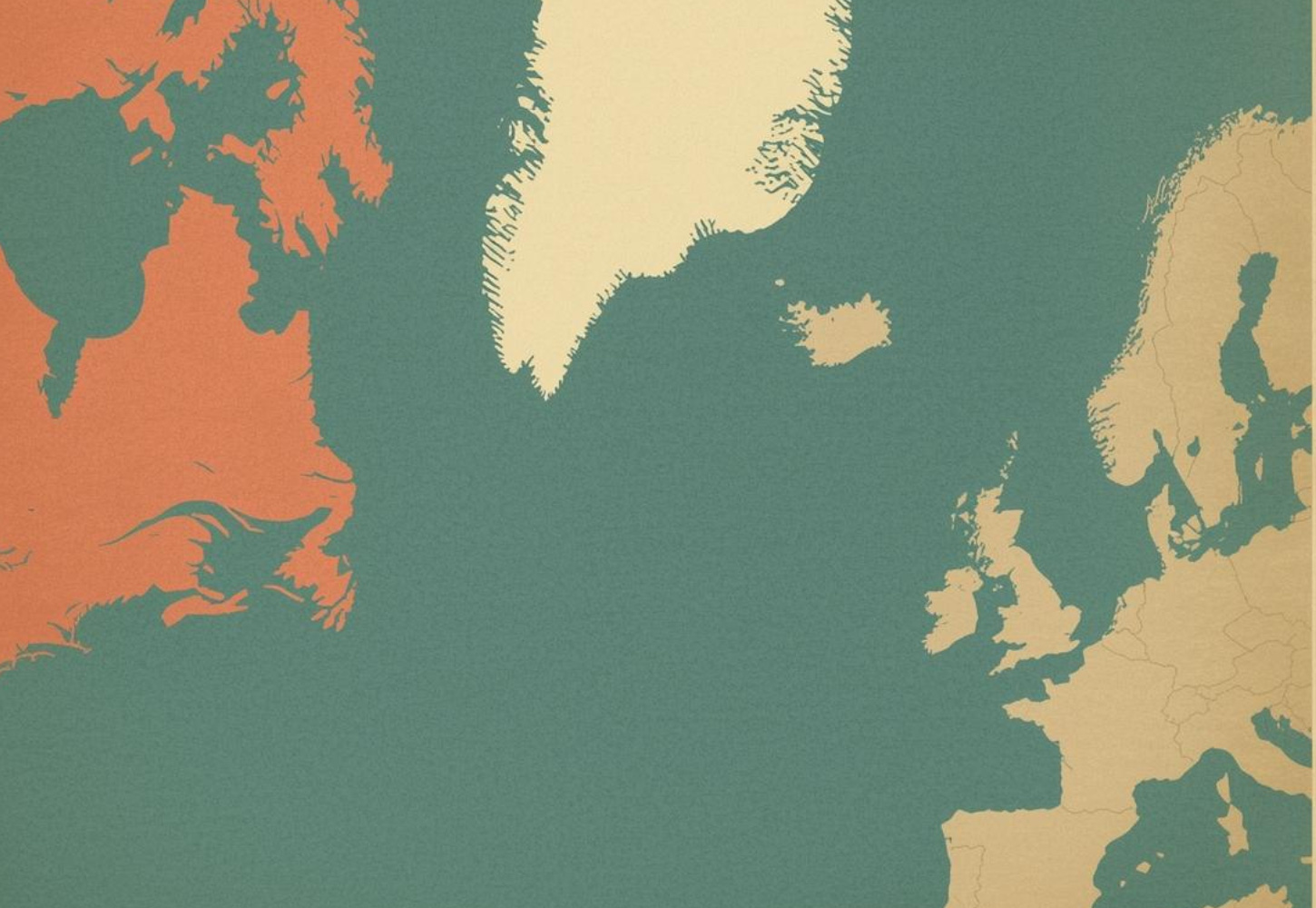
The United Kingdom (UK) stands at a generational inflection point. As the United States (US) reasserts a muscular approach to geopolitics in the Western Hemisphere, and as Russia and the People’s Republic of China (PRC) seek to reshape eastern Europe and the Indo-Pacific, Britain must decide whether it will shape events or be shaped by them. Nowhere is this choice clearer than in the North Atlantic.
Washington’s renewed focus on Greenland, driven by great power rivalry with Russia and the PRC, has brought the Greenland-Iceland-UK (GIUK) gap into acute relief. Greenland, a self-governing island under Danish sovereignty since 1953, holds vast reserves of critical minerals. In an era where maritime supply chains underwrite military strength, the GIUK gap has become the epicentre of strategic competition.
Britain is situated at the southern end of the GIUK gap; one of Europe’s two key critical maritime chokepoints alongside the Strait of Gibraltar. More than just shipping lanes, these are strategic nodes: Gibraltar governs access to the Mediterranean and Suez Canal, while the GIUK gap determines Russia’s ability to access the Atlantic from the Arctic and the US’ ability to reinforce Europe. Both are core spheres of British influence.
What the North Atlantic needs now is a security framework bringing together those whose prosperity and sovereignty depend directly on the GIUK gap: the UK, the US, Iceland and Denmark (including Greenland and the Faroe Islands).
‘Spheres of influence’ are often dismissed by Wilsonians as a relic of imperialism. Yet, this principle has guided the UK’s statecraft for centuries: preventing a single power from dominating the continent and threatening Atlantic Sea Lines of Communication (SLOCs). From the 1588 defeat of the Spanish Armada to the defeats of Napoleon, Kaiser Wilhelm II and Hitler, this logic endured. It rests on an immutable truth: in a multipolar world, interest must take precedence over ideals. Britain must relearn this lesson and apply it to the North Atlantic.
What the North Atlantic needs now is a security framework bringing together those whose prosperity and sovereignty depend directly on the GIUK gap: the UK, the US, Iceland and Denmark (including Greenland and the Faroe Islands). Britain should construct a ‘US-GIUK gap treaty’ grounded in working proactively – not reactively – towards ensuring one another’s national security interests are no longer neglected.
The US’ recent security concerns over Greenland are well-founded, as Russia continues militarising its Arctic territories at pace, increasing its illicit maritime trade in sanctioned oil across the North Atlantic (funding its full-scale invasion of Ukraine), and Beijing takes more and more interest in both commercial and military activity in Greenland. Previous American pushback against Chinese investment plans for Greenlandic airports, fearing dual-use by Beijing, are not without precedent, as seen in Cambodia and Tajikistan – both regional strategic allies of Beijing.
A new defence treaty between the GIUK gap nations and Washington – a ‘Foroe Doctrine’ – would rightly recognise that North Atlantic security is a shared responsibility. Named in recognition of the Faroe Islands’ centrality to the GIUK gap and echoing the Monroe Doctrine of 1823, it would recognise the North Atlantic as a distinct security space in which the four signatories hold responsibility for stability, resilience and deterrence of the region.
Its purpose is to keep the US in, not out. The surest way to keep unilateral rhetoric towards Greenland off the table is to channel American power into a cooperative architecture. As Thomas Jefferson enunciated of the UK’s support for the original Monroe Doctrine two centuries ago, ‘Great Britain is the nation which can do us the most harm; with her on our side we need not fear the whole world’. In the same spirit, a Foroe Doctrine would bind Washington to a North Atlantic compact, turning Greenland from a potential object of contention into a pillar of collective resilience.
To secure American buy-in, and avoid duplicating existing frameworks such as the North Atlantic Treaty Organisation (NATO) or the Joint Expeditionary Force (JEF), the treaty should deliver operational substance. It should operationalise a model that the US has applied successfully in the Indo-Pacific – playing the PRC at its own game. Similar to the ‘Squad’ – a quadrilateral security framework comprised of Australia, Japan, the Philippines and the US, designed to increase interoperability and protect partner Exclusive Economic Zones (EEZs) against Chinese aggression – a US-GIUK gap model could field a hybrid, multinational white hull coast guard. Under British leadership, this force would:
Monitor and protect Critical Undersea Infrastructure (CUI);
Interdict illicit maritime activity and ensure ‘shadow fleet’ sanction enforcement;
Provide a route to market for industry-developed Artificial Intelligence (AI) sensors and autonomous platforms to enhance detection;
Operate in extreme Arctic environments; and
Provide a persistent, scalable presence below the threshold of armed conflict.
The framework for such a renewed doctrine should encompass a new UK-led, JEF-compliant military task force, forward-deployed on a permanent rotational basis in Greenland, and separate to the existing American and Danish military operations on the island. This task force should be centred around British and Danish troops providing the first line of deterrence against any future incursion or annexation by a foreign power.
Such a deployment should evolve within five years to include a naval and air base on the island to be able to scale up troop numbers in times of crisis while still maintaining a permanent presence. It should include a Royal Navy frigate making regular anti-submarine patrols around Greenland, and a discussion on how to replicate NATO’s air policing mission in Iceland, with Icelandic authorities working alongside British, Danish and American counterparts to provide a similar capability on Greenland.
Deploying multinational white hull convoys to dominate the GIUK gap, supported by US Coast Guard key enablers, such ‘cutters’, would provide an asymmetric advantage in enforcing UNCLOS against Chinese and Russian military and commercial vessels.
This strategy would deliver three immediate benefits. First, it strengthens the UK’s strategy by reinforcing the Royal Navy’s ‘Atlantic Bastion’ concept across the full spectrum of armed conflict. It also opens market access to Denmark, Iceland and the US for the development and testing of bespoke defence capabilities in a climatically hostile environment, driving innovation and interoperability. By incorporating Denmark, it further extends anti-submarine capabilities and Maritime Domain Awareness (MDA) westward, securing the GIUK gap and constraining Russian access from the Arctic. This approach not only enhances deterrence, but positions Britain as the indispensable actor of North Atlantic security.
Second, it would improve the defence of Greenland, the Faroe Islands and Iceland – territories increasingly exposed to Russian and Chinese interference but lacking the military capacity to counter it alone. Iceland, with no standing military, would particularly benefit from a consistent presence. Deploying multinational white hull convoys to dominate the GIUK gap, supported by US Coast Guard key enablers, such ‘cutters’, would provide an asymmetric advantage in enforcing the United Nations Convention on the Law of the Sea (UNCLOS) against Chinese and Russian military and commercial vessels. Iceland’s experience in the ‘Cod Wars’ emphasises a hard truth: maritime disputes do not necessarily favour the stronger military. This approach would also mirror the PRC’s Indo-Pacific strategy, denying Beijing any credible counter-narrative.
Third, it demonstrates to a sceptical Washington that Europe is stepping up, and not only to secure its own region. By defending maritime approaches to the American East Coast, it is acting in the interests of US national security – reaffirming Britain as America’s strategic partner of choice in the North Atlantic.
The criticism should not be that the US sought to revive a ‘Monroe Doctrine’ for the 21st century, but that European nations failed to offer one of their own. For major powers, spheres of influence never went away. The Europeans’ failure was not that Washington considered a Monroe-style doctrine for the Arctic, but that they lacked their own doctrine. In that vacuum, unilateral rhetoric supplanted collective resolve. A Foroe Doctrine would correct this imbalance, anchoring Washington to a mutually beneficial compact which asserts responsibility and sovereignty, deters interference and reminds of a lesson which European nations were quick to forget: the immutable reality that geopolitics ultimately rests on power.
Robert Clark is a Visiting Fellow at the Council on Geostrategy and a Fellow at the Yorktown Institute in Washington D.C. He served in the British Army for 10 years.
To stay up to date with Britain’s World, please subscribe or pledge your support!
What do you think about this Memorandum? Why not leave a comment below?
Solid concept.
I would suggest that a minimum of 2 ASW frigates involved at a time would be better, with one patrolling around Greenland and the other between the UK and Iceland.
With the new Type 26 frigates coming online, this is a real value the RN can offer... and if Canada were to be added into the framework, their River-class variant would be a great compliment, and could allow for an increase in the surface ship ASW patrol presence.
I see no advantage for the U.S. to not pursue it alone, what added value can the U.K. provide apart from "sitting there and be pretty?"