

After the collapse of the high-profile Chinese espionage case in October, Sir Ken McCallum, Director General of MI5, expressed his frustration over the failure to prosecute the two men accused of spying for the People’s Republic of China (PRC). He also revealed the extent of MI5’s operations in combatting threats from external actors, citing a 35% increase in hostile activity originating from the PRC, Russia and Iran in the past year.
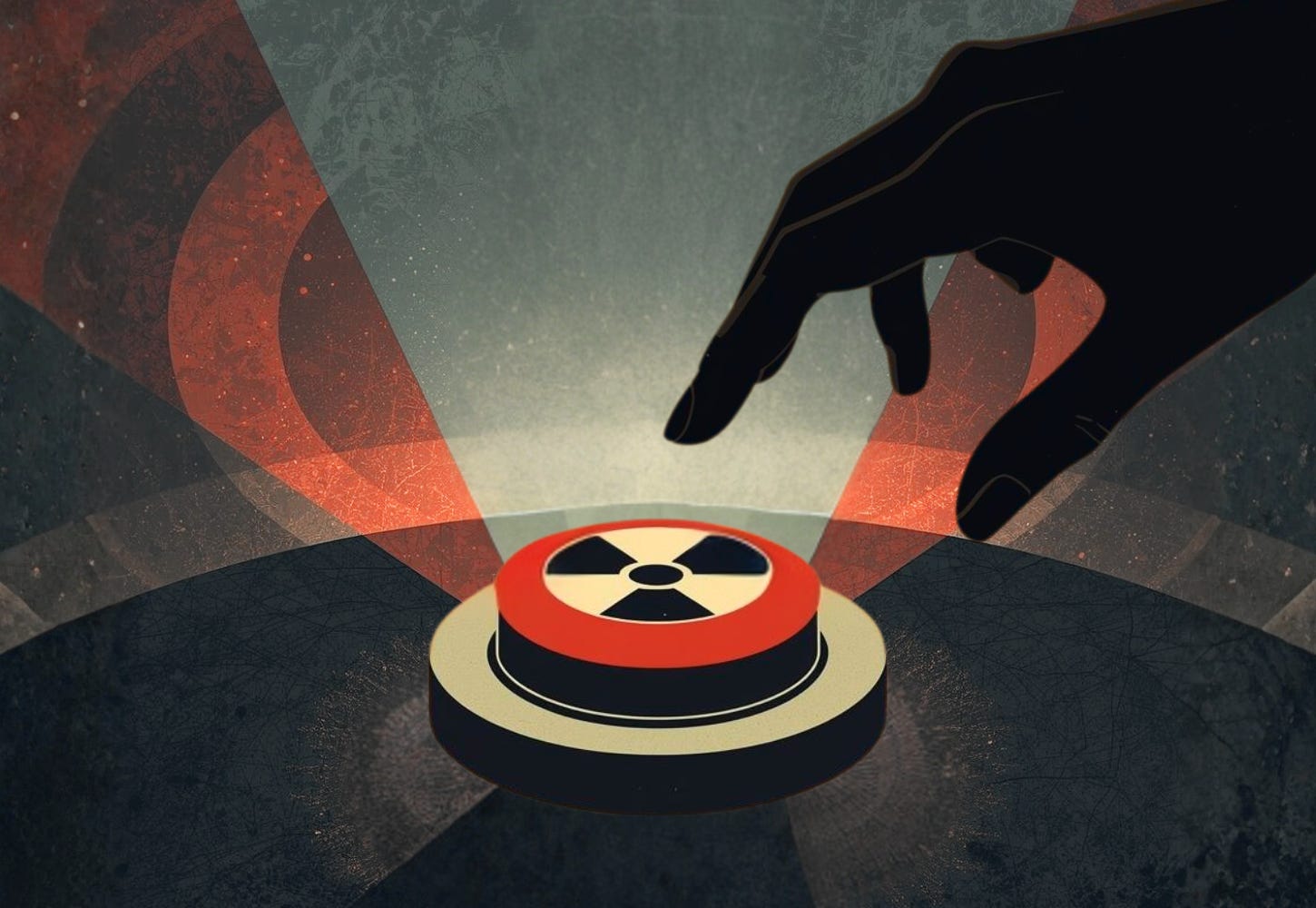
With the inevitable reactions in kind to Donald Trump, President of the United States (US), calling for a renewal of American nuclear testing, and growing alignment between the three aforementioned adversaries and North Korea – the four ‘CRINK’ nations – as well as their associates, the period of global stability enjoyed after the collapse of the Soviet Union in 1991 has come to an end. Considering the increasingly volatile state of the world, for this week’s Big Ask, we asked 12 experts: Are we in a new cold war?
In this article, we make a distinction between the historical Cold War of the 20th century and ‘cold war’ as a concept first described by George Orwell in his 1945 essay ‘You and the Atomic Bomb’.
Council on Geostrategy
Are we in a new cold war?
Yes. When Orwell, Walter Lippmann, Bernard Baruch and other commentators in the late 1940s talked about a ‘cold war’, they meant a period of heightened tension bubbling just below the threshold of all-out great power conflict.
We are in a similar condition today. As Donald Tusk, Prime Minister of Poland, recently said, the North Atlantic Treaty Organisation (NATO) is closer to war with Russia ‘than at any time since the Second World War.’ French and German military and intelligence chiefs have also publicly warned that Russia could attack NATO before the end of the decade.
To make matters worse, William Burns, former Director of the Central Intelligence Agency (CIA), publicly disclosed that intelligence shows Xi Jinping, General Secretary of the Chinese Communist Party (CCP), has instructed his military to be ‘ready by 2027 to conduct a successful invasion’ of Taiwan. More recently, Marco Rubio, US Secretary of State, warned Congress that the US ‘will have to deal with’ the PRC invading Taiwan before the end of this decade.
Orwell thought that nuclear weapons would stop great power confrontation turning into a ‘hot war,’ leading to a permanent ‘peace that is no peace’. His prediction came true, but only just. Despite the prudence that nuclear weapons inspire, the world came frighteningly close to a Third World War on multiple occasions.
Thankfully, the Cold War ended peacefully. However, that does not mean that the new cold war is destined to follow suit.
British Defence Attaché to Ukraine (2008-2011) and Russia (2019-2022)
There is no new cold war: the old one never ended. Orwell was right when he predicted that fear of nuclear annihilation would usher in a ‘horribly stable’ epoch of ‘cold war’, putting an end to large-scale conflicts between major powers at the cost of prolonging – indefinitely – a ‘peace that is no peace’.
Non-peace has driven consistency in Soviet and then Russian behaviour, albeit with a brief respite in the 1990s. As George Kennan, American diplomat and historian, explained in his Long Telegram, like the Soviet Union, Russia strives to undermine the rules-based international order, hamstring its defences, disrupt national self-confidence and stimulate unrest. Rather than being the cause of any disunity, Putinism – like communism – is a ‘malignant parasite which feeds on diseased tissue’.
If there has been continuity in Russian philosophy and approach since 1945, there has been discontinuity in tempo, goals and tools used. The recent uptick in Russian indirect aggression coincides with its strategic catastrophe in Ukraine and attempts to stop European nations supporting Kyiv. New technology, such as drones, Artificial Intelligence (AI) and networked information, present Vladimir Putin, President of Russia, with additional means for political warfare to complement those from the past.
But Russia isn’t the Soviet Union. Putin’s negative, strange ideology is not as attractive as communism. Russia is a declining – if dangerous – power, whatever Putin’s bluster. The small scale of Russia’s current campaign of indirect warfare speaks to its weakness, not strength. Nuclear deterrence still holds.
Founding Director, Centre for Britain and Europe, and Head, Department of Politics and International Relations, University of Surrey
Russia’s subsequent illegal invasions of Georgia, Crimea and Ukraine proper represent successive inflection points, which have tipped European nations and the United Kingdom (UK) into a new cold war era. Added to this is an American abdication from global rules-based structures, and presidential pugnacity newly interested in resuming US nuclear weapons testing ‘on an equal basis’ with Russia and the PRC. This presages a trinity of worrying developments.
First is the tit-for-tat reflexes that accompany any strategic weapons tests. Any American nuclear warhead test, regardless of where it takes place, would likely instigate a response in kind from Russia, the PRC or North Korea. Putin has already ordered Russian officials to draft proposals for possible nuclear weapons tests, arguing that retaliatory steps are an appropriate response to any US tests.
Second is the broader collapse of the arms control architecture by major nuclear powers, after a three-decade moratorium. Unfortunately, the expiration of the New START Treaty limiting deployed strategic warheads in February 2025 increases the chances of slipping back to pre-1960s scenarios – with its wholesale absence of treaties controlling nuclear weapons. The consequences of eroded nuclear governance are already on display. Military buildups in the PRC and Russia are easy targets, but, in truth, all nine nuclear-armed states – including Britain – are currently modernising and expanding their nuclear arsenals.
Third is the clear and consistent engagement by the CRINK nations in systematic and sustained espionage, and determined interference with democracy. These, and other jurisdictions, deploy advanced cyber terrorism against both governments and businesses, as well as old-fashioned sabotage, with increasing skill and frequency.
Taken together, these trends suggest the new cold war era is increasingly aligned with the disruptive principles and violent methods of the Cold War. However, unlike the Cold War’s basic bilateral competition, today’s landscape involves multiple nuclear powers and new vulnerabilities, producing systemic volatility that is now an essential reality rather than merely an existential threat. This is a truly regressive outcome for international relations.
International Fellow, Council on Geostrategy, and Associate Fellow, Royal United Services Institute
Both Friedrich Merz, Chancellor of Germany, and Ulf Kristersson, Prime Minister of Sweden, have referenced ‘You and the Atomic Bomb’ in stating ‘we are not at war, but no longer at peace either.’ Merz used the phrase to describe free and open European nations’ relationship with Russia, while Kristersson applied it to sub-threshold attacks on Sweden.
Orwell’s essay envisioned a prolonged state of hostility between major powers, where the mutual threat of atomic annihilation deterred direct military confrontation. Today, as with the Cold War, major power rivalries manifest themselves through proxy battles, ideological propaganda, espionage and economic pressures, creating a permanent tension which reshapes societies towards securitisation and expanding surveillance.
With the US, Russia and the PRC increasing their nuclear arsenals and arms control collapsing, Orwell’s ‘peace that is no peace’ endures. The threat of mutual annihilation prevents great powers from engaging in direct conflict, but there is a permanent readiness for war. This ‘cold stability’ has metastasised into every realm – conflicts in Ukraine and Gaza where great powers choose sides, deniable cyber and sub-threshold attacks, and an escalating technological arms race which advances missiles with algorithms.
Orwell also warned that such a world would consolidate into an oligarchy. Today’s digital monopolies and surveillance states echo that fear. Control is no longer solely maintained through weaponry but through information: propaganda, data and AI have become tools of governance. The concentration of destructive and technological power in a few hands breeds a global paralysis disguised as peace.
In a new cold war – as great power competition escalates, blocs are formed and strong nations again dominate weaker ones – small and medium-sized economies have increasingly limited room to manoeuvre.
International Fellow, Council on Geostrategy, and Senior Vice President of National Security and Intelligence Programmes, Centre for the Study of the Presidency and Congress
Much as it will chill the hearts of the European adherents of Kantian ‘perpetual peace’, the world today is reverting to its historical geostrategic norm – away from the exception of the last seven decades. The period of the Cold War and the post-Cold War end of history, that time of surprising stability despite conflicts large and small, is ending.
The halcyon days of greater (although by no means constant) strategic predictability are giving way to a time of increasing strategic unpredictability, where states – particularly great powers – are increasingly acting not in the pursuit of abstract ideals, but openly of their core interests.
The US under the second Trump administration is expressly pursuing an ‘America First’ agenda. While Trump’s predecessors put American interests front and centre, they did so more often cloaked under the guise of supporting the rules-based international order built in the wake of the Second World War, husbanded and nurtured by American military and financial largesse. The president’s ambition is to see the US become ‘self-contained’ (and indeed self-sufficient) in its own hemisphere, if rumours of the forthcoming National Defence Strategy’s orientation are to be believed.
Orwell’s 1945 suggestion that a ‘cold war’ of a small number of super-states, possessing atomic weapons, but ‘unable to conquer one another’ is therefore apt. The world is indeed increasingly leaning towards a state of ‘peace that is no peace’.
Honorary Fellow, Council on Geostrategy, and Director, Oxford Strategy, Statecraft and Technology (Changing Character of War) Centre
Periodically, there are accusations against free and open nations from the PRC and Russia of a ‘Cold War mentality.’ Despite denials from the US and European nations, the current geopolitical rivalry between democratic states and authoritarian regimes does seem to indicate that a new form of standoff is underway. There are emerging alignments, which could solidify in the coming years.
There is a persistent arms race, with the PRC rapidly expanding its nuclear arsenal and Russia using threatening nuclear rhetoric. A seminal hot war is also underway, namely Russia’s full-scale invasion of Ukraine, which, like the Korean War, is likely to shape relations between the free and open nations and Russia (as well as its associates) over the coming decades.
There are claims that the more enmeshed nature of global economies means that this cannot be a cold war, but the speed of commercial and scientific decoupling and the hostility demonstrated in recent diplomacy shows that international relations have moved from competition to confrontation and, increasingly, to coercion.
In the Cold War of 1945-1991, the West enjoyed an overwhelming economic advantage, and could afford to contain its rivals. This time, the same ideological and economic certainties are not present. We should not be surprised to find that this is a new form of cold war.
International Fellow, Council on Geostrategy, and Assistant Professor of International Relations, University of Waterloo (Canada)
Regardless of what leaders of NATO member states might want to believe, the Kremlin thinks of itself as being in major conflict with the alliance. Why else would it go about a sustained and deliberate campaign of sabotage and subversion; one which exploits the very openness and pluralism that characterises the Euro-Atlantic community?
The same goes for the PRC. The CCP has little interest in democracy and the rule of law, yet the belief that some sort of economic partnership is mutually beneficial and politically neutral still seems to persist in many NATO capitals.
Although some of the rhetoric in European circles has sharpened against these two authoritarian powers in recent times, NATO members’ actions fall short of what the term ‘cold war’ implies. European countries still purchase enough Russian hydrocarbons to fill Moscow’s coffers. Support for Ukraine as regards to military assistance remains halting and uneven, whereas talk of renewing strategic partnerships with the PRC abounds in some NATO capitals despite the country’s continued enabling of Russia’s ongoing invasion.
Even the second Trump administration has failed to embrace the competitive approach that it adopted in its first incarnation. If there is indeed a cold war, then the countries that make up NATO appear reluctant to wage it.
Member of the Advisory Board to the China Observatory, Council on Geostrategy
There is a significant risk that the Chinese-Western cold war will be different and more unstable from Orwell’s template. The PRC’s economic competition is designed to win it, and thus establish a new Sinocentric world order.
The PRC’s quest to dominate what Xi has called the ‘fourth industrial revolution’, and its drive to build self-reliance and ‘cleanse’ its supply chains began about 20 years ago. Industrial policy, now being carried out on an unprecedented scale, consumes far more of the PRC’s Gross Domestic Product (GDP) than any other nation spends on defence.
Instead of deeper economic integration and mutual dependency between the global east and west, there is now managed economic disengagement, or decoupling, in strategically important and national security-sensitive areas, punctured by periods of more overt disruption.
Free and open nations need to catch up, and do so promptly. Commercial tensions in the pursuit of resources, exports, markets, supply chains and standards in a fragmenting world are liable to intensify, and they may also do so with important emerging and middle-income countries, keen to protect their own industrialisation and local industry programmes.
Both the PRC and the free and open nations are pursuing, in the words of Edward Luttwak’s reflections on trade wars many decades ago, the ‘logic of conflict in the grammar of commerce’. However, they are doing this with the intention to prevail, not to balance one another out.
Postdoctoral Researcher, King’s College London
While it is unwise to force any historical period into a rigid theoretical frame – thereby narrowing the ability of policymakers and scholars to discern its subtleties – Orwell’s idea of ‘cold war’ nonetheless contains elements that echo in today’s geopolitical climate.
During the historical Cold War, the dynamics of nuclear deterrence and superpower rivalry were more pronounced than they were in the years immediately following the collapse of the Soviet Union in 1991. Yet, these dynamics never disappeared. Instead they evolved, drawing in new states seeking to join the nuclear club and broadening the relevance of Orwell’s observations.
What can be seen today is not a ‘new’ cold war in an Orwellian sense, but rather the continuation of a strategic condition which has persisted since the Trinity nuclear test of 1945 and the subsequent atomic bombings of Hiroshima and Nagasaki. This continuity is evident in the enduring centrality of nuclear arsenals to global power projection.
Major nuclear powers, including Russia and the PRC, continue to rely on their nuclear triads and pursue steady modernisation of delivery systems – developments which risk accelerating a renewed arms race in the absence of effective agreements.
Co-founder (Research), Council on Geostrategy
Orwell provided us with the intellectual apparatus to understand that all future periods of sustained geopolitical competition would be cold wars. He recognised that nuclear weapons would prevent the leading states – nuclear powers – from using decisive military force against one another. To do so would result in mutual suicide.
But he also realised that this would not end rivalry; it would merely displace it. Unable to find release through vertical escalation, the great powers would channel competition into every other available domain. Orwell argued that this situation would result in a ‘peace that is no peace’, or a ‘cold war’.
Why have we rejected this elegant concept? For at least a decade, a plethora of terms have been invented to account for the new era of competition: ‘hybrid warfare’, ‘“grey-zone” conflict’, ‘sub-threshold confrontation’. All of these are dangerous illusions. Why? Because they seek to deceive us: in focusing on the instrumental character of conflict, they reject its malevolent reality.
It is time to accept that multiple actors – especially the CRINK – see the world in zero-sum terms. The PRC, Russia, Iran and North Korea see the UK and other democracies as enemies whose political systems are threats to their own existence. From the economic and the technological to the cultural and ideological planes, these states are not only attempting to degrade the prevailing international order, but weaken the democracies themselves.
The quicker Britain comes to terms with the new era of confrontation, the better. It is time to accept the truth: we are in a new cold war. The sooner the UK accepts this, the sooner it can enhance its resilience and sharpen its foreign policy to push back against its adversaries.
Lecturer in Security Studies and Director of David Davies Institute of International Studies, Department of International Politics, Aberystwyth University
In late December 1992, just as his country was about to dissolve, Czechoslovakia’s last ambassador to Moscow returned to Prague. Amid the chaos and misery characteristic of Russia in the early 1990s, he had little positive news to report. Meeting Vaclav Havel, then President of Czechoslovakia, the ambassador had said he only had one bit of good news: ‘there are fewer and fewer of them every day’.
More than thirty years on, his words still ring true. They echo Orwell’s opinion that in the world of nuclear weapons, political stability would become so robust that ‘it is difficult to see how the balance can be upset except by slow and unpredictable demographic changes’.
Oppressive stability – not anarchy – concerned Orwell. Of course, he wrote about ‘a permanent state of “cold war”’ prior to the advent of thermonuclear weapons. Their utter destructiveness might have led him to appreciate stability more. Nevertheless, his remarks about cold war were prescient.
Today, we are not in a new cold war. To say otherwise would presuppose the previous cold war had ended. It has not: neither in the Orwellian sense, nor with regard to the historical Cold War. The divisions which that particular conflict forged are still with us. They fuel Chinese resentment and Russian revisionism, both aimed against the free and open nations.
There is an irony in the fact that the country which needed the most convincing to remain on the world stage and join the Cold War in the 1940s – the US – is most keen to leave the current iteration of the cold war. If it does, Britain and its European allies and partners will truly find themselves in a new cold war.
Executive Director, China Strategic Risk Institute
The ‘new cold war’ framing is misleading on three fronts.
First, it risks giving false comfort to liberal democracies, who recall winning the last one. Then, the West faced a poorer, technologically weaker Soviet Union. Today, it faces a far more formidable rival: an economic superpower fast achieving parity – and in some sectors superiority – in technology and industrial capacity.
Second, the rules of engagement have changed. While direct conflict remains unlikely, the ‘grey zone’ of sub-threshold confrontation has vastly expanded in the digital era. Cyber attacks on critical infrastructure, sabotage of undersea internet cables and manipulation of online debate are threats which the Cold War never knew.
Finally, the non-aligned world is now far more important. Unlike in the 20th century, the economic weight of India, Brazil and the Association of South East Asian Nations (ASEAN) is growing rapidly, while European and other free and open countries are in stagnation and decline. ‘Western’ influence in these regions has waned, even before Trump’s tariffs and aid cuts, and while the PRC’s Belt and Road Initiative has not been without its failures, it has bought many friends and allies.
The danger of Cold War nostalgia is that it obscures the novelty of this competition, and the scale and pace of response it demands.
If you enjoyed this Big Ask, please subscribe or pledge your support!
What do you think about the perspectives put forward in this Big Ask? Why not leave a comment below?