

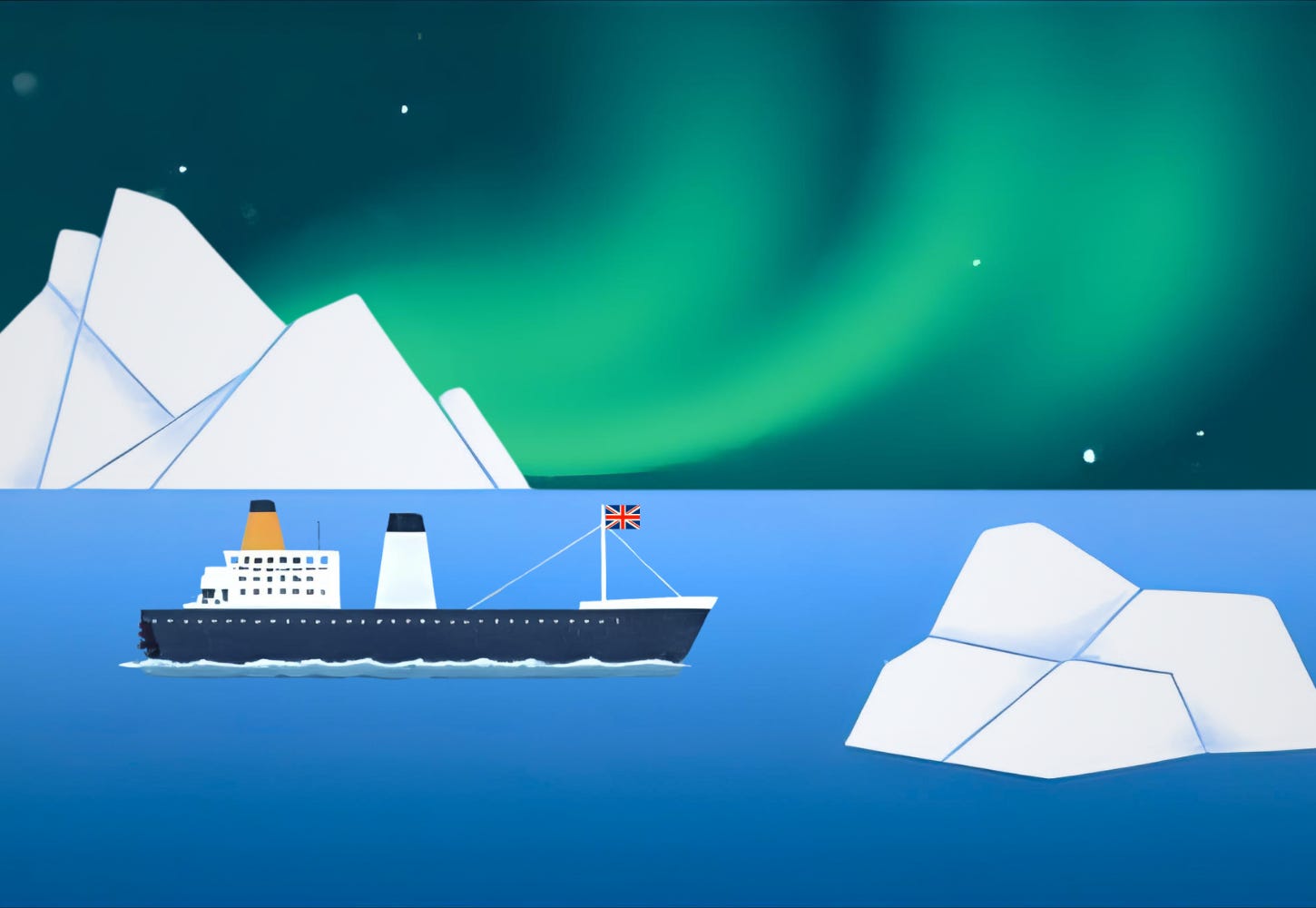
In August 2025, the Haijie Shipping Company announced the launch of the first trans-Arctic commercial shipping route, with container ship Istanbul Bridge departing Ningbo, in the People’s Republic of China (PRC), on 22nd September. Istanbul Bridge is scheduled to arrive in Felixstowe, the largest container port in the United Kingdom (UK), this weekend, meaning its transit time is cut to under three weeks, compared to an estimated 40-50 days had it sailed via the Suez Canal.
The PRC has displayed an interest in creating a ‘Polar Silk Road’ since 2018, having described itself as a ‘near-Arctic state’. Compounding the consequent strategic challenge of a potential Chinese military presence in the Euro-Atlantic is Russia’s Northern Fleet, which poses a threat to the security of the British Isles. With these issues in mind, for this week’s Big Ask, we asked eight experts: Why does the Arctic matter to Britain?
Associate Fellow, Chatham House, and Non-resident Fellow, CEPA
The Arctic is vital for Britain, and Britain is vital for the Arctic. Located along the Greenland-Iceland-UK (GIUK) gap, Britain is the most important European naval power in the North Atlantic, and plays an especially crucial role in anti-submarine warfare.
In a conflict with the North Atlantic Treaty Organisation (NATO), it would be in Russia’s interests to disrupt the GIUK line of communication to North America – and in NATO’s interests to ensure that Russian submarines cannot sneak past that line.
The UK has a longstanding and close strategic relationship with Norway, which was the second-largest supplier of oil and natural gas to Britain in 2024. Additionally, the UK’s military footprint in the Wider North is significant, including: Camp Viking, an Arctic operations command base in northern Norway, which serves as the hub for Royal Marines Commandos; future contributions to the new NATO Forward Land Force contingent in northern Finland; and the new Multi-Corps Land Component Command in eastern Finland. British leadership in the region, e.g., through the Joint Expeditionary Force (JEF), is both appreciated and expected.
PhD Candidate, Department of War Studies, King’s College London
Any answer to why the Arctic matters to the UK must explain why it matters more than elsewhere. Every region demands attention; few, however, fuse commerce, climate and conflict so close to home.
The growing viability of Arctic shipping, exemplified by Istanbul Bridge, will reconfigure global trade. Britain – through contract law, maritime insurance and shipbroking – already provides frameworks which govern such commerce. This could provide British companies with a competitive edge in the Arctic.
Yet, while melting sea ice creates these opportunities, it also exposes risks for the ‘Arctic’s nearest neighbour’. The effects of climate change in the region are quadruple the global average, disrupting weather systems and fisheries while incentivising potentially unsustainable resource attraction and tourism.
A scramble for the Arctic along these lines would add to an already fraught relationship between the littoral states. Not only this, the region anchors NATO’s northern flank – the defence of which underpins transatlantic reinforcement, the protection of critical infrastructure and freedom of navigation. The proposed ‘Atlantic Bastion’ in June’s Strategic Defence Review (SDR) speaks directly to the UK’s responsibilities in these areas.
For these reasons, the Arctic demands a coordinated, whole-of-government approach. To date, unclear command structures, frequent staff turnover and episodic political attention have undermined this.
The implication is clear. To paraphrase Trotsky, Britain may not yet be interested in the Arctic, but the Arctic is interested in Britain.
Senior Research Fellow, RAND Europe
The UK is the nearest non-Arctic state, and with three Arctic policy frameworks released in the last decade, all have been eager to stress why the Arctic matters. Environmental change in the Wider North, including sea ice reduction, shapes British weather patterns. The UK also has economic interests to consider, including the role of Arctic states as energy suppliers and trading partners. Scientifically, Britain retains a research station in Svalbard and conducts research across the circumpolar Arctic, including the Arctic Ocean.
If, as is widely acknowledged, the Arctic is no longer reliably frozen, there is every possibility that the region will attract more commercial shipping traffic, which could allow British ports and professional services to capitalise on.
A more open Arctic, however, is not risk-free. The UK’s relative proximity has taken on added geopolitical zest in recent years. A resurgent Russia is once again stress testing NATO preparedness on land, at sea and in the air. The self-styled ‘near-Arctic state’ of the PRC is consolidating its Arctic expertise and engagement. Other BRICS+ parties, such as Saudi Arabia, are becoming embroiled in Russian polar projects.
The Arctic will continue to heat up, literally and figuratively, and Britain’s relative proximity means that all of this will demand domain surveillance, infrastructural sustenance and analytical scrutiny.
Associate Fellow, Royal United Services Institute
The PRC’s ‘Polar Silk Road’, via the melting Northern Sea Route, illustrates the Arctic’s importance for Beijing and London as a major gateway for trade, security and resources. Concurrently, however, Beijing’s strategic ambitions in the Wider North threaten to reshape the region, challenging the UK’s interests.
The Arctic route cuts shipping times between Asia and the British Isles from roughly 40 to 18 days. This has clear benefits over crisis-prone trade routes such as the Suez Canal, especially for time-sensitive industries. The Arctic route enhances Beijing’s global logistics influence, and gives the PRC – and its Russian partner – greater leverage in shaping maritime rules.
The rush to commercialise the melting Arctic places the UK in a dilemma. As a NATO member, Britain faces increasing geopolitical and military rivalry in the Wider North – a recognised hotspot for great power competition. The SDR highlights the need for a renewed Arctic focus, aligning with NATO’s duty to protect the region.
However, growing Chinese-Russian cooperation – evidenced by over 100 joint military exercises and Chinese support for Russia’s full-scale invasion of Ukraine – exposes the UK’s weakness in depending on a Chinese state which exploits trade for its strategic aims.
This contradiction is stark: His Majesty’s (HM) Government aims to engage with Beijing economically, allowing significant Chinese investment in British infrastructure, while NATO labels the PRC a systemic challenge extending beyond the Wider North. The Arctic has become an arena where the UK’s economic security, alliance commitments and strategic independence are at stake, as it seeks to trade with a potential adversary.
The Istanbul Bridge isn’t merely a ship, but an alarm call. In a warming world, ignoring the PRC’s chilly ambitions could leave Britain exposed from the north. Therefore, it must reassess its security priorities in the Wider North by strengthening surveillance, defence and diplomacy with NATO and its Nordic allies.
Deputy Director (Geopolitics), Council on Geostrategy
The Arctic is integral to European continental security on the one hand and economic opportunity on the other. The UK’s proximity to the region increases both factors by some degree. Any Russian or Chinese air or naval threats to Britain’s northeastern flank will come from there or the Baltic Sea.
While the latter is sandwiched between numerous NATO allies, the former presents a clear maritime route to British Isles, lightly buffered by the Norwegian coastline. In addition, it presents Russia with the opportunity to attempt to threaten the North Atlantic route to North America.
Likewise, the growth of the northern corridor as a trade route presents the UK with opportunities to increase its trading volume to northeast Asia – an engine of global growth and a source of manufactured goods. While the new Chinese Arctic Express service has not yet proved its worth in adverse weather conditions, general projections predict a cut from 40 to 18 days.
According to HM Government figures, total British trade to northeast Asia (the PRC, Japan and South Korea) in the past year was £146.1 billion. Russia, of course, has realised this, and has increased its military hold over the Arctic region.
Moscow’s behaviour – that of a great power trying to control international waters – is a typical example of rent-seeking land powers that sit astride major trade arteries. It is a classic Mahanian gambit; something which the Royal Navy has centuries of experience of addressing.
Research Associate and Deputy Editor-in-Chief, Arctic Institute
The Arctic was a region once defined by isolation, but it is now becoming a testing ground for power projection, arguably even more so than the South China Sea. The Arctic’s proximity to the UK’s northern approaches, especially the GIUK gap, makes it a vital gateway for NATO operations and the defence of North Atlantic sea lanes which underpin British security.
As melting ice opens new routes and access to resources, competition between states is accelerating. Russia’s Northern Fleet continues to expand its reach, while the PRC’s growing presence through Arctic shipping ventures underscores how far the region’s geopolitical balance has shifted.
A credible British presence in the Wider North is, therefore, essential for early warning, deterrence and interoperability with NATO partners. Recent years have seen major British investments in Arctic defence capabilities: the Royal Marines train year-round in Norway; the Royal Navy deploys Arctic patrols and exercises; and P-8A Poseidon aircraft enhance maritime surveillance in the region.
The Arctic is no longer remote. It is the northern flank that the UK cannot afford to ignore. Britain must treat it as a front line of its national defence and strategic influence.
Professor of War Studies, Loughborough University
It is commonplace to say that what happens in the Arctic does not stay in the Arctic. As the region continues to melt, sea levels rise, and near neighbours such as the UK suffer from coastal erosion and flooding, damaging national infrastructure. British research is acknowledged as world-leading in understanding the evolving Arctic, and access to the region is critical for predicting future climate change impacts on the UK.
Protecting national interests also means ensuring the future security of Britain’s allies in the Wider North. As a key member of NATO, the UK plays a vital role in safeguarding critical infrastructure, such as undersea cables in the eastern Atlantic, and monitoring Russian aggression (including nuclear threats) across the GIUK gap. In an age of uncertainty over the geopolitical intentions of Donald Trump, President of the United States (US), allies such as Norway and Denmark are essential to Britain’s ability to operate across the Arctic.
More prosaically, as the ice melts and the region’s riches become accessible, the UK, as a trading nation, will want to benefit from the abundant fish stocks, plentiful oil and critical minerals lying in the Arctic. Britain currently holds one-third of the mining licences in Greenland, demonstrating where future national prosperity may lie.
Policy Researcher and MPhil Graduate, University of Oxford
The Arctic matters to the UK because it is where defence, resilience and strategic influence converge. Britain’s northern security architecture – its nuclear deterrent, critical undersea cables and NATO alliances – traverses Arctic waters where the PRC is building leverage, largely unnoticed by Westminster.
Beijing’s self-designation as a ‘near-Arctic state’ is geopolitical positioning, not rhetoric. The PRC pursues three coherent objectives dangerously close to British interests: a Polar Silk Road, normalising a People’s Liberation Army Navy (PLAN) presence near North Atlantic approaches; access to rare earth minerals, ports and seabed infrastructure; and influence over Arctic governance and scientific standards. Hydrographic surveys map submarine corridors, and land acquisition attempts in Norway and Iceland seek forward positioning near the GIUK gap.
The UK’s response has been systemically weak. Parliamentary engagement through the All-Party Parliamentary Group (APPG) for the Polar Regions has gone quiet. On a visit to Britannia Royal Naval College earlier this year, I found just five Arctic books in the Navy Library; a stark indicator of how little priority the Royal Navy gives the Wider North. ‘Looking North: the UK and the Arctic’ articulates intent, but the Ministry of Defence still lacks updated Wider North doctrine and capability.
What Whitehall has failed to grasp is that the Arctic is no longer about environmental monitoring or distant territorial claims. It is about command of the northern approaches to the Atlantic. As the world’s most northerly non-Arctic state via Scotland, Britain is the natural transatlantic connector.
Whitehall should resource a dedicated talent pipeline from the Scott Polar Research Institute at Cambridge, which translates polar research into policy bandwidth and sustains a British voice in Arctic governance. It should treat the Wider North as a strategic arena – Beijing already does.
If you enjoyed this Big Ask, please subscribe or pledge your support!
What do you think about the perspectives put forward in this Big Ask? Why not leave a comment below?
"Britain – through contract law, maritime insurance and shipbroking – already provides frameworks which govern such commerce." Why UK has to decide something being geographically unlinked with this territory? Is this revisionist policy of the stub of the British Empire?