

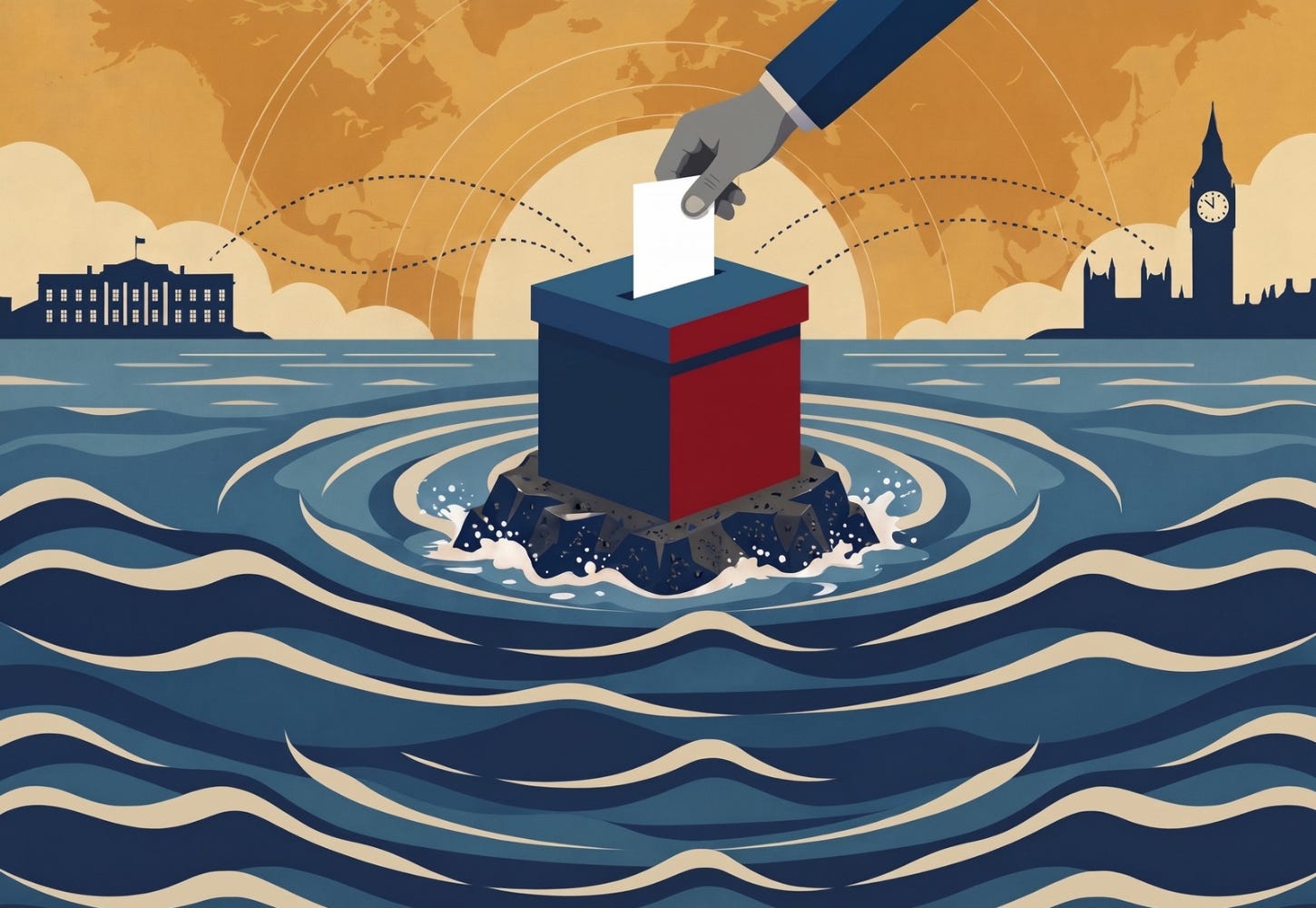
On 3rd November 2026, the United States (US) held its midterm elections. The Democratic Party (the Democrats) won both the Senate and the House, and will remain in control of Congress for the remainder of Donald Trump’s second term as president of the US.
Post-election analysis suggests that the Democrats’ victory was in part due to the fallout of the US-Israel-Iran conflict that began in February 2026, as well as the Trump administration’s foreign policy more generally. While the White House still retains ultimate control over American foreign policy, a question arises as to whether the midterm results will see a shift in Trump’s international outlook. Thinking about the possible effect on the United Kingdom (UK) in particular, for this week’s Big Ask we asked four experts: How will the American midterm results affect British foreign policy?
Honorary Fellow, Council on Geostrategy
The big swing towards the Democrats could make one breathe a sigh of relief and hope for a return to business as usual. That would be a mistake for at least three reasons.
Firstly, Trump’s more transactional approach to international relationships may be somewhat extreme, but it is part of a broader trend, not an aberration. The era of McCain/Romney Republicanism – and the ‘Third Way’ alignment of Bill Clinton, former President, with Tony Blair, former Prime Minister – is long gone. The UK will continue to have to work hard to make itself relevant to the US, whoever is in charge.
Secondly, the Democrats are a disparate group, not necessarily as sympathetic to British interests as might be assumed. They may be as protectionist as Trump on trade, and just as willing to accommodate Russia in ways that harm Europe (some northern European allies hoped that Trump’s second presidency would be an improvement on Jake Sullivan, former National Security Adviser of the US, in this respect).
Thirdly, if the ‘new normal’ is wild oscillations, that in itself poses a challenge for the UK. Moving from George W. Bush to Obama, Trump, Biden, Trump, and a more left-wing Democrat does not equal a stable foundation.
So, what should Britain do in response? First, it should work hard to keep Washington onside and acting in ways that make the UK more secure and richer. Second, to achieve that, it should do everything it can to grow its economy and military power – which helps even if it fails to win over the US. And third, Britain should accelerate its rapprochement with its European allies and partners.
Senior Lecturer in Post-Soviet Security, Department of War Studies, King’s College London, and Associate Editor, European Journal of International Security
American foreign policy may become more aggressive for the rest of 2026 as the Trump administration tries to advance its objectives before the start of the new Democrat-led Congress. Ukraine is one example of this: in the past week, we have seen increased pressure on Kyiv to capitulate (for instance, by throttling Starlink again). This is going to make things more uncertain and more dangerous for the next few weeks.
After January, Congress is clearly going to try to use the levers available to it to put a check on the Trump administration’s policies on Ukraine, the North Atlantic Treaty Organisation (NATO), and Russia, as well as the conflict with Iran. This may limit aspects of the administration’s alignment with the Kremlin and its hostile approach to NATO, which would be a significant win for the UK and the rest of Europe. His Majesty’s (HM) Government will be able to engage with a more sympathetic Congress, and is likely to start looking at building relationships in advance of a possible Democrat administration after 2028.
The main risk for Britain is the temptation to think that things will return to business as usual in American foreign policy, with renewed US leadership on European security. This is unlikely to happen now or after Trump leaves office, but wishful thinking could limit the moves towards greater European autonomy. The midterms are good news for European nations, but they are not a magic bullet for the problems that the continent faces.
Senior Fellow, Yorktown Institute
The midterms matter less for who won than for what the result constrains. Personnel is policy. Stephen Miller’s elevation to White House Chief of Staff puts someone who understands the bureaucracy at the centre of the machine, filling a gap that Marco Rubio, Secretary of State of the US, never did. The Trump administration will act more decisively in the Western Hemisphere, where legislative constraints – especially on funding – have less impact given the distances involved.
The harder truth for the UK is that a divided government generates several lost years of military modernisation, leaving Britain with more to cover. Without a coherent budgetary process, American military shortfalls will be even greater in 2029, undermining hopes that a future administration might return to a comprehensive European military posture.
Nor does the UK control the conflict with Iran. It will absorb the consequences without steering the decisions. Here, Trump has significant latitude to take a decision that is grossly impactful for Britain.
Finally, the grand entente with Russia that some anticipated is now close to impossible. Oversight, budget limits, and broader congressional constraints will close that door in January. This puts European nations squarely in control of Ukraine’s fate. The UK has shown little desire to meet such a challenge, but it will have the opportunity to do so.
International Fellow, Council on Geostrategy, and Senior Vice President of National Security and Intelligence Programmes, Centre for the Study of the Presidency and Congress
The midterm ‘blue wave’ will markedly affect American domestic and foreign policy, but probably not as British politicians hope. While this demonstrates democratic accountability, a return to ‘normal’ US politics may prove disappointing.
The Democrats are divided, with democratic socialists and progressives fighting for the soul of the party against centrist, traditional Democrats. This will surface vividly on issues such as the US’ relationship with Israel and Artificial Intelligence (AI), with many Democrats advocating halts to data centre expansion and developing advanced models.
How this squares with competing against the People’s Republic of China (PRC) is unclear. Considerable support remains for European security and NATO among the American people, but the new generation of Democrats lacks that instinctual affinity – despite rejecting Trump’s rhetoric, the idea of burden-shifting and pivoting to the Indo-Pacific still resonated. This will be a more inward-looking Congress.
More practically, Democrats will reassert congressional prerogatives through process and politics. Procedurally, investigations and hearings will increasingly consume the Trump administration’s attention, unlike under the Republican majority. Politically, the Democrats will seek, for example, to tie defence funding to winding down the Iran conflict. This will constrain Trump’s agenda, complicating allies’ policy choices.
The lame-duck fight over Russian sanctions will be an early test of congressional pushback. Whether Republicans break with Trump to mandate increased sanctions will be telling. Yet, even the new Congress is unlikely to muster the two-thirds majority to override the presidential veto.
While Parliament and Whitehall may have welcomed the Democratic victory (albeit off the record), Andy Burnham, Prime Minister, must still work with Trump for the next two years. The President will still pursue burden-shifting within NATO, a settlement on Ukraine and Russia, and his cultural agenda. These efforts may intensify as the Democrat-led Congress hamstrings his domestic priorities.
If you enjoyed this Big Ask, please subscribe or pledge your support!
What do you think about the perspectives put forward in this Big Ask? Why not leave a comment below?
Any sort of relaxing now would be a mistake. We have already decided that the US may not be the most trustworthy, they certainly don’t have the UKs interest, and British influence is minuscule in Washington. Democrats, Republicans, it does not matter. The UK should hedge its best. Don’t break off completely from the US but it certainly needs to look out for itself.