

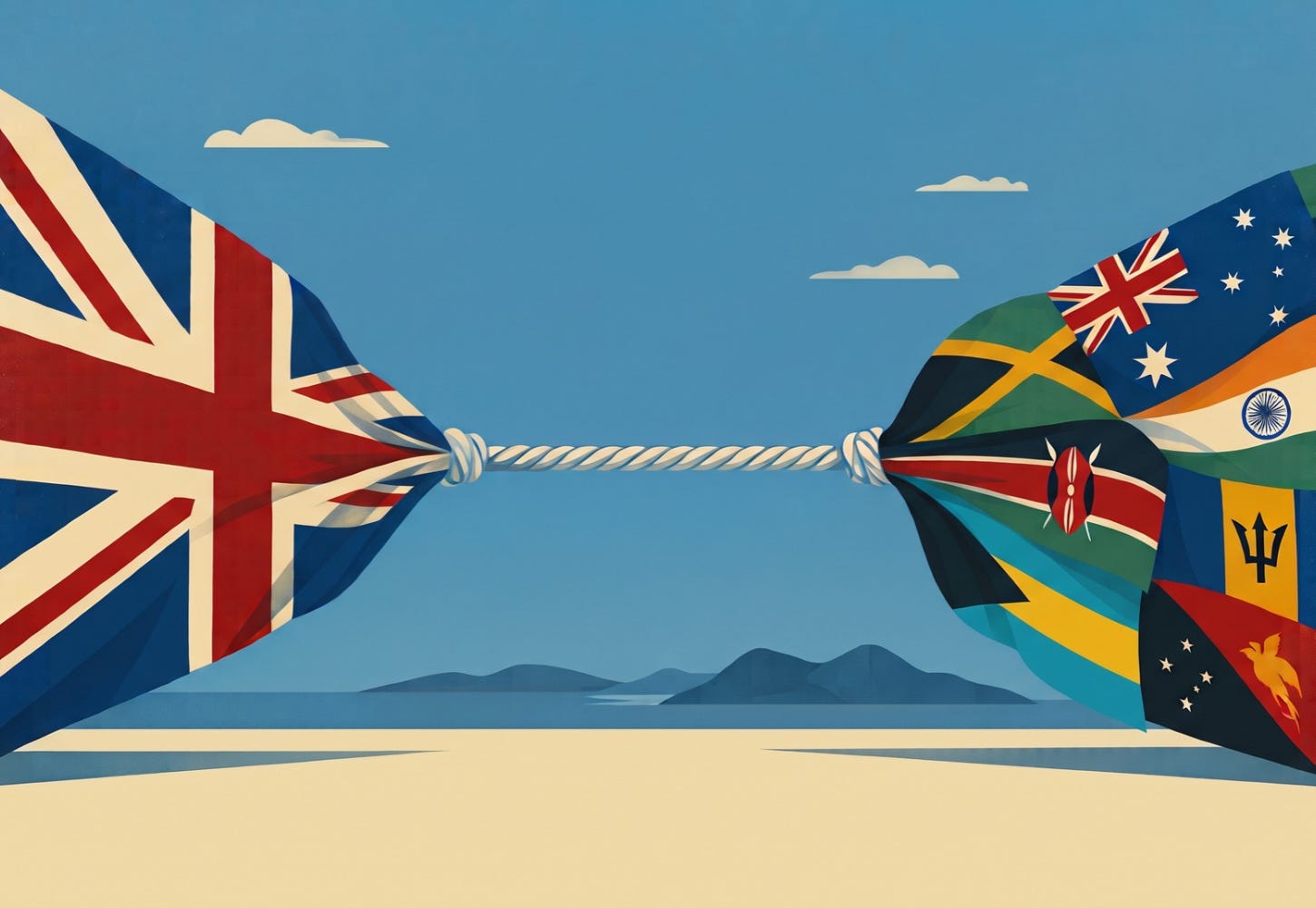
The upcoming Commonwealth Heads of Government Meeting (CHOGM) will be hosted in Antigua and Barbuda from 1st to 4th November 2026. While the summit is intended to unite its members around common interests, diplomatic friction has emerged as Caribbean and African members call once again on the United Kingdom (UK) to offer reparations for the transatlantic slave trade. Even Shirley Ayorkor Botchwey, Secretary-General of the Commonwealth, has weighed in, suggesting that a formal apology from His Majesty King Charles III ‘wouldn’t hurt’.
As Britain faces growing challenges from global adversaries, some are questioning whether navigating these historical disputes has become a distraction for British foreign policy, while others still view the Commonwealth as a vital pillar of international influence. As such, for this week’s Big Ask, we asked seven experts: Does the Commonwealth now hinder British interests?
The Rt. Hon. Lord Biggar of Castle Douglas CBE
Member, House of Lords, and Regius Professor Emeritus of Moral Theology, University of Oxford
The Commonwealth can serve the UK’s interests in several ways. Insofar as it comprises a forum for the building of relationships, the fostering of mutual understanding, and the exchange of fruitful ideas, it can benefit Britain, as personal relationships do matter in international relations. It can also be a marketplace for the promotion of the UK’s goods and expertise, and a medium for the expression of British soft power, whether cultural or educational.
Now that the UK is no longer obsessed with the European Union (EU), it should begin to revive interest in other parts of the world that it has tended to neglect. Africa is certainly one of these, now that its countries are rising in self-confidence, wealth, and influence. Given that Britain has an interest in countering the influence of the aggressively authoritarian regime in Beijing, it has an additional reason to pay African nations fresh attention.
However, if the Commonwealth were to become a ‘mini United Nations’ (UN) where, egged on by the illiberal People’s Republic of China (PRC) and Russia, Asian, African, and Latin American states indulge in anti-‘Western’ politics and seek to exploit the misplaced white guilt of an historically ignorant British elite, then the UK’s interest is bound to wane.
That is why it is so important that the King and His Majesty’s (HM) Government resist calls from the Caribbean Community (CARICOM) and the African Union to concede reparations for historic transatlantic slavery. The reparations campaign is historically distorted, ethically unfair, and politically opportunistic. It could plunge the Commonwealth into rancorous division and distract from collaboration on important environmental and educational ventures.
Adjunct Fellow, Council on Geostrategy, and Senior Lecturer in National Security Studies, King’s College London
Does the Commonwealth now hinder British interests? Quite the opposite.
The Commonwealth is one of the UK’s most underutilised assets. At a time when Britain needs friends in an increasingly contested world, even a whiff of suggesting that it neglects a network of 56 countries seems foolhardy.
When the Conservative government under Boris Johnson announced its grand Indo-Pacific ‘tilt’ in 2021, one might have thought that the UK was just discovering the region. Yet, through the Commonwealth, it already had longstanding relationships across the Pacific. In Fiji, those ties helped to pave the way for a maritime security agreement in 2022, allowing British and Fijian personnel to serve aboard each other’s vessels. That is exactly the type of pragmatic partnership worth nurturing.
Not every engagement needs warships or nuclear submarines. Educational exchanges, the Royal Commonwealth Society’s literacy initiatives, and climate resilience cooperation build relationships, while shared language and professional networks open doors to trade.
Of course, colonial history cannot be wished away. For instance, the UK should offer a long-overdue formal apology for the 1919 Amritsar Massacre. However, acknowledging historical wrongdoing does not automatically entail financial reparations.
Reciprocity also matters; Commonwealth partners should engage with Britain as it is today, with constrained public finances and priorities of its own. Both sides must resist treating shared history as an asset for trade one moment and an obstacle to cooperation the next. From India to Jamaica, Malta to Ghana, these relationships demand mutual respect and realistic expectations.
The danger to the UK’s interests comes from neglecting the Commonwealth, rather than from the Commonwealth itself. In a post-Brexit world of renewed great-power competition, the UK already has a remarkable international network. It needs to start acting like it.
The Rt. Hon. Lord Howell of Guildford
Member, House of Lords
Given the wording of the question, a large number would say ‘yes’. However, a large number would be hopelessly wrong, because the question is wrong.
Behind the words, it is asking about a world that no longer exists, in which the very meaning of words is disputed, to which there is no good argument for return, and in which tragic issues of history have been divorced from all truth.
Thanks not to one revolution but a whirlwind of transforming forces in almost all human relations, the Commonwealth has long since changed in character, nature, size, and membership (by seven times), in impact beyond all predictions, and on a scale barely foreseen by the most prescient seer.
We are looking at new patterns of trade and investment lying largely outside familiar economic behaviour systems. A frightening world security imbroglio confronts Britain, not just on land but across the maritime domain and the seabed beneath.
This presents entirely new international challenges. It is a diplomatic and security environment that is simultaneously pulling the nation together and tearing it apart. The last threads of unifying endeavour created out of the rubble of two 20th-century world wars, leading to the creation of the UN and a remarkable successor international order, are quickly breaking away.
It would be the ultimate aberration, spitting in the face of the future, for the UK now to step aside from the forces, the culture, the common language, the institutions, and the basic architecture of law and order – all now under intense attack. This is a task of both world and national recovery, in which the Commonwealth network, for all its faults, has to be both a partner and contributor.
No answer, I accept, to the question posed – thank goodness!
Chair, British Foreign Policy Group
Does the Commonwealth now hinder British interests? No. It can help the UK to strengthen relationships around the world that can enhance its interests. Good diplomacy can ensure there is more value than hindrance.
The question reminds me of the CHOGM I attended in Auckland in 1995 as part of the British delegation. Then, there were two big issues. I worked on one: defending the decision made by John Major, then Prime Minister, to back France’s last programme of nuclear testing in the South Pacific. The task was to tone down criticism of Paris and to focus on supporting the ongoing negotiations for a Comprehensive Test Ban Treaty, but no amount of smart diplomacy could take away from the fact that the UK was in a minority of one, especially in New Zealand.
The other big story was the decision to suspend Nigeria’s membership following the regime’s execution of a group of activists including Ken Saro-Wiwa. Britain played an important role in building consensus for a firm and principled response from the Commonwealth, working closely with other members – especially African ones.
There is a lesson here for the Commonwealth in 2026. The UK should not expect agreement on all the difficult issues. Good diplomacy means being clear when countries cannot agree, and remaining friends in order to work together where they can. This is not out of a sense of misplaced historical sentiment, but a recognition that countries in different continents, and with different levels of development, have many shared interests.
Britain would be ill-advised to give up on a forum where it can seek to pursue those interests where possible.
*This response is written in a personal capacity, and does not necessarily reflect the views of the British Foreign Policy Group.
Professor of Historical Geography, School of Global Studies, University of Sussex
Although the Commonwealth does not actively hinder British interests, it is very far from being a vehicle to advance them. It does, however, have the potential to become one, with a leap of faith and trust from the UK’s leaders.
Counterintuitively, the Commonwealth would serve British interests best only if the UK accedes to its demands for reparative investment. Acknowledgement of the development gap that Britain created through transatlantic slavery and colonialism, followed by impact investments – for example, in climate-adaptive housing and infrastructure, and much-needed debt relief – would create the foundations for a new partnership of Commonwealth democracies at a time when the UK desperately needs them.
Caught between a capricious administration in the United States (US), a Europe besieged by far-right destabilisation and Russian aggression, and a PRC intent on usurping free and open nations’ moral and economic leverage throughout Asia, Africa, and Latin America, the retrieval of Britain’s moral standing, based on sustained economic pre-eminence within the Commonwealth, could prove a vital reorientation.
Honorary Director, Delhi School of Transnational Affairs, Delhi University, and Professor of International Relations, King’s College London
The Commonwealth does not undermine British interests, but the strategic value HM Government attaches to it deserves closer scrutiny. It offers the UK diplomatic reach, institutional familiarity, and soft power across Africa, Asia, and the Pacific. Yet, historical affinity is no substitute for material power.
The promise of ‘Global Britain’ after Brexit exposed this contradiction. The Commonwealth is neither a unified free trade bloc nor an alternative to the economic advantages of proximity to mainland Europe. Shared language, legal traditions, and institutional ties may lower trade costs, but they cannot overcome the structural limits of geographical distance and fragmented markets.
Nor is the Commonwealth free of political baggage. Colonial legacies, demands for reparations, and divergent positions on Russia and the PRC complicate the UK’s efforts to forge a common strategic outlook. Its consensus-driven character facilitates dialogue, but often constrains collective action.
The real question, therefore, is not whether the Commonwealth serves British interests, but whether the UK expects too much from it. As an instrument of soft power, it remains valuable. As a substitute for robust economic partnerships and credible security arrangements, it is deeply inadequate.
Britain’s challenge is to distinguish the symbolism of its imperial past from the strategic realities of its present.
Co-President (Research), Council on Geostrategy
The Commonwealth itself is not the problem, however dated its premise may seem in an era of geopolitical confrontation. As a loose network rooted in common law, language, and historical ties, it retains modest diplomatic utility for the UK. The real problem is now its flagship biennial summit – CHOGM – which has degenerated into a circus that actively undermines British interests.
Rather than addressing vital modern challenges – from authoritarian coercion to environmental pollution to economic development – CHOGM is increasingly consumed by performative grievance. The recent obsession with slavery reparations has degraded the summit into a choreographed tribunal, where Britain is summoned to answer for a historic wrong that it was not uniquely responsible for, abolished two centuries ago, and deployed the Royal Navy to eradicate around the world.
British ministers and officials cannot afford to squander scarce diplomatic bandwidth indulging those who reduce centuries of complex transatlantic history to an invoice. While Russia and the PRC do not direct this charade, they are its primary beneficiaries – gleefully watching the UK put on trial by its supposed partners while they court the so-called ‘Global South’.
Enduring these biennial ambushes buys no geopolitical loyalty either: Commonwealth members regularly diverge from Britain at the UN while deepening security ties with its rivals (incidentally, including those that have been accused of modern slavery and forced labour).
The Commonwealth’s quiet bilateral channels are worth preserving, but CHOGM is becoming an unhelpful distraction. If member states insist on prioritising simplified historical recrimination over future-oriented and constructive statecraft, HM Government should threaten to downgrade its attendance. If that does not work, it should starve the summit of oxygen and instead conduct Commonwealth business increasingly through bilateral and minilateral channels.
If you enjoyed this Big Ask, please subscribe or pledge your support!
What do you think about the perspectives put forward in this Big Ask? Why not leave a comment below?