

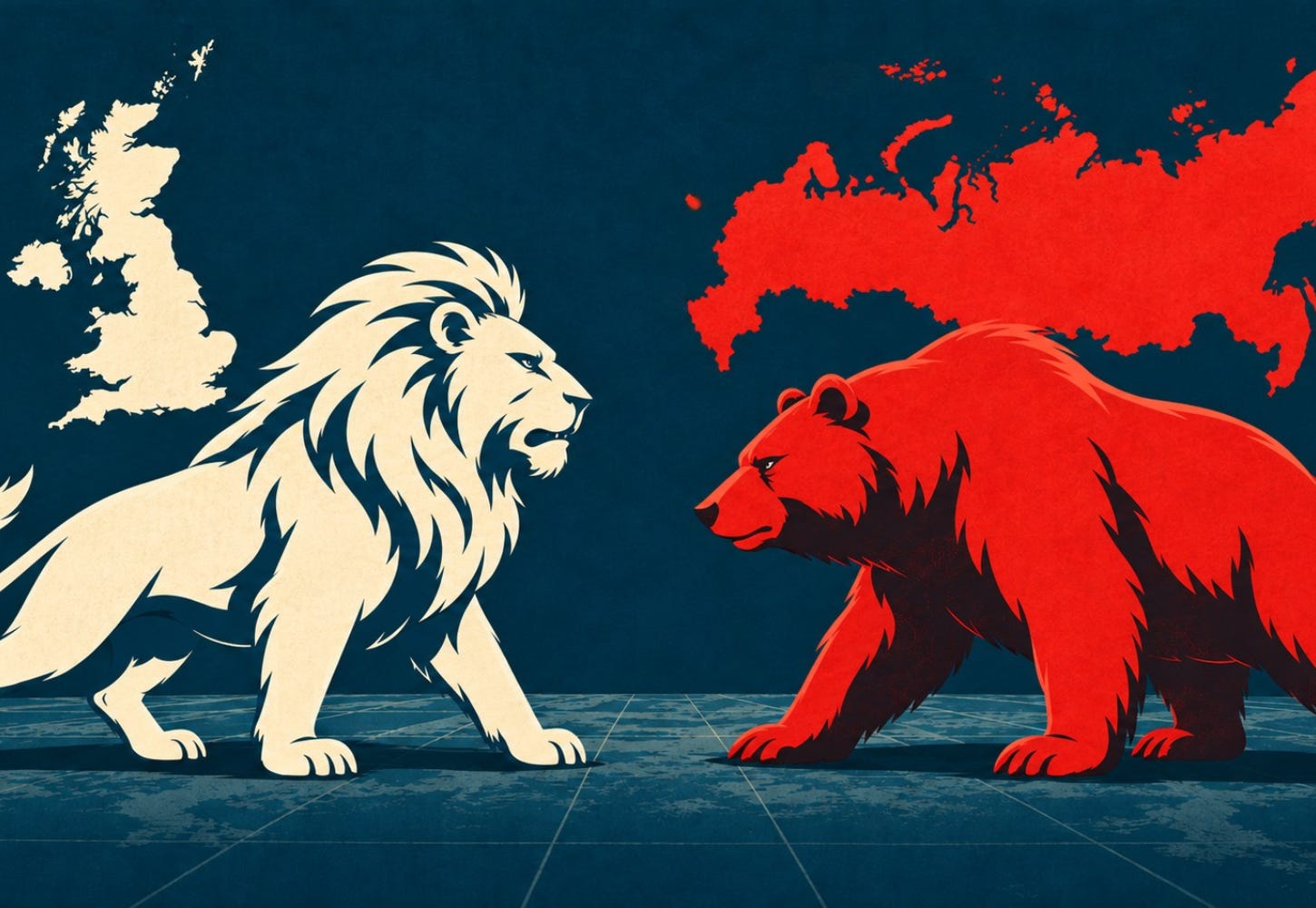
In response to the televised version of Sky News’ podcast The Wargame, the Russian Embassy to the United Kingdom (UK) issued a statement that were Russian territory to be targeted by the North Atlantic Treaty Organisation (NATO), the Kremlin would respond by ‘using all means at Russia’s disposal, including nuclear weapons’. Such rhetoric is far from unusual, however, with the Kremlin’s mouthpieces consistently positioning ‘Perfidious Albion’ as Russia’s primary opponent in its attempts to rewrite the international order in its favour.
Britain is framed as the reason for the Kremlin’s failures in Ukraine, prolonging the conflict by directing Kyiv behind the scenes, and Russia consistently views the UK as a greater challenge than other free and open nations. Considering the antagonism emanating from the Kremlin, for this week’s Big Ask, we asked six experts: How should Britain prepare for being Russia’s leading adversary?
Professor of Geopolitics and Faculty Dean, Middlesex University London, and Honorary Fellow, Council on Geostrategy
Russia is a revanchist power, maintaining a Soviet-era preoccupation with a bastion defence posture in and around the Kola Peninsula. The Kremlin views the UK as a strategic adversary and enabler of NATO’s presence in the High North and the North Atlantic. Britain’s strategic relationship with Norway, leadership of the Joint Expeditionary Force (JEF), and military support for Ukraine colour Russia’s highly prejudicial view. The Kremlin has warned of ‘consequences’ for this support for Kyiv, and the UK’s critical infrastructure and military assets are targets.
Britain’s approach to the High North demands a solid understanding of operational realities. First, the High North is linked to the wider security of the North Atlantic, North Sea, and Baltic Sea. Second, near-constant maritime awareness in the High North is vital given that Russia’s ships, autonomous vessels, aircraft, and the ‘shadow fleet’ threaten undersea infrastructure and contribute to general disruption.
Third, Russian-sponsored Global Positioning System (GPS) jamming and Electronic Warfare (EW) disrupt civilian and military traffic in northern Norway, including Svalbard. Fourth, credible readiness is crucial. UK Commando Force worked with allied European and American counterparts on vital islands such as Jan Mayen and the Faroe Islands in summer 2026.
Finally, a refreshed British Arctic policy framework draws attention to the role of and for Arctic science in building and sustaining coalitions of the willing. The Arctic is no longer reliably frozen, and that matters to the UK’s weather and seasonal volatility.
British command of NATO Joint Force Command Norfolk (with an area of responsibility that includes the North Atlantic, the Arctic, the High North, and sea lines between North America and Europe) provides an opportunity to demonstrate that deterring Russia requires capability, credibility, and communication with friends and foes alike.
Defence Sector Lead, Walker Morris LLP, and Army Reserve Officer
The UK should prepare for being Russia’s leading adversary by understanding why the Kremlin appears to view it differently from many other European states. Russian hostility towards Poland, Finland, or the Baltic states can readily be explained by geography and history. Britain’s role is different.
Despite its relative distance from Russia, the UK remains one of Europe’s foremost military powers, a nuclear-armed state, a leading intelligence actor, and a central pillar of NATO. For the Kremlin, Britain has come to symbolise not simply opposition to Russian aggression, but the wider resolve of free and open nations that constrains Russian ambitions.
The revival of terms such as ‘Perfidious Albion’ suggests this hostility is becoming increasingly ideological rather than purely geopolitical. If so, the UK should assume that Russian pressure, whether through cyber operations, espionage, disinformation, or military intimidation, will persist regardless of developments in Ukraine.
Preparation therefore requires more than stronger armed forces. Britain must strengthen the resilience of its critical infrastructure, improve its ability to counter ‘grey-zone’ activity, and maintain a defence industrial base capable of sustaining long-term competition. Just as importantly, it should continue investing in the alliances that amplify its influence.
The UK should not become more cautious or less engaged in European security. Rather, it should demonstrate that sustained leadership carries no strategic penalty. The most effective answer to Russian hostility is a Britain that remains confident in its role, resilient at home, and unwavering in its commitment to NATO.
Author of the podcast The Wargame; Director of the Changing Character of War Centre, Oxford University; and Honorary Fellow, Council on Geostrategy
In the podcast and television programme The Wargame, the skeletal nature of the UK’s defences was brutally exposed by a full-scale Russian armed attack. Of course, the scenario is highly unlikely – not least because of Britain’s nuclear deterrent and because of the cohesion within NATO, which in conventional terms dwarfs that of Russia.
It is not in the nuclear and conventional fields that the UK will be attacked directly. The Kremlin has already commenced a policy of coercion using disinformation, economic leverage, threatening military presence, strategic rebalancing, violent proxies, and assassination. Through fear, Russia is waging political warfare against Britain.
It is into this gap in the UK’s capabilities that measures are required. Its preparation should include training and deploying personnel in a proactive campaign to expose Russian disinformation. It needs not only comprehensive surveillance and built-in redundancy of communications networks, but also active defence measures to ensure that costs are imposed immediately on those who perpetrate hybrid forms of attack. It requires a robust legal system that ceases to persecute its own military personnel and focuses instead on defeating Strategic Lawsuits Against Public Participation (SLAPPs) and other vexatious foreign legal claims. It needs to bolster its counterintelligence and counterespionage capabilities. It needs to seek out more diverse sources of supply to ensure no pressure can be applied through economic warfare. It needs to rediscover the art of political warfare itself, to detect, deter, and defeat deliberate attempts to sow division, subvert, mislead, and undermine its constitution and national unity.
Britain requires more confidence in long-term planning, to give the public confidence in the future rather than a diet that fosters fear and insecurity. After all, when was the last time you heard a political leader offering a vision of the long-term future that was positive? To defeat an enemy in political warfare, one needs to make a better offer.
Visiting Fellow, Centre for Statecraft and National Security
It may or may not be self-evident, but the UK is not Russia’s leading adversary. Ukraine is. It is Ukraine that is fighting the Russian Ground Forces across a 1,200 kilometre-long front, inflicting 30,000 casualties per month, and that has put over 50% of Russia’s oil refining capacity offline.
Kyiv is doing this at brutal cost, but it is buying time for Britain and European allies to prepare for what is perhaps inevitable, and it is showing lessons that the UK must learn.
One lesson is the capacity of society. In a total war, a state must reach beyond its immediate resources and tap into the latent potential of society at large: it must mobilise the country. Unlike British historical precedent, and as Ukraine has shown, this goes beyond mobilising civilians into soldiers.
Ukraine’s pre-2022 software developers are now designing the defence technology that is punishing the Russians and saving civilian lives. Kyiv’s volunteer groups assist in supplying Ukrainian soldiers with kit and intelligence, and are repairing damaged homes. Civilian data analysts provide strategic and tactical insight that drives policy and reform. None of this is under direct government control.
This is what a ‘whole-of-society’ approach looks like, and the UK should embrace this approach now. It must establish the frameworks and partnerships that, if it comes to it, can be stood up quickly to ensure all the latent capability of British civilians and society is utilised. We will not have time once the shooting starts.
Co-President (Research), Council on Geostrategy
Russia sees the UK as its principal antagonist because British power and political resolve obstruct the realisation of Russian hegemony. The Kremlin cannot be appeased or placated; it seeks the overlordship of Europe, which would be intolerable to British interests. The UK must now prepare for the long haul.
Hardening the domestic sphere – protecting Critical Undersea Infrastructure (CUI), purging illicit capital, and countering foreign digital interference – is an essential baseline, and work that is largely underway. Yet, domestic resilience alone will not deter future Russian aggression. Britain cannot secure its interests simply by becoming a more durable punchbag; passive defence permanently cedes the initiative and invites perpetual probing.
To regain the initiative, the UK should advance along three key vectors:
Asymmetric offence: His Majesty’s (HM) Government should take the fight to Russian networks. The National Cyber Force should systematically degrade Russian military intelligence infrastructure, while British maritime surveillance persistently monitors and disrupts Russian undersea transit corridors, turning the Kremlin’s own covert playbook against itself.
Forward military containment: The UK should leverage its naval leadership within NATO and the JEF to dominate the Wider North, aggressively interdicting Russia’s sanctions-busting shadow fleet and constricting its fleet mobility. It should also double down on supporting Ukraine by helping Kyiv strike deeper and harder into the Russian interior.
Network disruption: Britain should weaponise its intelligence and regulatory apparatus to wage offensive economic and information warfare – hunting Kremlin revenue streams and evasion hubs across third-party jurisdictions, while actively dismantling Russian influence channels abroad and inside Russia itself.
Ultimately, the UK needs a new kind of statecraft, not merely to deter Russia, but to undermine and weaken it. By exhausting the Kremlin’s resources and forcing it into a permanent defensive crouch, HM Government would ensure that the Kremlin is too consumed by its own acute vulnerabilities to menace the British state.
Minister of State for the Indo-Pacific (2022-2024), and Minister of State for the Armed Forces (2019-2020)
Russia likes to portray the UK as its principal European adversary, reviving the old colonial invective of ‘Perfidious Albion’, because Britain is the leading driver of support for Ukraine. This perspective is deeply embedded in Kremlin thinking, and the UK should be under no illusion that it cannot expect a prolonged period of strategic competition and ‘grey-zone’ threats.
The first priority must be national resilience. Russia will target Britain through cyber attacks, disinformation, espionage, and other forms of hybrid warfare. I do not anticipate Russian troops landing on the beaches of Brighton, but cyber security, critical infrastructure protection, and public preparedness should be treated as core elements of national defence requiring urgent investment.
The UK should also strengthen maritime security. As an island nation dependent on trade, energy imports, undersea cables, and global supply chains, it remains vulnerable to disruption beyond its shores. Protecting CUI, offshore energy assets, ports, and strategic maritime routes should be first priority for HM Treasury. Without economic security assured, economic growth becomes challenging – as the Covid-19 pandemic demonstrated.
Defence modernisation must accelerate. The conflict in Ukraine has demonstrated the importance of industrial capacity, secure supply chains of critical materials, stockpiles, and innovation alongside advanced military platforms. Britain needs greater munitions reserves, stronger domestic defence manufacturing, improved air and missile defence, and expanded investment in autonomous systems and Artificial Intelligence (AI).
The UK should also recognise that competition with Russia is ideological as well as geopolitical. Protecting democratic institutions, social cohesion, and public confidence is a national security imperative, and the challenge of achieving it should not be underestimated.
Britain is a founding member of NATO, the most successful and committed defensive alliance in the world. However, Russia chooses – incorrectly – to interpret it as threatening. Success in protecting the UK’s assets and citizens will depend on assured resilience, credible deterrence, and strong alliances.
If you enjoyed this Big Ask, please subscribe or pledge your support!
What do you think about the perspectives put forward in this Big Ask? Why not leave a comment below?
‘When was the last time you heard a political leader offering a long-term vision of the future that was positive?’ Dr Robert Johnson.
This sums up the greatest current threat to Britain’s future security. Lack of any coherent and honest communal political vision. Until there is a shared cross party longterm political vision offered by the British state that all can fully enter into with hearts and minds, any kinetic of hybrid conflict with hostile foreign powers is already lost before it’s begun.