

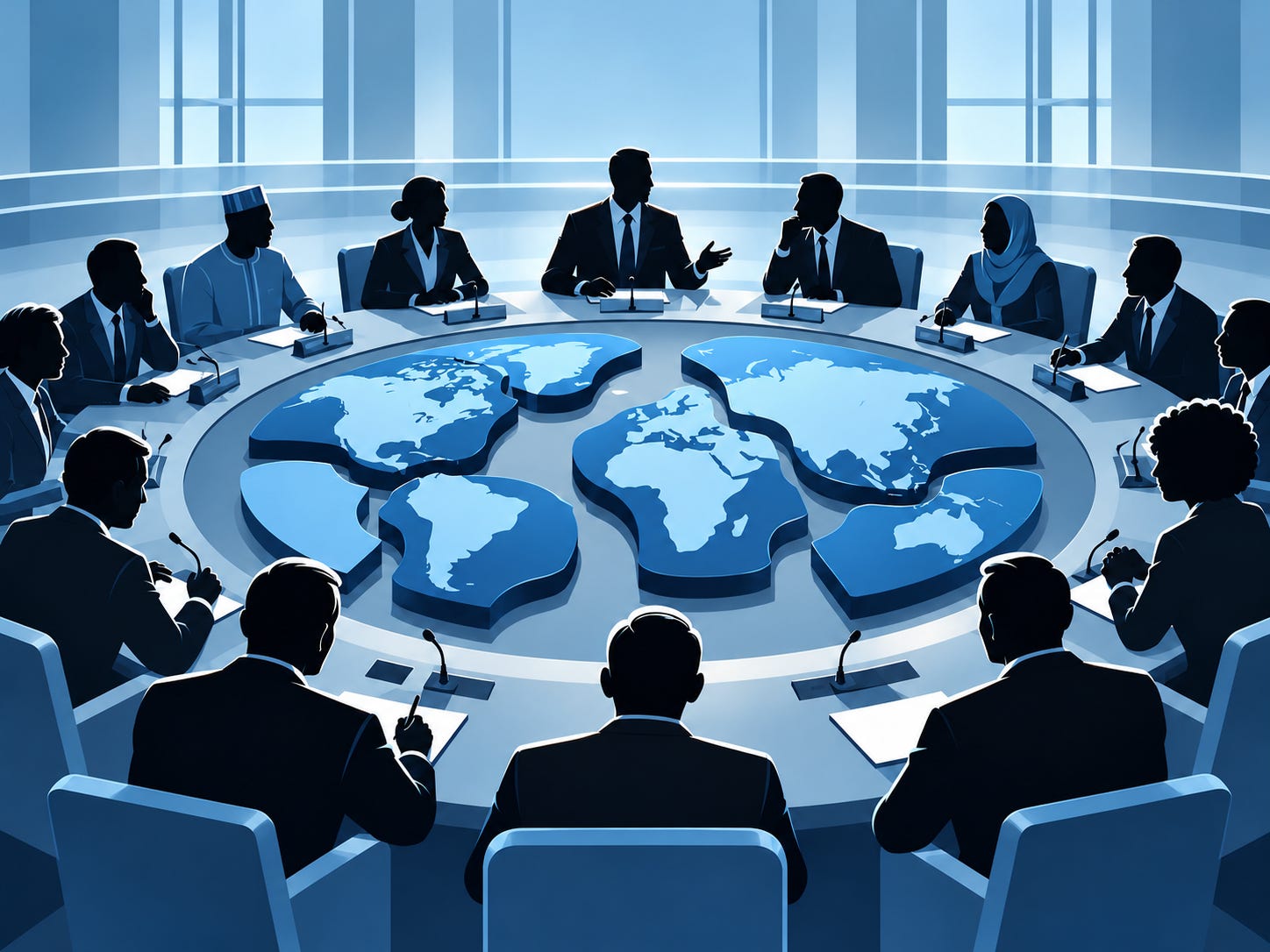
With the waning of the post-Cold War ‘peace dividend’, the world is again coalescing into spheres of influence and power hierarchies. Great powers exist alongside ‘middle powers’ – those with a significant level of international influence, but to a lesser extent than the great powers.
In Davos in January 2026, Mark Carney, Prime Minister of Canada, advocated for middle powers to collaborate with each other as great power rivalry intensifies. While such efforts have occurred before – notably the Non-Aligned Movement of the Cold War – the effectiveness and relevancy of middle power coalitions is contested. Using this as the basis for this week’s Big Ask, we asked nine experts: Are middle powers natural allies of each other?
Senior Lecturer, SGH Warsaw School of Economics, and Senior Research Fellow, EU Programme, Polish Institute of Foreign Affairs (PISM)
Middle powers can be natural allies, but the challenges involved are considerable. Their central problem is aggregating and coordinating complementary resources to compensate for the concentration of power in a single great power. This requires military and industrial capacity, economic resilience, and – crucially – sustained political will.
The European Union (EU) illustrates this well: its 27 members possess enormous economic and significant military potential, yet converting these assets into a coherent strategic actor demands constant political efforts and investment, with no guaranteed success. As a result, American leadership of free and open nations remains extremely difficult to replace, providing both capabilities and a framework for coordinating allies.
This helps to explain why countries on the North Atlantic Treaty Organisation’s (NATO) eastern front – facing a persistent Russian threat – are reluctant to consider security arrangements premised on reducing the United States’ (US) leadership. As Carney argues, great power competition makes increased middle power cooperation highly desirable for the sake of greater resilience against coercion.
Yet, from a Polish and broader Central and Eastern European countries’ perspective, this does not make a ‘third path’ between great powers more feasible. Their fundamental strategic interest remains deterring Russia, which is best achieved through NATO and maintaining strong American engagement in Europe. Therefore, middle power cooperation can and should complement core alliances while enhancing participants’ ability to influence both partners and adversaries.
Poland’s relations with the United Kingdom (UK), the Nordic states, Canada, South Korea, and Japan show how countries can work together where interests converge. Defence and defence‑industrial cooperation, critical minerals, energy, cyber security, technology, and resilient supply chains are particularly promising. Nonetheless, middle powers’ strategic relevance will ultimately depend on transforming shared interests into collective capabilities rather than merely diplomatic coalitions.
Adjunct Fellow, Council on Geostrategy, and Senior Lecturer in National Security Studies, King’s College London
There is nothing inevitable about middle power solidarity. Middle powers are most likely to cooperate when a common problem creates a common interest. In periods of great power rivalry, that may mean they align most readily around what they stand against – such as coercion, forced choices between blocs, or the erosion of multilateral rules that give them room to manoeuvre. Indeed, the Non-Aligned Movement exemplified this. Coalition-building can also give states influence they would struggle to exercise alone.
Nevertheless, ‘middle power’ is a relative category, and it is deeply history-laden. Strategic cultures develop through geography, historical experience, available resources, and perceptions of threat. For instance, Japan and South Korea are both commonly described as middle powers, both are US allies, and both face many of the same pressures in East Asia. Yet, Japan’s imperial rule over Korea from 1910-1945 remains politically salient and continues to shape bilateral trust – a shared position in today’s international hierarchy does not erase yesterday’s relationships.
Middle power cooperation is therefore likely to be pragmatic and issue-specific, far from automatic. Carney’s rousing proposition is most persuasive as a call for flexible coalitions, whereby states work together where their interests coincide while accepting that they will diverge elsewhere. In this spirit, middle powers can find common cause, particularly when great power competition threatens their room for manoeuvre, but that does not make them ‘natural’ allies. Whether in love or diplomacy, relationships will always take hard work.
Founding Director, Centre for Britain and Europe; and Head, Department of Politics and International Relations, University of Surrey
The question of whether middle powers are natural allies highlights a significant geopolitical debate unfolding in both Europe and Canada, but with striking differences.
From Ottawa’s perspective, Carney remains the most prominent advocate of middle powers, both as a necessary counterweight to superpowers, and as natural partners. His landmark Davos address was a warning that the international order was experiencing ‘a rupture, not a transition’ and called for medium-sized liberal democracies to withstand geopolitical challenges collectively.
Imposing retaliatory tariffs on the US (ironically, alongside the People’s Republic of China [PRC]) in response to Washington’s trade war, Carney was adamant in his recent speech to the European Parliament that his vision is not of ‘a great power rival – only with better manners’ but a nimbler, ostensibly values-based cooperation among democracies such as Canada, Nordic nations, Australia, Japan, and EU member states – many with shared concerns over American capriciousness, and Russian and Chinese ambitions.
European reactions, however, have been ambivalent. Despite the broad endorsement by Ursula von der Leyen, President of the European Commission, of Carney’s ‘middle powerism’, the suggestion that Canada become an ‘associate member’ of the EU received a decidedly cool response.
Carney considers Canada both the definitive middle power and European in calling, while European decision-makers argue that the EU itself is hardly a middle power. While certainly a convenient collection of middle powers, the real question is whether the EU regards itself as a coalition for them, particularly as a balance against overactive great powers.
Carney’s vision presupposes that middle powers can and should work together, but not necessarily to the limits of pooling sovereignty or aggregating into a great(er) power to succeed. Having pooled significant amounts of power, competence, policy, and influence, Europeans – at least those keen on developing the EU’s strategic autonomy – already regard themselves as a great power, albeit an uneven one.
Whatever the differences, Canada has upped its geopolitical game: a visible and useful improvement in the eyes of Brussels. Equally, Carney’s words about deteriorated Canadian-American relations remain a cautionary tale for European nations: ‘a trade relationship that was once a great strength has now become a serious vulnerability’.
Prof. Robyn Klingler-Vidra and Prof. Ramon Pacheco Pardo
Professor of Political Economy and Entrepreneurship, King’s College London; and Professor of International Relations, King’s College London
Middle powers can work together, but are not necessarily natural allies. They may share an interest in preserving room for manoeuvre amid intensifying American-Chinese rivalry, but their economic dependencies, security relationships, and national interests differ too greatly to make a durable ‘middle power club’ easy to build, let alone to sustain.
For countries such as the UK, one option is simply to wait out the remaining years that Donald Trump will be President of the US. However, this overlooks an important feature of Trump’s approach to international relations: his predisposition for ‘the art of the deal’ – as well as his track record of bilateral negotiations.
Additionally, most of the bilateral agreements that the Trump administration signs are likely to survive, given their economic, security, and diplomatic benefits for the US. Rather than seeking strength primarily by banding together, middle powers should focus on increasing what they individually bring to the negotiating table. This means cultivating what can be called ‘niche superpowers’: areas of concentrated economic, technological, or regulatory strength that confer disproportionate strategic relevance relative to a country’s overall material capabilities.
South Korea offers a useful example. Faced with Washington’s tariff pressure in 2025, Seoul made its shipbuilding capabilities central to negotiations through its ‘Make American Shipbuilding Great Again’ (MASGA) initiative. A sector in which South Korea possesses exceptional capabilities became leverage in its negotiations with Washington.
The lesson for middle powers is not that cooperation is undesirable. Coalitions can amplify their influence when interests align. However, autonomy in a transactional international order ultimately rests on each nation state’s strategic indispensability. Cultivating capabilities that great powers need may offer middle powers a more reliable route to national self-determination than attempting to stand behind a lasting club among themselves.
International Fellow, Council on Geostrategy, and Assistant Professor of International Relations, University of Waterloo (Canada)
No country is ever a natural ally of another. After all, alliances are the product of geostrategic priorities, political interests, and even cultural affinities. Alas, even these factors hardly guarantee their formation, and thus if alliances themselves are indeterminate, then so is the concept of ‘middle powers’ – an ambiguous category of states that are neither great nor minor but somewhere in between.
Still, what Carney had in mind is how countries with sufficient bandwidth have a shared interest in being stewards of an international order that has long been dependent on the preponderance of American military and economic power for its own functioning.
This idea is appealing, but it is nevertheless hard to imagine that the usual candidates for middle power status – for example, Canada, Australia, Brazil, Türkiye, South Korea, and Mexico – would not only agree on what to do together, but would also provide the capacity necessary for guaranteeing freedom of the seas, providing a common and global reserve currency, and acting with sufficient unity to overcome the collective action problems that a strong and willing US has arguably done in the past. To say nothing of other potential middle power candidates, those countries put together differ enormously in their military capabilities, strategic interests, cultural perspectives, and international goals to be a coherent bloc.
Yet, disorder is not inevitable either. Even with Washington setting the highest tariffs since the 1930s, for example, many countries appear to recognise that beggar-thy-neighbour policies are a dead end, and can find scope for mutually beneficial cooperation all the same.
Lecturer, Department of Defence Studies, King’s College London
Middle powers, particularly those of the so-called ‘Global South’ rather than European NATO members, are not necessarily natural allies, but they often share important diplomatic interests. Many support key elements of the liberal international order while advocating reforms to make international institutions more representative and responsive to developing countries. They also tend to value multilateralism and strategic autonomy, seeking to avoid excessive dependence on any single great power or becoming entangled in great power competition.
At the same time, middle powers are rarely united by common security interests. Their foreign and security policies are largely shaped by geographical realities, meaning that states respond primarily to challenges in their immediate neighbourhoods. As a result, the security concerns of a Gulf state, a Southeast Asian country, and a Latin American power may differ considerably, limiting the scope for meaningful strategic cooperation.
Relatedly, limited military capabilities and resources further reduce middle powers’ ability to support one another across regions. Moreover, supporting another middle power on a particular issue may risk damaging relations with a more powerful state.
As a result, while middle powers often share a common vision of international order, differences in geography, security concerns, and national interests frequently limit cooperation in practice. Their relationships are therefore characterised as much by pragmatism as by solidarity.
Professor, International Christian University; Senior Fellow and China Project Lead, Macdonald-Laurier Institute; and Centre for Global Outreach Fellow, Japan Institute for International Affairs
Carney’s Davos speech pitched an attractive idea. In short, a coalition of middle powers would band together to survive the crossfire of great power rivalry. It sounds great on paper. However, assuming these nations are natural allies is a fundamental mistake.
Just because countries share a fear of weaponised trade and shrinking diplomatic space does not mean that they share a game plan. Advanced middle powers and developing countries might both hate being bullied by superpowers, but their actual goals rarely align. Developing nations are not looking at this through a ‘Western’ moral lens. More often than not, they want practical deliverables such as market access, technology transfers, and infrastructure.
Talk is cheap, and building a real coalition is a massive headache. Look at Canada’s own track record. The 2017 Trans-Pacific Partnership walkout mess in Da Nang is a perfect example of how countries do not get to claim leadership just by giving good speeches. Trust has to be earned through actual burden-sharing.
The world is now stuck in a rigid bipolar system, and countries cannot put off picking a side forever. Pretending that American unpredictability is exactly the same as Chinese revisionism is a massive strategic blunder. Middle powers are not magically going to unite just because the geopolitical climate is getting tense. If they want to survive, they need to drop the wishful thinking and start doing the hard, unsentimental work of building real frameworks and actual credibility.
Co-President (Research), Council on Geostrategy
Whether middle powers are natural allies depends entirely on how the term ‘middle power’ is conceptualised. If it is defined strictly through a positional lens – merely as states that are neither superpowers (the US), or major powers (Britain, France, and the PRC) – middle powers do not make for natural allies of one another. Under this positional perspective, alignment is driven by national interests, the regional security dynamics, and geopolitical convenience rather than shared status.
True, ‘middling countries’, such as Russia, Türkiye, Japan, India, Indonesia, Germany, Australia, and Canada share a structural classification, yet their strategic priorities are very different. Their relations remain transactional; they pursue sovereignty, or coalesce around greater powers (such as Canada and the Nordic and Baltic states are with the UK through the Joint Expeditionary Force [JEF]).
If, however, the term ‘middle power’ is understood as a normative identity – defining states that embrace international law, multilateralism, and the so-called rules-based international system – a stronger case emerges for natural convergence. Under this classification, middle powers such as Canada, Australia, Japan, Germany, and Sweden share a foundational interest in preventing greater powers from overriding their interests. They embrace multilateralism and pursue global governance structures in order to prevent geopolitical and geoeconomic revisionism.
Perhaps the real question is whether states should willingly embrace ‘middlepowerdom’ in this normative sense, as Carney recommends. For some, it is a strategic necessity, making them natural partners out of shared vulnerability.
Britain, however, has the luxury of playing both roles: it has close pre-existing relationships with many normative middle powers, but it also retains the raw strength, nuclear capability, and global reach to act as a geopolitical centre of gravity (e.g., through the JEF, AUKUS, and NATO). For the UK, the imperative is not to shrink into the middle tier, but to leverage its position to offer security and structure to those that do.
Research Fellow (Indo-Pacific Geopolitics), Council on Geostrategy, and PhD Student, Department of International History, London School of Economics and Political Science
Shared interests make partnerships; shared values make them a natural fit. Despite Carney’s emphasis on pragmatism, he does acknowledge this. The two exemplars of ‘variable geometry’ that he holds up – the Coalition of the Willing and Security Action For Europe (SAFE) – are composed of democracies.
Among like-minded countries, ad hoc groupings and minilaterals make sense. In certain circumstances, their nimbleness may give them an edge over large, legacy arrangements. Indeed, they can enhance and complement the existing US-led alliance system. Yet, Carney appears to be presenting a different proposition: that ‘new networks and…pragmatic alliances’ provide an alternative to, or even a counterbalance against, American power.
Proponents of middle power coalitions argue there is no choice, given the US’ turn inward and against its allies. Yet, Trump is sui generis. Assuming his approach will permanently define American foreign policy would be premature. Traditional internationalist currents remain powerful in the Democratic and Republican parties, and among the American people.
It would be better for free and open nations to encourage these tendencies and collectively build frameworks to constrain any rash unilateralist impulses within Trump’s successors. They would be better placed to do so if they also address one of Trump’s major – and entirely legitimate – criticisms: their underspending on defence. Done properly, the US-led alliance system, more balanced than before, could emerge stronger.
Trying to obtain security and prosperity through middle power coalitions would be neither feasible nor desirable. The US is the world’s premier military power, its economy continues to outperform those of Europe, and American companies lead the global race in Artificial Intelligence (AI).
The only serious alternative to American pre-eminence is Communist Chinese pre-eminence. Yet, those who promote middle power coalitions appear to understate the stakes of this great power competition, while simultaneously bemoaning the breakdown of an order only made possible by Washington’s triumph in the Cold War.
In the late 1940s, Ernest Bevin, then Foreign Secretary, was able to prevent a war-weary US from abandoning European security – and consequently, NATO was born. This can be done again. Like-minded middle powers can form bespoke partnerships, but they should not write off nor dismiss the value of American leadership.
If you enjoyed this Big Ask, please subscribe or pledge your support!
What do you think about the perspectives put forward in this Big Ask? Why not leave a comment below?