

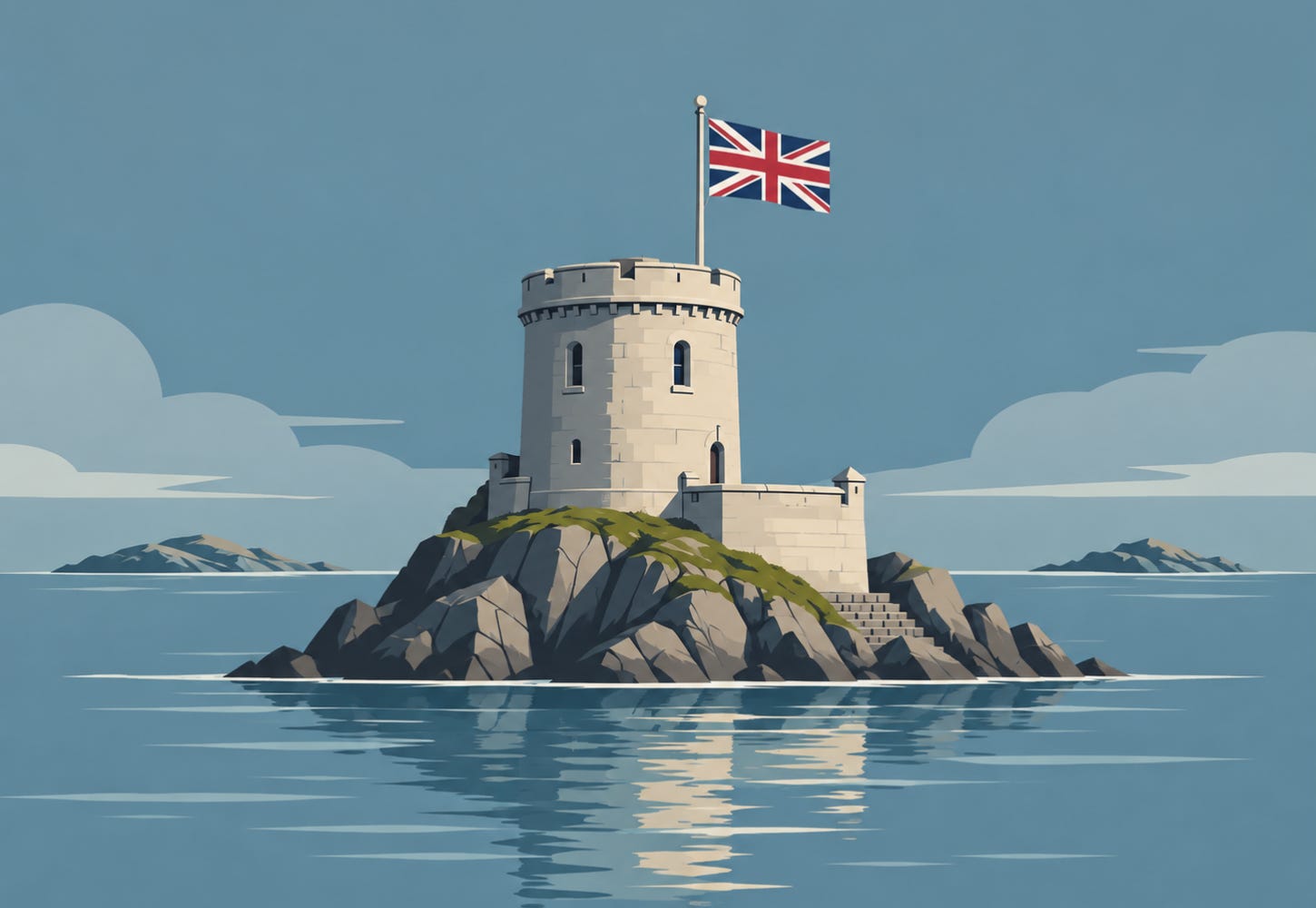
In recent weeks, multiple actors have questioned the sovereignty of particular British territories. Argentina has renewed its spurious claims over the Falkland Islands; the Maldives has asked His Majesty’s (HM) Government to reopen discussions about the British Indian Ocean Territory (BIOT) – with Andy Burnham, Prime Minister, announcing that his administration will move forward with the planned deal with Mauritius – and the first ministers of Scotland, Wales, and Northern Ireland met in Cardiff to sign an agreement calling for independence referendums in their respective constituent countries.
Great powers have also become embroiled in the debates over the United Kingdom’s (UK) territory. The People’s Republic of China (PRC) is a close ally of Mauritius and supports its claim to the BIOT, while Donald Trump, President of the United States (US), has suggested that Washington may not support London over a new Falklands conflict, as well as stating that a united Ireland would be a ‘fantastic thing’. Considering these developments, and the inevitability of adversaries taking advantage of them, this week’s Big Ask poses the following question to five experts: How should Britain respond to those with designs on its sovereign territory?
Professor of Foreign Policy and International Relations, The Open University, Associate Fellow, Chatham House, and Associate Commissioning Editor, International Affairs
The UK faces multiple challenges to its sovereignty, both domestically and abroad. Its response will vary according to the case, but should be based on the following five ‘D’s:
Firstly: Deny rival claims. This comes in two parts, denying the facts of the claim, and denying the oxygen of publicity to those looking to provoke a spat. A simple restatement of the British position is often preferable. Claims can be evoked in bad faith for populist electoral reasons (as with the sudden interest in the Falklands expressed by Javier Milei, President of Argentina, as his net disapproval rating nears -30).
Secondly: Discredit rival claimants. Many threats to the UK’s territory are overtly or covertly nurtured by authoritarian governments or populist politicians. Diplomacy and information warfare could be deployed to undermine their legitimacy, such as by drawing attention to corruption, human rights abuses, and domestic social or economic problems. ‘Whataboutism’ can be a useful technique to highlight hypocrisy.
Thirdly: Deter hostile states. Where a military threat exists, Britain must ensure that it has sufficient resources to respond if attacked to deter an adversary from trying in the first place.
Fourthly: Distract adversaries. Many states have boundary disputes with neighbours, civil and ethnic tensions, and internal political divisions. If rival governments are looking to subvert British sovereignty, the UK has the option of responding robustly in turn, either overtly or covertly. Funding can be diverted to opposition groups and separatist movements. International legal cases over their sovereignty can be supported. Problematic histories can be resurrected and disseminated.
Lastly: Demonstrate British commitment to its sovereign integrity. Government policy initiatives and good news stories should be announced with visits to all four nations, not just England. Commitment to overseas territories and dependencies should be demonstrated with ministerial visits and military rotations. A minimal approach to deterrence may be efficient, but it is not always effective (a Royal Navy presence off Cyprus, for example, may not have added much to the defence of Akrotiri in early 2026, but it would have shown that the UK was fully committed to its sovereignty).
Many of these five ‘D’s would benefit from the asymmetric approach recently advocated by the Council on Geostrategy. Above all, Britain should be clear that it will defend its sovereign territory, using the full spectrum of its means of influence, from now on.
Honorary Fellow, Council on Geostrategy; Author of the podcast The Wargame; and Director of the Changing Character of War Centre, Oxford University
The notion of sovereignty has been so long established, it is easy to forget the struggles of its origins and how much blood has been shed to establish and preserve it. It is a concept; not of territory, but of a people and their inheritance. It is, in essence, not simply a question of interests, but of our very nature. Attacking sovereignty, in whatever form, is an intolerable infringement of our being.
In 1945, after the world’s bloodiest conflict, there was a conscious effort to minimise conflicts over borders by the intervention of the United Nations (UN). The principle of self-determination, established in 1917 concurrently in the UK and the US, was enshrined in the spirit of the UN Charter, and was to be upheld by the permanent members of the UN Security Council.
Today, three members of that grouping are in breach of the charter: Russia, by its aggression against Ukraine and regional states; the PRC, by its coercion and threats towards Taiwan, the Philippines, and Japan; and even America, with its demands for sovereignty over Canada and Greenland, and some undiplomatic remarks about Britain with regards to Northern Ireland and the Falklands.
The response should be the quiet but firm diplomacy for which the UK has a considerable reputation and long experience. An advisory word, delivered off the record, can save hours of official talks and avoid embarrassment for all concerned.
We can dismiss absurdities. Buenos Aires does not have the armed forces capable of defeating the British garrison in the Falklands, nor its nuclear-powered attack submarines (SSNs), Carrier Strike Group, and the Royal Air Force (RAF). Washington has absolutely no intention of enforcing the unification of Ireland or carrying out an illegal attack on an ally. The Kremlin is not about to commit national suicide by launching an armed attack that would bring the entirety of the North Atlantic Treaty Organisation (NATO) against it. Beijing knows that an attack on Taiwan would cause economic retaliation that would cost a catastrophic 7% loss to its economy – some US$1.46 trillion (£1.09 trillion) worth of damage, and potentially more.
The bigger threat to sovereignty is, in fact, domestic. Nationalists and separatists see political mileage in pushing their independence agendas, hoping to use the European Union (EU) as leverage against London, even though they must realise that Brussels would be reluctant to take on the costs that England willingly meets in the Barnett formula.
This requires a different approach: a reiteration and remembrance of how, whole and entire, the British Isles left behind the old conflicts and united against the tyrannies of the world. That is the sovereign inheritance that should not, through ignorance and absent-mindedness, be given up.
International Fellow, Council on Geostrategy, and Assistant Professor of International Relations, University of Waterloo (Canada)
Milei appears to have ratcheted up his country’s claims on the Falkland Islands out of the sense that the UK cannot do much about them. The Royal Navy is much smaller in 2026 than it was in 1982, and Britain is lurching from one domestic crisis to another amid a merry-go-round of prime ministers and deeply unpopular mainstream political parties. Worsening matters is that Trump has suggested he might review the US’ policy of supporting the British position on the disputed territory.
Indeed, the UK’s allies are under no obligation to render assistance if Argentina were to launch a military campaign against the islands, for they fall well outside the geographical scope defined by the North Atlantic Treaty. London can count on receiving verbal affirmations about the territorial status quo, the inviolability of borders, and peaceful conflict resolution from its allies and partners. However, such niceties would not deter a resolved and armed Argentina.
The best that HM Government can probably do is to convince Trump and his administration that they could go without a new foreign policy crisis which would unsettle markets and divert scarce policy attention. Trump may very well come around to the British position, but the sooner the better, so that Milei does not risk making the same miscalculation as Leopoldo Galtieri and his junta did in 1982.
Law, Defence, and Geopolitical Affairs Researcher
The territorial sovereignty quandaries that currently besiege the UK are not entirely uniform, but share a common thread: an imperial past. Under the provisions of the UN Charter, territorial integrity remains a fundamental right of states, albeit with definitive prohibitions. How territory is obtained or secured in an ostensibly post-colonial era continues to pose moral and legal questions for all nations.
What continues to pang the United Kingdom of Great Britain and Northern Ireland though is the poorly addressed aftermath of that changing order. Like the recent meeting of the devolved nations named specifically, this is Westminster’s problem above all else.
The heart of the issue is self-determination. This holds for the question of devolution, the BIOT, and the Falkland Islands. Argentina’s arguments against the UK – based on colonial grounds – disregard modern realities, administration, and history (and paradoxically simply advance colonialisation by Argentina). As the International Court of Justice adjudged, however, the Chagos issue is a matter of decolonisation, which cannot be viewed without respect to the unjust displacement of the Chagossians themselves.
At the same time, Britain’s primary defence, legally and politically, would be in representing the contemporary wishes of the Chagossian people. Yet, doing so in name but not in action weakens the UK’s right as an administrator, and responsible power. It should be clear that it is not Trump’s comments about a united Ireland which threaten Britain, it is the failure to appreciate that the UK is not England.
The recent Cardiff meeting illuminated the hubris of Brexit, which pulled the smaller nations out of a deeply needed customs union. Westminster cannot continue to take its position for granted. As is often the case, if the UK is concerned about remarks or ‘designs’ on its territorial integrity, it must first secure matters at home.
Co-President (Research), Council on Geostrategy
The response to this question should be short and simple. Competitors and adversaries with designs on a foreign power’s sovereign territory grow bolder when they smell weakness. Until Britain reasserts strength – by regenerating the Union, rebuilding its armed forces, and prioritising national interests over international law – those with designs on its sovereign territory will only grow louder.
At this stage, it is not about responding to every transgression. The UK needs to reassert itself more generally: firstly, by ceasing with ‘own goals’ such as the peculiar decision to surrender overseas territories for no good reason; secondly, by regenerating civic nationalism at the British level to overcome regional secessionist forces; and, thirdly, by promoting the great feats of British ingenuity – from the steam engine and penicillin to the eradication of chattel slavery and the creation of parliamentary democracy – that have immeasurably improved the human condition.
If you enjoyed this Big Ask, please subscribe or pledge your support!
What do you think about the perspectives put forward in this Big Ask? Why not leave a comment below?
The UK could and should do more to support adherence to international law beyond the Russian invasion of Ukraine. The illegal Israeli occupation of the Palestinian West Bank and ongoing genocide in Gaza are examples where sanctions and divestment could be used by the UK to encourage compliance with UN directives and other aspects of international law. This would enhance UK soveriegnty and support the rules based order generally.