

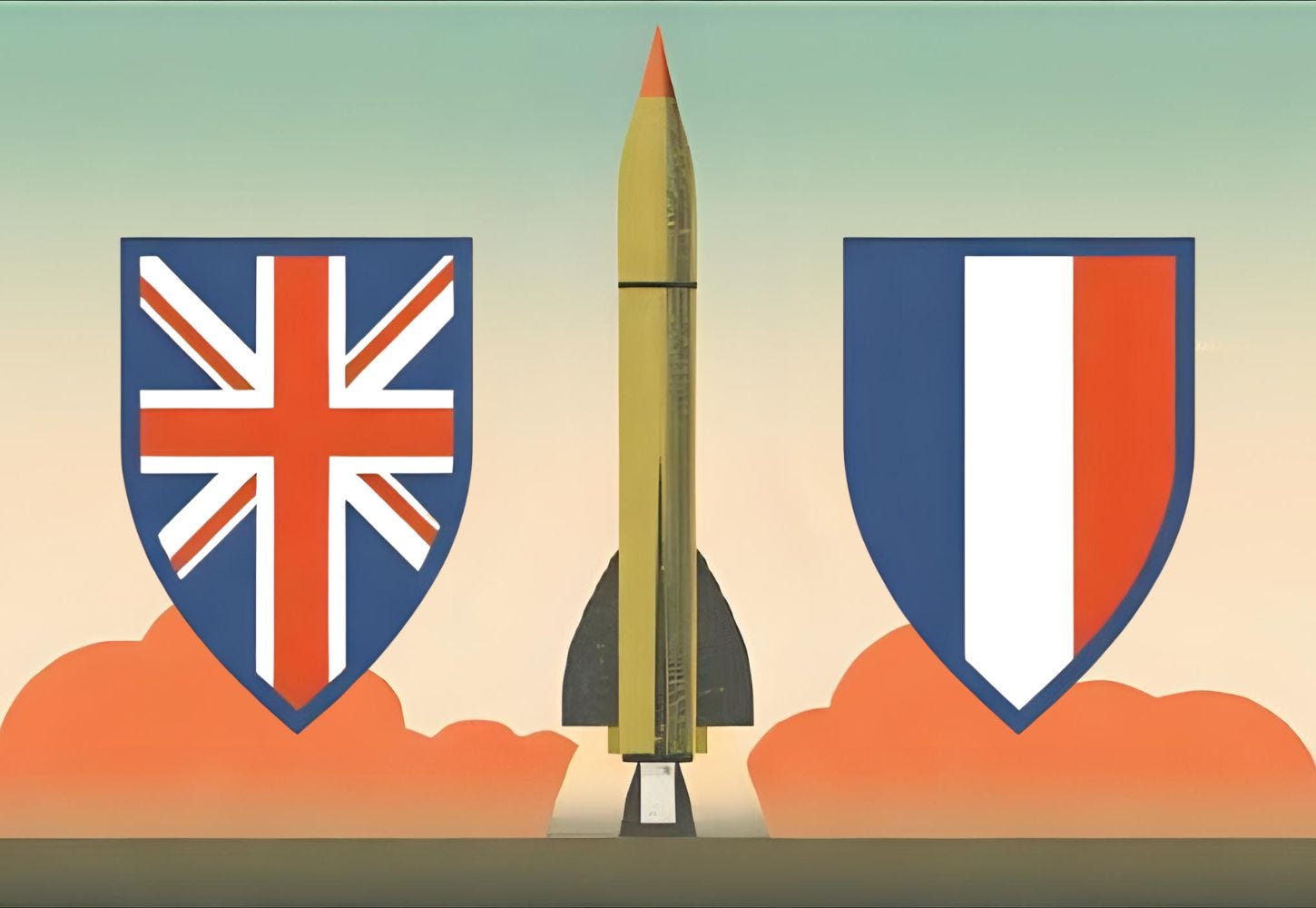
During his state visit to the United Kingdom (UK) last week, Emmanuel Macron, President of France, signed a joint declaration with Sir Keir Starmer, Prime Minister, on nuclear cooperation between Britain and France. The Northwood Declaration highlights that while both countries’ nuclear arsenals remain sovereign, cooperation on nuclear deterrence can ‘contribute significantly’ to the security of the North Atlantic Treaty Organisation (NATO) and the Euro-Atlantic region.
The Northwood Declaration announces the formation of a ‘UK-France Nuclear Steering Group’ to shape nuclear coordination and reiterates both nations’ support for the Treaty on the Non-Proliferation of Nuclear Weapons, but does not offer any further guidance on bilateral nuclear cooperation. This absence provides the topic for this week’s Big Ask, in which we asked seven experts: How should Britain and France cooperate to realise the Northwood Declaration?
James Black
Deputy Director, Defence and Security, and European Lead, Space, RAND Europe
Of course, most of the details of deepening British-French coordination on nuclear matters will be highly classified, and any public messaging carefully controlled. From a deterrence perspective, the interesting question now is less what practical steps collaboration will entail, and more what early signs there might be of cognitive effects on different audiences. Deterrence is, after all, in the eye of the beholder.
The first of these is Russia, which the UK and France seek to deter. Beyond the expected Kremlin spin on the Northwood Declaration as ‘aggression’ and ‘provocation’, will Russia adapt its own nuclear doctrine and posture or modulate its signalling in the coming months?
The second audience is other European NATO allies – which Britain and France seek to reassure – who are conscious of increasing nuclear threats from Russia and the People’s Republic of China (PRC), of murmurings around proliferation in some capitals, and of renewed questions around extended American deterrence. Will Europeans push for additional assurance measures (e.g., deployments of French nuclear-capable aircraft) or prove broadly satisfied by recent announcements? Will they look to coordinate further with the UK and France on escalation management with conventional forces?
And what of the Trump administration in the United States (US), to whom Europe’s leading powers seek to demonstrate their commitment to burden-sharing? Or the Chinese, Iranians, North Koreans, or others equipped with, or contemplating acquiring, nuclear weapons which could threaten Europe?
To all of these, London and Paris have signalled fresh resolve: to coordinate, to deter, to reassure and to make clear their shared responsibility for securing Europe against ‘extreme threats’. Now, the test is whether other audiences hear such signals as intended – and whether they deem the message credible.
Research Fellow and Head of the Deterrence and Proliferation Programme, Security Studies Centre, French Institute of International Relations
British-French nuclear cooperation must now deliver concrete, high-value outcomes. First, operational coordination should intensify. Joint nuclear exercises, particularly as the Royal Air Force (RAF) rebuilds a nuclear culture, would strengthen mutual readiness. British and French forces should also explore mutual support in deterrent patrols, such as contributing to each other’s ballistic missile nuclear submarine (SSBN) dispersal and protection.
Second, sharing intelligence and coordinating targeting logic would enhance psychological credibility, reinforcing adversary perceptions of uncertainty and resolve. While the UK and France retain full operational independence, working in tandem adds a layer of ambiguity and strategic depth which benefits both nations.
Third, political alignment should be deepened. Britain and France should present a unified front on arms control and nuclear non-proliferation, preserving their equities as independent powers. Together, they can act as a diplomatic corridor – anchored in credibility – between the US on one side and Russia and the PRC on the other to keep the P5 Process alive.
Finally, they should sustain scientific and technical excellence. The Teutates Programme, including the EPURE facility, form the backbone of this collaboration and should be resourced and updated continuously.
Strengthening these pillars will not only reinforce deterrence for both countries, but also contribute to European and transatlantic strategic cohesion in an increasingly contested nuclear environment.
Professor of Foreign Policy and International Relations, The Open University, Associate Fellow, Chatham House, and Associate Commissioning Editor, International Affairs
As the Northwood Declaration reaffirms, the UK and France’s vital security interests are indistinguishable. It is therefore welcome news to hear that they are deepening their cooperation on nuclear matters. My only reservation is with the final paragraph referring to the Treaty on the Non-Proliferation of Nuclear Weapons and its obligations.
The deepening legal commitments around non-proliferation in the 1990s and 2000s were a product of their time, reflecting optimism about the possibility of trust and cooperation between Russia and its former adversaries. Since then, the 2015 and 2022 non-proliferation conferences ended without consensus, and in 2023, Russia suspended its participation in the New Strategic Arms Reduction Treaty, meaning that it is becoming increasingly hard to estimate its capabilities. Furthermore, on 19th November 2024, Vladimir Putin, President of Russia, approved a nuclear doctrine which lowered the threshold for nuclear use to include a large conventional attack by a non-nuclear state.
Russia has been upgrading and modernising its nuclear forces and developing new delivery systems for two decades. It has also made regular threats of nuclear use in regards to supposed red lines relating to its full-scale invasion of Ukraine.
Britain needs to ensure that it has a credible and flexible nuclear response to the threat Russia poses. While it has adopted the stopgap measure of acquiring F-35A Lightning II Joint Combat Aircraft – dual-capable aircraft able to drop nuclear bombs – the US is now too unstable an ally to rely on as the sole supplier of nuclear weapons. Ultimately, the UK will likely have to combine its efforts with France to develop alternative options. Doing this will come up against the maximalist legal position on nuclear sharing of the current non-proliferation regime, but, when it comes to security, governments do what they must.
Distinguished Professor, Centre for Security, Diplomacy and Strategy, Brussels School of Governance, VUB
Apart from physically de-conflicting the patrols of their SSBNs so that they don’t bump into one another, it might be helpful for Britain and France to coordinate schedules so that a Royal Navy Vanguard class submarine does not have to be at sea for an unplanned-for length of time due to refit problems on the other boats.
Once the UK acquires American dual-capable F-35As, British representatives might think through – with their French counterparts – options for the coordination of deployment and use of the French nuclear-capable Rafale and the UK’s F-35As in certain contexts. It would also make sense to bring in countries in whose territory these aircraft might be deployed, and/or which might be affected by their use – so best done within NATO.
British F-35As would carry US nuclear weapons subject to American permission, just as the F-35s of Belgium, the Netherlands, Italy, Germany and others do. It would thus have been preferable to buy Rafales and develop an independent British nuclear weapon to be deployed from them – which His Majesty’s (HM) Government seems unwilling to budget for. While the F-35A might have some technical advantages over the Rafale, the great doubt regarding US permission for nuclear use – debated extensively since the late 1950s – has, if anything, increased since Donald Trump began his second term as President of the US in January 2025.
Julien Lalanne de Saint-Quentin
Associate Fellow, Council on Geostrategy
Ultimately, the credibility of nuclear deterrence rests on three pillars: declaratory, technical, and operational.
The Northwood Declaration marks incremental, rather than transformational, progress on two of these pillars. Firstly, declaratory, through ever-closer recognition, initiated by the 1998 St. Malo Declaration, of the deep intertwining of the conditions under which the UK and France would use nuclear weapons. Secondly, technical, through the promise to expand the cooperation initiated by the 2010 Lancaster House treaties in the field of weapon simulation.
Without diminishing the significance of these two areas, it seems prudent to emphasise the importance of British-French cooperation in the third pillar: operational cooperation, particularly in the North Atlantic.
Geography (still) rules: the UK and France are, as the military say, ‘upthreat’. Their operational bases (Faslane and Île Longue) are not sheltered by a vast ocean, like King’s Bay, Georgia, is. They are also close to each other, which obviously explains the simultaneous acts of harassment regularly reported in the press by their adversaries (conducted by submarines, ‘scientific’ vessels, etc.).
Britain and France are playing a two-goal football match in the North Atlantic. It would make no sense for the players not to pool and share their defenders.
Lecturer in Security Studies and Director of David Davies Institute of International Studies, Department of International Politics, Aberystwyth University
The UK and France acquired their nuclear arsenals decades ago because they were spurned by, and distrustful of, the US, while also facing the hostile Soviet Union. There is a bit of irony in the fact that they now find themselves pondering the question of closer nuclear collaboration yet again because of renewed Russian aggression and American unpredictability.
Insofar as nuclear deterrence rests on a combination of capabilities, intentions and credibility, British-French nuclear collaboration will need to augment all three of these elements to achieve tangible outcomes.
The realm of intentions is easiest – but not easy – to shape. It would be a mistake, however, to dismiss the Northwood Declaration containing the commitment to ‘coordinate across nuclear policy, capabilities and operations’ as mere words which lack power. Anyone observing world politics today should understand that talk is not cheap. This declaration is not an exception.
Tangible outcomes therefore must go beyond announcing intentions which will complicate calculations of any would-be attacker. Given national sensitivities, it perhaps had to be stressed that the respective deterrents will remain independent. And there are also some strategic advantages derived from not fusing the two arsenals. Nevertheless, what should now follow is closer practical coordination concerning respective numbers of nuclear warheads, the means of their delivery, configuration and deployment of the two nuclear forces, and, last but not least, targeting.
Short of meaningful changes regarding ‘capabilities and operations’, the Northwood Declaration would actually leave both countries worse off. Their joint commitment would lack credibility.
Professor of International Relations, University of Kent
The Northwood Declaration lays an important foundation for a deeper nuclear partnership between the UK and France. To build on it meaningfully, both nations should invest in a full-spectrum infrastructure of shared expertise across the nuclear enterprise, from warhead science and delivery systems to strategic doctrine. This would enhance interoperability, allow joint development of key technologies and ensure both forces can operate in greater coordination.
For Britain, this is not about displacing the essential relationship with the US, which remains foundational. However, in an era of growing uncertainty in American politics – and the future direction of its international commitments – closer British-French nuclear cooperation is a prudent strategic hedge. It reinforces European resilience and sovereignty in deterrence, while staying firmly within the NATO framework.
The newly announced Nuclear Steering Group should now swiftly set out a roadmap for this collaboration: prioritising integrated strategic planning, joint wargaming, officer and civil servant exchanges at scale, and building greater redundancy through shared early warning arrangements. All of this would serve the purpose of creating a reservoir of trust and an intimate understanding of each other’s deterrence posture, which would significantly strengthen European NATO’s nuclear credibility – particularly in the face of persistent Russian aggression and an evolving NATO landscape.
A robust British-French nuclear partnership strengthens deterrence, increases resilience and ensures that Europe’s two nuclear powers are prepared to act in concert if needed – whether in support of NATO or, if future circumstances demand, independently of it.
If you enjoyed this Big Ask, please subscribe or pledge your support!
What do you think about the perspectives put forward in this Big Ask? Why not leave a comment below?
This is an intetesting article. I would also have liked to have seen the UK pivot towards the nuclear capable Rafale rather than the F-35A. Recent events in Ukraine have shown that the US cannot be relied upon to defend Europe and selecting a system that depends on the US President to authorise it's use just increases that dependence. This dependence on the US also appears to constrain our willingless to act independently when it comes to other foreign policy matters. An example of this is the UK's failure to take any meaningful action to prevent the atrocities by Israel and it's genocide in Gaza.