

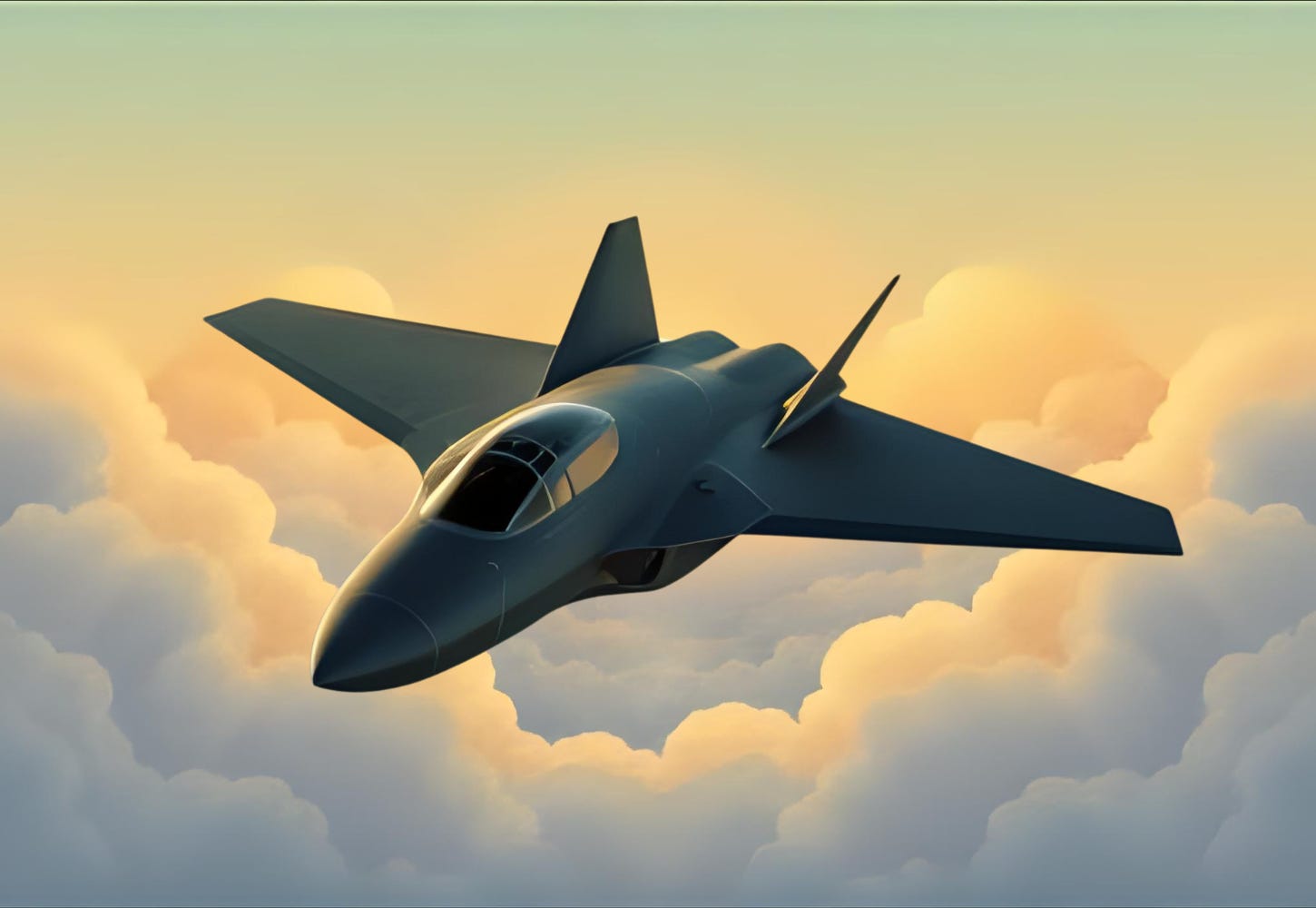
On Monday, the new headquarters for the Global Combat Aircraft Programme (GCAP) – the trilateral arrangement between the United Kingdom (UK), Italy and Japan for developing a next-generation combat aircraft – was opened in Reading. At the same time, concerns have arisen over the Future Combat Air System (FCAS) – a European equivalent to GCAP involving France, Germany and Spain.
There is an ongoing debate as to whether GCAP would benefit from additional partners, with Germany, Sweden and Saudi Arabia having been discussed as potential candidates. As well as enhancing the security of Britain’s allies and partners, expanding GCAP would also assist in distributing the costs of the programme. On the other hand, it could create delays or reduce workshare for existing partners. With these debates in mind, for this week’s Big Ask, we asked six experts: Should GCAP be opened to other countries?
Research Fellow (National Security), Council on Geostrategy
The answer is both yes and no.
No, because complex military development programmes like GCAP are incredibly difficult to design and deliver. History is littered with as many abandoned projects (such as the MBT-70) as it is successful ones (such as the F-35 Lightning II Joint Combat Aircraft). Establishing workshare agreements and the myriad other necessary industrial arrangements between the UK, Italy and Japan was not easy. Adding in another partner, which would have its own capability, industrial and fiscal demands, would at worst risk destroying what has already been established and at best significantly delay it.
However, the answer is also yes for two separate reasons. Firstly, GCAP will be an incredibly expensive project, at a time when other long-term and short-term military programmes are crying out for investment, and government finances in all three partner countries are facing their own struggles. Additional upfront investment would be a welcome boost. Given that bringing in a full partner is a bad idea, this upfront investment could be sought in return for a guaranteed subsidy for future exports for those willing to invest. This would be doubly beneficial in that it would also help industry establish early indications of appetite for increased production numbers.
The other area where expanded partnership could prove beneficial would be in joint development of Uncrewed Combat Aerial Vehicles (UCAVs), to work alongside the Tempest fighter and potentially other programmes such as the United States’ (US) F-47, South Korea’s (fifth-generation) KF-21 or FCAS.
Ben Goodwin*
Typhoon Pilot, Royal Air Force, and Associate Fellow, Council on Geostrategy
Grand strategy, such as national industrial and foreign policies, drives international armament collaborations. Operational priorities, such as project finance and military capability, usually suffer. GCAP’s current intergovernmental structure will give preference to the strategic; it should not expand beyond its three founding partners.
An expansion would divert resources into discussions about contributions, security, work share and negotiation space. In the medium term, system developments will be more complicated, pulling still more resources and energy into negotiations.
For these reasons, international collaborations have a poor record of delivery to time, cost and specification. GCAP should be left to focus entirely on its product, applying any spare capacity to advance the schedule and reduce the budget. Successful collaborations are either driven by a single nation and supported by many (e.g., the F-35 programme), or by an independent executive, free to pursue specific project outcomes over national policy goals (e.g., Intelsat).
Britain, Italy and Japan are aligned as liberal democracies seriously interested in defence. However, they are remarkably different in foreign policy and threat perception, as well as culture and language, making this already an extremely complicated programme.
Additional partners may bring benefits such as financial or technological resources. But under the existing governance, definite impediments outweigh the uncertain benefits of any new member.
Executive Editor, Internationale Politik Quarterly and Internationale Politik
Should GCAP be opened to other countries? Yes.
The reason is another four-letter acronym: FCAS. Pursued jointly by France, Germany and Spain, the project to produce a next-generation fighter jet was launched in earnest in 2017 by Emmanuel Macron, President of France, and Angela Merkel, then Chancellor of Germany. It has been ill-fated from the start.
Almost a decade later, the lead companies – France’s Dassault and Airbus – are still engaged in hand-to-hand combat over how to work together. Recent reports suggest that Dassault is attempting to move the goalposts, allegedly now demanding an 80% workshare – not an attractive proposition from Berlin’s point of view. Additionally, there is the unambitious, from-another-era timeline, with deliveries expected no earlier than well into the 2040s.
When Macron visits Berlin in late July, Chancellor Friedrich Merz will have drawn his own conclusions. Does FCAS, envisioned as a bilateral prestige project, still make sense? Leaving it to Dassault and instead joining the competition – which promises to be more agile and cost-conscious – would certainly deliver a blow to the French-German relationship at a time when hopes are high for a renewal. That relationship, however, may be better served by new defence projects which entail real French-German cooperation, rather than clinging to those which do not.
Postdoctoral Fellow, Finnish Institute of International Affairs
The opening of the GCAP headquarters is significant for European security. Mixed political signals from the Trump administration have the North Atlantic Treaty Organisation’s (NATO) European members facing difficult dilemmas in security planning.
Last month’s NATO summit in The Hague has created nervous European expectations that American military drawdowns proposed for the continent might not be as tumultuous as were first anticipated. However, transatlantic cooperation remains dubious, with little guarantee that it can boost European security to cope with rising strategic competition.
Competing with multiple sixth-generation fighter programmes globally, GCAP must gain a technological edge on its competition while diversifying its industrial base to be less dependent on American supply chains. Visions of European Union (EU) strategic autonomy are evolving, and Britain is seen as an indispensable partner. GCAP helps to evolve these visions further by including Japan’s competitive technological innovation capacities to support a capability which will define future European military operations. Italian membership anchors GCAP in the EU’s strategic progression.
Interoperability in strategic airpower also underpins Nordic defence cooperation. Finland will watch with interest if neighbouring Sweden accepts future fighter development opportunities that Stockholm has previously considered with GCAP partners. Possible Swedish entry could be vital to ensure that GCAP becomes the sixth-generation programme of choice in the wider Nordic region.
Research Fellow (Sea Power), Council on Geostrategy
When thinking about GCAP, we should learn from the experience of the biggest international joint procurement project to date: Joint Strike Fighter, which produced the F-35. The Joint Strike Fighter programme was intended to create a common fifth-generation fighter which would satisfy the requirements of several military services, while providing economies of scale in procurement and unprecedented interoperability in service – all benefits which GCAP also intends to bring. However, these intentions were challenged by daunting technical requirements, overly complicated bureaucracy and overruns on both costs and scheduling. It is notable that the American experience of the programme has led to it not joining either GCAP or FCAS, preferring instead to go it alone for its future sixth-generation aircraft.
Although it is eminently possible for the GCAP nations to learn the lessons of the F-35, and fix some of the problems which led to the cost and time overruns, the more nations that are involved, the more complicated the programme becomes – and the more likely it will be for these problems to arise. The addition of any other partner nation should only be attempted after a rigorous cost-benefit analysis, balancing the downsides of adding complexity with the potential upsides of more cost-sharing, more interoperability and access to that nation’s industrial base. The GCAP nations should also remember that partner nations do not need to be added to the programme outright to benefit – they could simply buy the aircraft once it comes into production.
Senior Research Fellow, Indo-Pacific Security, RUSI
Japan’s sense of operational urgency gives it a distinct perspective on GCAP expansion. Japanese pilots are going up daily against ever greater numbers of increasingly sophisticated fifth-generation Chinese planes and air defence systems, sometimes combined with the Russian Air Force. These aircraft now enter Japanese territorial airspace, including above the Senkaku Islands, which the People’s Republic of China (PRC) claims as Chinese.
Japan’s defence planners, expecting their current fourth-generation F-2 fighter to go out of service in 2035, are therefore keen to minimise the possibility that expanding GCAP could cause delays, necessitating an extended F-2 operational lifespan. Establishing a smooth working culture with Italy and the UK has taken some effort, and Japan, having relatively less experience with multilateral collaborations, will be sensitive to the structural complications which a greater number of partners may bring.
Having more defence funding available than Britain and Italy, Japan is less driven by the appeal of spreading costs across more countries. However, it is internationalising its defence industry, and is alert to the diplomatic leverage which defence collaboration and exports provide. Tokyo’s response to the attacks on Iran in June is a reminder that there are a few exceptions to its foreign policy alignment with London and Rome.
*This response was written by the author in a personal capacity. The opinions expressed are his own, and do not reflect the views of HM Government or the Ministry of Defence.
If you enjoyed this Big Ask, please subscribe or pledge your support!
What do you think about the perspectives put forward in this Big Ask? Why not leave a comment below?
Dr Philip is entirely correct.
The Geopolitical situation calls for partnerships uncluttered by actors who put commercial interests above the geo strategic.