

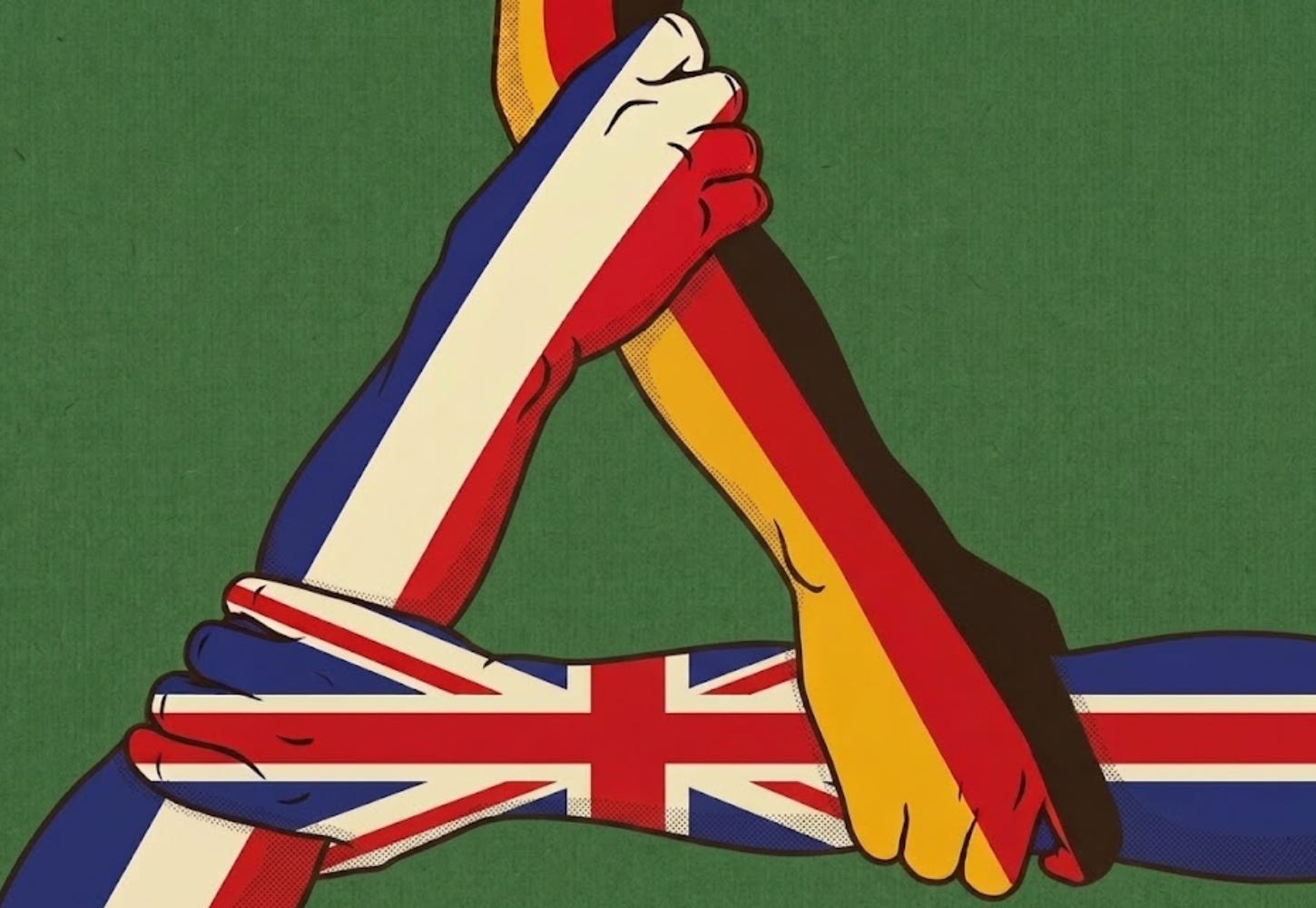
The European Three (E3) is an informal grouping of the United Kingdom (UK), France, and Germany – arguably the three most powerful countries in the European continent. Having convened for the first time in 2003 in the wake of the United States (US)-led invasion of Iraq, it seeks collaboration on common foreign and defence policy between the three nations.
Despite its turbulent relationship with European nations following Brexit, the UK maintains security ties with France and Germany through membership of the North Atlantic Treaty Organisation (NATO), bilateral agreements signed with each country, and shared security interests. As such, for this week’s Big Ask, we asked seven experts: How can Britain work more effectively within the E3 to advance its national security objectives?
International Fellow, Council on Geostrategy, and Executive Editor, Internationale Politik Quarterly and Internationale Politik
Originally formed in 2003 to negotiate a nuclear agreement with Iran, the E3 laid somewhat dormant after the Brexit vote, but emerged recently as Europe’s most effective troubleshooting grouping, especially with a view to Ukraine. That Ukraine’s future is now again being discussed not in a triangle (US-Ukraine-Russia), but in a quartet with Europeans included, is one of the recent achievements of the E3 that is highly regarded by Germany.
However, the E3 could be much more, including a vehicle for the UK to advance national security objectives. This is particularly true in two respects: forging greater strategic alignment on – and organising – a future European deterrence and defence that will likely have to make do with a much-reduced American contribution; and coordinating much more closely on European strategic engagement in the Indo-Pacific.
For that to happen, the E3 needs to hold regular meetings at the top level. That changes at the presidential and head-of-government level are afoot in France (April 2027), possibly in Britain, and perhaps even in Germany (Friedrich Merz, Chancellor of Germany, faced headlines speculating about his future this week), only reinforces the point: an effective E3 needs a meeting of minds at the top. To function well, effectively, and long-term, however, the E3 will need to set up permanent working groups and institutionalise the format in various other ways. This requires diplomatic capital that would be well spent on such an endeavour.
Research Fellow, School of Economics, Politics, and International Relations, University of Kent
Six years after the withdrawal of the UK from the EU, the E3 remains the most accessible vehicle through which Britain can shape European security deliberations without sitting at the EU table. Its value lies not in institutional weight, but in precisely the opposite: a format informal enough to survive Brexit, flexible enough to move faster than EU machinery, and intimate enough to align positions before they harden. Yet, the UK has too often engaged reactively – a pattern that successive strategy documents have failed to correct.
The current moment demands a different approach. With US-led mediation on Ukraine stalled and Berlin explicitly naming the E3 as Europe’s renewed diplomatic instrument, Britain can advance three concrete national security objectives: shaping peace settlement terms before they are fixed by others; ensuring Ukraine’s security guarantees reflect UK commitments rather than being subcontracted to EU mechanisms excluding London; and anchoring NATO cohesion amid transatlantic uncertainty.
The E3 is also the most credible channel through which Britain can influence the EU’s emerging European Security Strategy – as an indispensable partner whose positions Paris and Berlin carry inward – while proving the Labour Party’s reset delivers strategic value, not goodwill alone.
The UK’s nuclear status, expeditionary credibility, and intelligence relationships confer a standing neither France nor Germany can replicate. The architecture is there; now His Majesty’s (HM) Government just needs the political will to use it.
Senior Analyst, Foundation for Strategic Research (FRS)
The July 2025 Northwood Declaration paved the way for political, technological, and above all operational coordination between Britain and France in the nuclear domain. At the same time, both countries have each initiated in-depth strategic bilateral dialogues with Germany, reinforcing the E3 as the core of Europe’s future security and defence architecture. While Paris and Berlin vie for European leadership, London occupies a unique position within the Atlantic alliance: it is an autonomous nuclear power independent of the US, yet also a participant in NATO’s Nuclear Planning Group (NPG).
Although France’s forward deterrence initiative has been positively received by both European allies and the American partner, the country’s absence from the NPG could create a risk of confusion in the event of a parallel escalation of both nuclear postures. The UK could therefore serve as a bridge between extended deterrence and forward deterrence.
Moreover, while nuclear deterrence will play a central role in continental security, it cannot stand alone. It must be supported by robust conventional capabilities, particularly for deep strike operations, which will be critical in managing escalation. The strong bilateral relations between Britain and its two partners – especially at times when relations between France and Germany are turbulent – could also enable better political and operational coordination among the three powers.
Thus, the UK could be entrusted with a genuine pivotal role within the E3, facilitating relations between its two partners as they each compete for leadership in shaping the future of European defence.
Research Associate, German Institute for International and Security Affairs (SWP)
Britain should collaborate with France and Germany to establish the E3 as the fundamental means by which European nations can assume greater responsibility within NATO. The two European nuclear powers, together with Germany’s military and economic potential, represent the large part of the core of any serious European effort, and as such should take on that responsibility sooner rather than later.
The underlying question is whether free and open European nations are able to deter Russia, and, if necessary, defend themselves against it. Building that capacity is a European task, and the E3 should lead the way once the three nations have agreed to this necessity and made it a reality. Ideally, this would automatically include – and also represent the interests of – European partners, in the light of the Russian threat, particularly the Northern and Baltic flank states as well as Ukraine.
For the UK, this would mean treating the format as a structural commitment that would also support an often slower-acting Germany in taking on this trilateral responsibility within NATO. The E3 should become the anchor for Europe within the alliance; the core around which a more capable, self-reliant European contribution is organised, and through which London, Paris, and Berlin can align their planning, capabilities, and political weight behind the common deterrent of NATO.
Co-founder (Research), Council on Geostrategy
For Britain, minilateral groupings, alongside enhanced bilateral arrangements, and NATO, are the future of European security. The question is how to coordinate them all to the extent that the UK is strategically indispensable and NATO remains primus inter pares. HM Government’s ultimate objective should be simple: no country or institution in Europe should be able to take any geopolitical decisions without British consent.
However, the E3 is a cosy creation from an earlier era. It is no longer fit for the new age of geopolitics in Europe, where Poland and Romania – and Ukraine – are central to the eastern flank of NATO, and where Italy, Turkey, and the Nordic states – especially Norway – are critical to its southern and northern flanks.
Besides, the balance of power in Europe is changing quickly. Due to Russia’s full-blown invasion of Ukraine, and Poland’s dramatic military modernisation programme, power has shifted eastwards. At the very least, the E3 should be enlarged to include Poland, which is often close to British perspectives and is amassing economic and military power that cannot be ignored. Including Poland would help to balance France and Germany, especially if Russia-friendly governments re-enter office in Berlin and Paris in the future.
The UK should then see this consequent E4 as the centrepiece of European security, and the pillar from which a more Europeanised NATO can be built. Additional minilaterals, such as the Joint Expeditionary Force and Weimar+ should then be positioned to intersect with the E4, making Britain even more pivotal. The E4 could then be used to create additional minilaterals to cover the Mediterranean, with Italy, and the Black Sea, with Romania and Ukraine, further centralising the UK in the geopolitical landscape of contemporary Europe.
Head of Strategic Studies, Defence Department, Embassy of France in the United Kingdom
In the current, quickly evolving strategic environment, at a time when European allies are taking further primary responsibility for their defence, the E3 format provides a relevant and coherent format to take forward European security interests.
The close coordination between Paris, London, and Berlin, in the field of defence within this format, based on the robustness and vitality of the respective bilateral partnerships, remains essential to advancing jointly along the path towards a more European-led NATO as the core of a rebalanced and mutually beneficial transatlantic bond.
At the strategic level, high level consultations within the E3, and through close complementarity with Poland and Italy with the E5 format, contribute to the development of a shared assessment of the Russian threat for European security and to the definition of how European countries intend to address it at the operational, capability, and political levels.
In the run up to the NATO Ankara Summit, this E3 structure, as it gathers allies which are both able and willing to bear a greater responsibility for the security of the European continent, has the ability to mobilise European allies further for the preservation of NATO’s unity, which remains a major prerequisite for its military credibility, making the alliance even more resilient.
Finally, the signing of the Northwood Declaration by France and the UK in July 2025, alongside the development of the forward deterrence framework including Germany, demonstrates the depth of strategic cooperation and mutual commitment that characterise the bilateral relationships within the E3.
Professor of International Relations, University of Kent
Britain should use its position within the E3 to champion the creation of a European Security Council. Comprising three significant European defence and diplomatic powers, the E3 is uniquely positioned to act as a vanguard for this idea – collectively marshalling the political weight, institutional experience, and cross-European relationships needed to bring such a body into existence.
The UK should use its position within the E3 to acknowledge the grouping’s limitations, and lead its transformation into something more fit for purpose. The E3 was conceived for a different era. Bringing together Britain, France, and Germany, it made sense as a diplomatic vehicle for issues such as Iran’s nuclear programme. However, the defining security challenge of our time is Russia’s full-scale invasion of Ukraine, and for that challenge, the E3 is the wrong configuration.
Any coalition serious about European security must have Ukraine at its centre, as the frontline state whose resilience determines the broader security of the continent. A grouping that excludes Ukraine – and that lacks the Nordic, Baltic, and Central European states most acutely exposed to Russian aggression – cannot credibly claim to speak for European security interests.
This is precisely why the E3’s defining purpose should become the genesis of a European Security Council – a wider, more representative body that includes Ukraine, the Nordic and Baltic states, and Poland, alongside the major Western European powers. Since Russia’s invasion began, the UK has demonstrated the leadership necessary to build such coalitions. It should now direct that energy toward making the E3 the launchpad for a more ambitious and durable European security architecture.
If you enjoyed this Big Ask, please subscribe or pledge your support!
What do you think about the perspectives put forward in this Big Ask? Why not leave a comment below?