

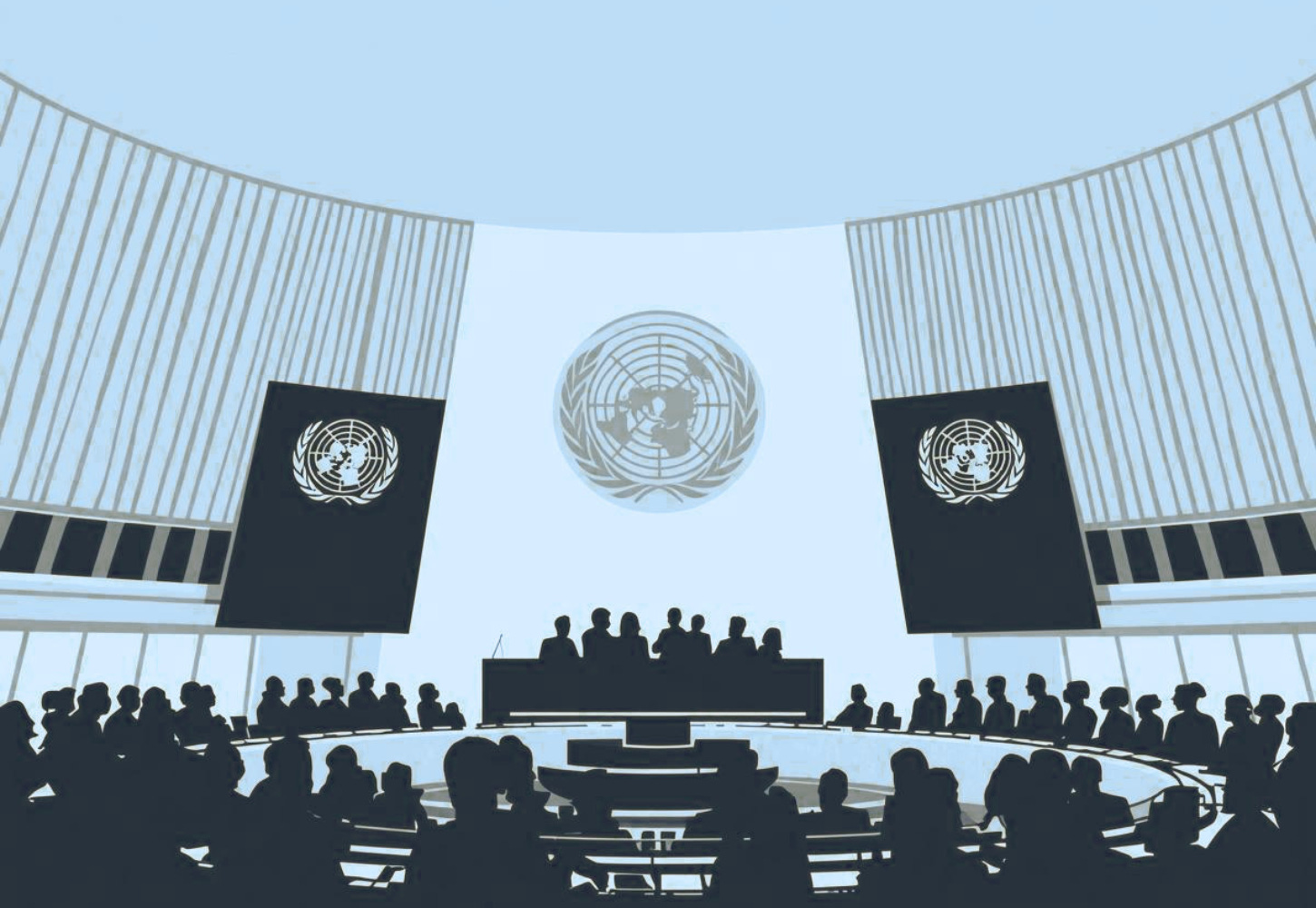
On 25th March, the United Nations (UN) adopted a resolution that declared the transatlantic slave trade to be the ‘gravest crime against humanity’. Spearheaded by Ghana, the resolution received 123 votes in favour, three against, and 52 abstentions – including from the United Kingdom (UK).
While not legally binding, such UN resolutions often carry geopolitical significance. Given the controversy over the righteousness of reparations for the slave trade, and the fact that the British taxpayer would potentially be on the line were such reparations to be initiated, should the UK not embrace a more forceful position? This question forms the basis of this week’s Big Ask, in which we asked four experts: Was Britain right to abstain from the UN vote on slavery reparations?
Prof. Lawrence Goldman FRHistS
Lecturer (CUF) in Modern History, University of Oxford, and Executive Editor, History Reclaimed
Yes, the UK was right to abstain, because the transatlantic slave trade was not a crime in Britain – or anywhere else – during the period when Britain was involved in it (roughly from the 16th century to the early years of the 19th century).
It is looked upon it differently today, of course, but until 1807, when the slave trade was abolished by Parliament, it was, however horrendous, not illegal. It would be against all the principles of English and Scottish law to criminalise retrospectively something that was once legal.
In addition, the following points should be noted:
The UN resolution makes no mention of the Arab slave trade out of Africa, which sold even more Africans into the Ottoman Empire and the Near East generally than were transported across the Atlantic; and
The first stage of West African slavery involved the capture and enslavement of Africans by other Africans, who sold their captives at the ports to European traders.
Why does the motion not ask for reparations from Arab and African nations that also captured and sold slaves? Also important to note is that in 1807, when Britain became the first major nation to outlaw the trade, more people around the world laboured as forced labourers – whether as slaves, serfs, or indentured servants – than as free men and women.
In short, the UK was right to abstain, because the motion does not condemn all slavery and human sale; only that undertaken by ‘Western’ nations.
Chair, University Association for Contemporary European Studies (UACES), and Professor, International Politics, University of Manchester
Britain’s abstention on the UN vote on slavery reparations is a political choice. It is not a principled position. It is an evasion.
To be clear, reparations are not simply about financial transfers between governments. They are about confronting the ongoing legacies of colonialism; the dispossession and the structural inequalities, often gendered, that shape the realities of Africa and African-descendent people globally.
The past is not behind us. It is present in every trade arrangement that perpetuates extraction, every multilateral institution that centres ‘Western’ interests as universal ones, and every decision that reproduces a hierarchy of whose lives are grievable, whose sovereignty is protected, and whose destruction is permitted.
The UK’s abstention at this moment signals a refusal to reckon with these issues. Britain has indeed already helped to develop the architecture of accountability through instruments such as the Basic Principles on the Right to Remedy, which it is now choosing to step back from when being asked to move from rhetoric to action.
What makes the abstention particularly telling is its timing. As Official Development Assistance (ODA) budgets are slashed, and many commitments to justice are quietly being hollowed out, this feels like another nail in the coffin for the idea of a progressive ‘Global Britain’.
So, no, the UK was not right to abstain. It was wrong.
Professor of Historical Geography, School of Global Studies, University of Sussex
Britain was wrong to abstain not just on moral grounds – its dominance of transatlantic slavery in the 18th century was one of the greatest crimes against humanity ever – but also because agreeing to reparations talks may well be in the UK’s long-term interests.
To get one thing straight, reparations have been deliberately misrepresented by those opposed to any kind of conversation. They are not the transfer of trillions of dollars, charged to British taxpayers. US$19 trillion (£14.2 trillion) is the amount calculated by Brattle Group consultants as theoretically owed, were the UK ever to pay the wages of generations of enslaved workers, compound interest, and damages for the trauma of racialised captivity.
This is not what the Caribbean Community (CARICOM) and its African allies are seeking. They are asking for talks that might ultimately result in agreed bespoke measures (as happened between Germany and Israel after the Second World War). The outcome would most likely be as follows:
First, an apology and recognition that the scars of transatlantic slavery persist in racial and geographical inequalities maintained through indebtedness, multinational mis-invoicing, punitive debt, and exploitative resource extraction; and
Second, an agreement on long-term measures of support, such as debt relief, assistance with health care, low-carbon energy transfer, and climate change adaptation.
The refusal even to begin a conversation is denting British moral leadership, creating distrust, and preventing the formation of sorely needed new alliances. Reparative discussions could revive the Commonwealth as a meaningful entity, embracing African countries with some of the world’s most critical minerals that are now being assiduously courted by the People’s Republic of China (PRC). With reparations talks, the UK has a chance to enhance a much-diminished global status, free of dependency on the United States (US).
Senior Research Fellow, Institute of Commonwealth Studies, University of London
The answer to the question must be ‘yes’. Slavery is a critically important question, but the way it was posed before the UN was badly misguided. The resolution calls for ‘recognition of the transatlantic slave trade and slavery as the gravest crime against humanity’. By framing the call for action in this manner, the full horror of African enslavement is obscured.
No recognition is given to the far longer, equally substantial, and just as brutal trade across the Indian Ocean. There is no reason to single out the transatlantic trade when it accounted for perhaps 20% or 25% of Africa’s historic enslavement.
The trade with Arabia, or that controlled by Arabian nations, was at least as large as that undertaken by the Europeans or Americans. It began much earlier and continued into the 1960s or 1970s. Should the modern Arab countries not also be approached for reparations if this debate is to encompass the whole gamut of enslavement?
Indigenous slavery by Egypt, the Sokoto Caliphate, and Ethiopia (to name just three) is ignored. So too is the role of indigenous elites in historic enslavement, for which they too should be held to account.
Most importantly of all, the resolution fails to tackle contemporary chattel slavery in at least five African states today: Mauritania, Mali, Niger, Libya, and Sudan. The African Union, Arab League, and UN have all failed to put pressure on member states to end this notorious practice.
If you enjoyed this Big Ask, please subscribe or pledge your support!
What do you think about the perspectives put forward in this Big Ask? Why not leave a comment below?
I find resonance with all of these arguments, and I particularly like the idea that the Commonwealth - now a basically defunct organisation - could be reinvigorated if the UK took the brave step to use the organisation as a forum to discuss these issues. The issue we also have to grapple with is a domestic audience and how would Britain sell a 'yes' vote to an increasingly vocal right wing electorate? In a short term fight for votes each election cycle, big picture issues such as this are boiled down to culture wars and very little real debate is even possible without being reduced to simplistic soundbites such as that issued by Reform recently on this topic.
Some great points raised here, particularly the role of addressing slavery in the context of Britain's ongoing moral leadership.
But it should also be noted that the abstention was wrong on the grounds that we should have voted against instead. The recognition of the Atlantic slave trade as the gravest crime is subjective and hard to defend given the competition from multiple genocides (some ongoing within africa today) and the other slave trades mentioned in the commentary above.
The final contribution makes the point cleanly - this was not a unique crime, nor was the responsibility purely Western. The system existed before and after European involvement, and much of the violence which perpetuated it was performed by Africans, for the benefit of Africans, on the dime of Europeans, Asians, Arabs, and other Africans. That's not to excuse the participation of the West in the practice, but the framing of the resolution DOES excuse the participation of nearly everyone but the West.
Abstention in this case is a tacit acceptance of the legitimacy of a frame of argument which is fundamentally anti-British and anti-Western. If we will not stand up for our perspective then we will become irrelevant