

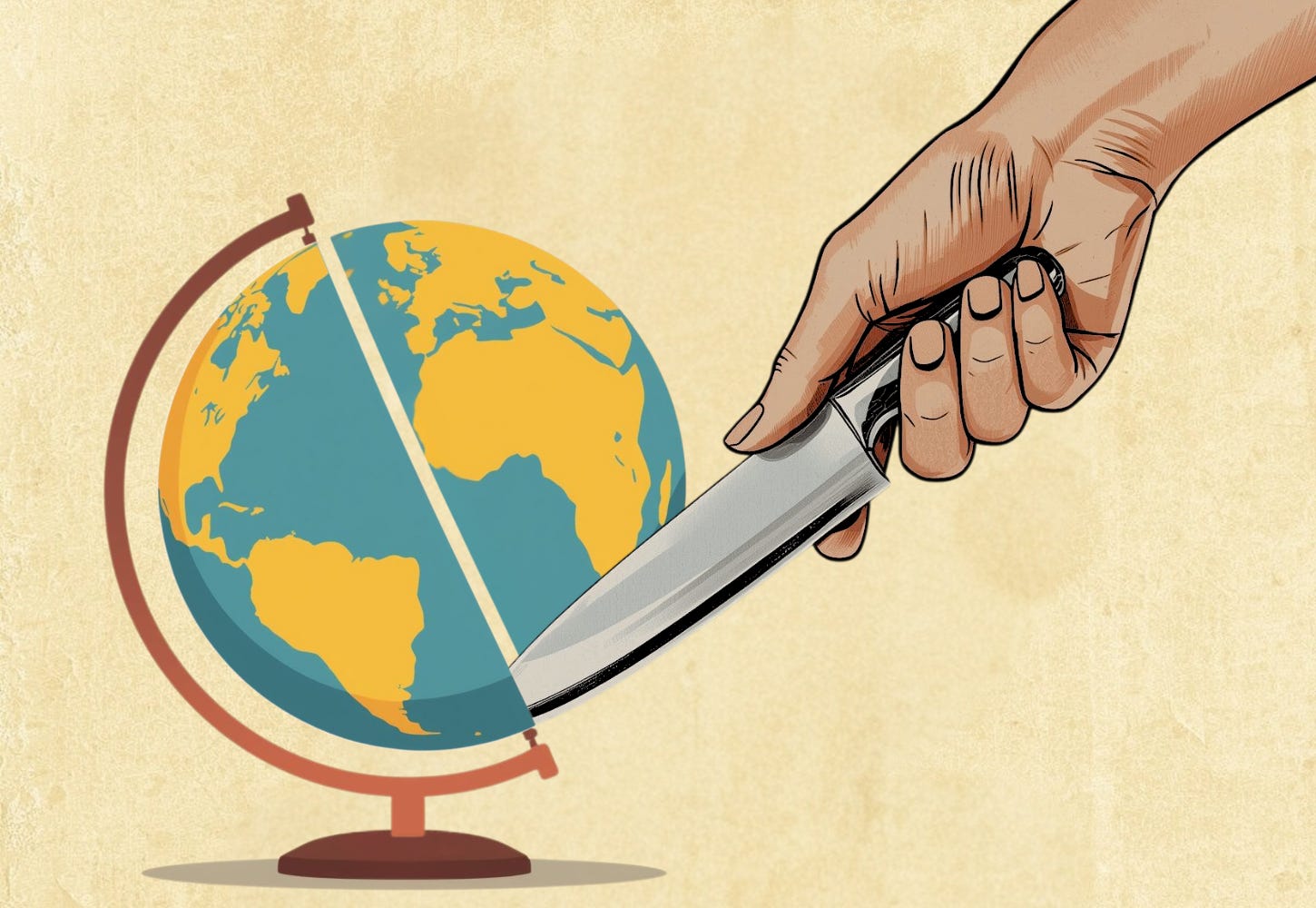
The United States (US) has reasserted the Monroe Doctrine in the Western Hemisphere; Russia seeks to dominate swathes of Eastern Europe; the People’s Republic of China (PRC) is pushing into Africa and the Middle East; and the United Kingdom (UK) has asserted the primacy of the Euro-Atlantic to its foreign and defence policy. The major powers appear to be territorialising their strategic postures, perhaps in principle as much as in fact.
In his speech given in Davos on 20th January, Mark Carney, Prime Minister of Canada, stated that the institutions upon which the post-Cold War ‘peace dividend’ relied have been superseded by ‘intensifying great power rivalry’. Political and economic competition between major powers is engulfing smaller states, and a new multipolar world order is emerging. Considering this, for this week’s Big Ask, we asked 12 experts: Are we entering a new world of spheres of influence?
Senior Research Fellow (Space Power), Council on Geostrategy
The concept of spheres of influence harks back to the high tide of late 19th century imperialism, when the main colonial powers of the time were carving up various parts of the world, such as Africa, between themselves. Later, the term became central to the Cold War reality of a world split along political-ideological lines between the Western and Eastern blocs, with a grouping of non-aligned states gravitating between the two.
In both periods, ‘spheres of influence’ served as instruments for the management of geopolitical competition, and were the immediate or more secondary result of negotiations grounded primarily in hard power realities. Insofar as this approach to foreign relations eschewed any other considerations of ‘morality’ or ‘international law’ (such as it might have existed at the time) and any serious regard to the wishes of the peoples or even states bundled into such ‘spheres’, then yes, the world we are heading into can be said to conform to this logic more than to any other.
But this similarity does not suffice to support the overall case. A crucial element is missing today: the willingness, opportunity and perhaps the ability to negotiate any settlement of this kind. The realpolitik spirit of current times is not (yet) matched by the geopolitical conditions – such as the late stages of a great war, as at Yalta in 1945, or major international diplomatic conferences such as Berlin in 1884-1885 – that can generate relatively clear, sustainable agreements.
What the world has is, for now, worse: a descent into increasingly unrestrained competition in which military power across all domains – including space – is the paramount factor. A point of equilibrium will eventually have to emerge, and with it new, stable spheres of influence – but not before we are made to endure more chaos, and perhaps full-scale war.
Adjunct Fellow, Council on Geostrategy, and non-resident Senior Fellow, Australian Foreign Policy Institute
The risk of a regressive drift to a world defined by spheres of influence is real and, to a concerning extent, already upon us. Globalisation has lost its popular mandate in free and open nations, while adversaries stand to benefit from a divided world, in which the PRC dominates East Asia; Russia overshadows Europe; and the US retreats into the Western Hemisphere, potentially leaving its allies and partners beyond the ambit of a Monroe Doctrine redux to fend for themselves.
The bewildering transatlantic flare-up over Greenland should serve as a warning that a more fragmented, anarchic future is gathering momentum. But the slide towards spheres of influence isn’t irreversible. It can also deceive.
Although the PRC and Russia aspire to roll revanchist frontiers forward, they and their autocratically like-minded associates continue to coordinate and act globally – by deploying rogue merchant ships that move energy and other contraband to bypass sanctions; by spreading disinformation via media that they have themselves banned; and by sourcing warfighting technology from under the noses of ‘Western’ countries’ intelligence and law enforcement.
While free and open nations rightly fear that globalisation has been weaponised against them, the flipside is that modern autocrats still lack the autarky to which they aspire. This is also true for the US, as its official commitment to defend non-territorial American interests in the Indo-Pacific and elsewhere under its new National Defence Strategy (NDS) attests.
The spheres are out of alignment, but they remain interconnected – for friend and foe alike.
Founding Director, Centre for Britain and Europe, and Head, Department of Politics and International Relations, University of Surrey
British foreign policy is entering a fundamentally different world, with the concept of ‘spheres of influence’ increasingly shaping geopolitical dynamics and forcing strategic reorientations. Several factors are driving this transformation.
First is America. The approach led by Donald Trump, President of the US, to Washington’s foreign policy explicitly embraces the concept of spheres of influence, led by strongmen and predicated on zero-sum ratios calculated in economic wins rather than political progress.
Second, energy resources have become major drivers, with the hunt for rare earth and raw materials generating ‘resource imperialism’ for the US, the PRC and countries in Europe, allowing governments to wade back into the fray as guardians of energy security.
The broader global context also reinforces this trend. Business leaders and politicians alike refer routinely to increasingly isolationist trends in both private and public sector domains, prompting a sense of regressing to the rudimentary ‘great games’ mapped out by a few major players.
From the perspective of foreign policy, however, a return to spheres of influence rides roughshod over an enormously complex, interdependent world which has largely beneficially institutionalised a raft of rules and regulations to produce certainty, stability and representativeness. A world of spheres actively ignores the roles of institutions, the interests of smaller countries and the correctives of civil society.
The UK should firmly support those countries which are seeking, in a principled and pragmatic way, to strengthen the rule of law and rules-based markets, as well as highlighting the critical balancing role played by middle powers, as artfully highlighted by Carney in Davos. A good start is to work with comparable European countries – notably France and Germany, but also Italy, Poland and others – to protect common interests, while dealing with a US that is still needed, but not trusted.
Distinguished Professor, Centre for Security, Diplomacy and Strategy, Brussels School of Governance, Vrije Universiteit Brussel
Are we entering a new world of spheres of influence? The answer is yes.
Should we be afraid of this? The answer is yes, again – very much so.
Sir Herbert Butterfield’s Whig Interpretation of History holds that societies have, over the centuries, made progress towards a more just and peaceful world. Horrendous historic deviations from this have shown this faith in progress to be misplaced. Yet, one would expect free and open societies to have retained some lessons, for example: tyrannies, despotism, absolute monarchies – bad; checks and balances - good; great power-dominated spheres of influence: dangerous, as de facto the strong do as they wish and the weak suffer what they must.
The 19th century version of this resulted in lots of wars, even among the great powers, culminating in the First World War. This is why reformers, led by Woodrow Wilson, President of the US from 1913-1921, subsequently championed the League of Nations. This step forward proved sub-optimal in view of its domination – being once again driven by five or six great powers, excluding the US, of which only two were fairly dedicated to upholding the League’s principles.
After another even worse world war, another global organisation was invented (again with American support) as the United Nations (UN) – but again it was adulterated by the institutionalised dominance of five great powers that rarely agreed. Still, at least there was now a set of rules that were proclaimed and enshrined in the UN Charter – arguably another great step ahead for humankind.
Abandoning this push towards rules-based international order by reverting to the 19th century order – great power domination without that set of rules – is a step back towards wars. Be afraid. Be very afraid.
Patrick Horgan OBE
Senior Adviser, Geopolitical Strategy, GMTL Advisory Ltd.
Few would argue with the contention that the relative stability and predictability of the post-Cold War period is gone, supplanted by a more contested and multipolar world, and buffeted by great power rivalry. But does that mean we are entering ‘a new world of spheres of influence’?
Is this really a déjà vu moment of emerging neo-imperialism and global carve-up, or the imminent arrival of some form of new uneasy equilibrium between a few global powers, each with their own ‘backyard’, ‘near abroad’ or ‘tributary states’? Or is it, as Stephen Miller, political adviser to the Trump administration, insists, simply a more honest recognition of age-old truths; that we live in a world ‘that is governed by strength, that is governed by force, that is governed by power’?
As the world grapples with new realities and the erosion of old certainties, there will no doubt be events that seem to align with this bleak analysis. However, Carney’s succinct and cogent speech at Davos made no reference to the concept of ‘spheres of influence’, and highlighted instead the response of allies diversifying to hedge against uncertainty and withstand pressure.
The ongoing struggle in Ukraine and the rejection of US territorial claims to Greenland show that sovereignty, once gained, can seldom be taken away easily or without longer-term consequences in terms of legitimacy and international support. While the pathway through this ‘rupture’ remains unclear, a new world of spheres of influence is not a goal to aim for, nor is it an inevitable outcome.
International Fellow, Council on Geostrategy, and Senior Vice President of National Security and Intelligence Programmes, Centre for the Study of the Presidency and Congress
What the world is entering into is less clear than what it is exiting: a period of greater certainty and predictability, based upon a shared agreement among the UK, the US, European nations and select countries of the Indo-Pacific. The existing ‘liberal international order’, as is being realised, was predicated more on American military power and Washington’s willingness to abide by agreed-upon norms rather than a strict set of rules and values. This was more palatable, although those later concepts may have introduced such predominance (under which Washington often cloaked its actions).
The idea of spheres of influence presupposes that those within the spheres accept the dominance of one power, and are ultimately without agency. Neither of these are true. While the US prioritises the Western Hemisphere in its recent National Security Strategy (NSS), and certainly exercises military overmatch in this region, this by no means suggests that Brazil et al. will simply acquiesce to Washington’s desires or interests any more than South Korea or Japan would accept Chinese predominance.
This period of transition is messier, more fractious and more uncertain – more a ‘rough’ or ‘tough’ world order, where self-interest is more nakedly pursued or at least unmasked, rather than a set of spheres of influence.
Adjunct Fellow, Council on Geostrategy, and Assistant Professor, Strategic Studies, Nanyang Technological University (NTU) Singapore
The real question is whether the US is prepared to allow Russia and the PRC spheres of influence in Europe and East Asia respectively. Washington has long asserted primacy over the Western Hemisphere; the current administration has simply been more explicit and forceful in trumpeting a ‘Trump Corollary’ to the Monroe Doctrine. America therefore already claims at least one sphere of influence.
Based on current evidence, there is little sign that Washington is prepared to allow rival great powers to dominate other regions. Its 2025 NSS commits the US to working with allies and partners to ‘maintain global and regional balances of power to prevent the emergence of dominant adversaries’. In Europe, this entails greater burden sharing, enabling capable allies to ‘work in concert with us to prevent any adversary from dominating’ the continent.
The NDS extends the same logic to East Asia, warning that the PRC cannot be allowed to control the Indo-Pacific, as it would be able ‘to effectively veto Americans’ access to the world’s economic center of gravity’. Beyond words, the US continues to station well over 100,000 troops across Europe, Japan and South Korea, and remains invested in bilateral and minilateral security arrangements such as AUKUS – hardly signs of retrenchment.
What evidence could convince otherwise? A wholesale American withdrawal from its garrisons in Europe and East Asia, effectively abandoning its allies, would suggest that spheres of influence are indeed returning. As it stands, however, the US’ strategy towards the PRC and Russia is best summarised as ‘spheres for me, but not for thee’.
International Fellow, Council on Geostrategy, and Assistant Professor of International Relations, University of Waterloo (Canada)
We are not entering a new world of spheres of influence. Nor should we try to do so.
The very notion suggests that societies are bundled together and sealed from one another under the lordship of some great power. What can be observed instead is a world of fracture, because many people across different continents are able to exercise some degree of agency – sometimes in support of liberalism and democracy, but sometimes in support of illiberalism and autocracy. Of course, certain regions will feature greater or lesser influence from a certain great power by dint of historical and institutional legacies as well as geographic proximity.
Hence, the US will have more impact on South American politics than Russia, for example. Yet, that impact would not necessarily be tantamount to a sphere of influence per se. Indeed, explicit declarations that reiterate and reformulate the Monroe Doctrine have provoked criticism and pushback from North and South American leaders alike precisely because few, if any, want to be outwardly treated like a vassal.
Asserting influence is not the same as having it. Anti-colonial discourses of sovereignty that have become so popular in the last 80 years will not go away with the simple stroke of a presidential pen.
Senior Adviser for Geopolitics, Centre for Risk Studies, and Convenor, Geopolitical Risk Analysis Study Group, University of Cambridge
The short answer is no – not because we are not living in a world shaped by spheres of influence, but because we never stopped living in one.
For decades, liberal internationalists in free and open nations have held that the international system is governed by a ‘rules-based international order’, in which great powers have curbed their impulse to dominate smaller states, particularly those in their immediate vicinity. But this was always perception rather than reality.
The US has long maintained an expansive sphere of influence across the Americas, Europe and East Asia, underpinned by overwhelming military, economic and financial power. It embraced multilateral cooperation only insofar as doing so aligned with American interests, and disregarded the rules when they did not.
Other powers have never operated by any other logic. Russia has consistently asserted hegemony over its ‘near abroad’, sometimes by force. The PRC has spent decades methodically building its influence, first in its neighbourhood and increasingly on a global scale. Even the European Union (EU) lays claim to a de facto backyard in places such as the Balkans.
Recent episodes – from Ukraine to Venezuela to Greenland – have not created a new international order. Rather, what has changed is recognition among those who long denied it that the international political system is defined not by laws, treaties and norms, but by raw power and strategic interest.
That is how it has always been, and that is how it will continue to be.
International Fellow, Council on Geostrategy, Founder and Principal, Barrier Strategic Advisory, Adjunct Fellow in Naval Studies, UNSW Canberra, and Expert Associate, ANU National Security College
We are not just seeing a shift in the global order; it is breaking apart. And this is happening quickly. As Carney put it, this feels less like a transition and more like a rupture. In moments like this, there is a strong temptation to reach for neat labels to explain what comes next. History suggests those labels usually only make sense after the fact.
What replaces the multilateral system that has shaped global order since the Second World War is not yet clear, and it may not be for some time. The idea that we are returning to spheres of influence has gained traction because it offers a simple way to understand growing competition between major powers. But it is also an oversimplification.
There is little evidence that the US, for example, is seeking to abandon Europe or the Indo-Pacific. What can be seen instead is an effort to reduce over-extension, push allies to do more with their own conventional forces, and be more selective about where and how it bears risk.
This does not point to a clean division of the world into spheres of influence. Rather, it points to a far messier environment of contested influence, selective engagement and greater pressure on smaller states to navigate uncertainty. The risk is mistaking a convenient label for an accurate description of what is actually unfolding.
Co-founder (Research), Council on Geostrategy
There are two distinct kinds of ‘sphere of influence’: regions of dominance and zones of denial. Historically, continental powers – Russia, France, Germany and the PRC – have sought to carve out areas in which they hold suzerainty: where smaller nations must subordinate their foreign policies to the interests of the large nearby power. If done successfully, this can multiply a major power’s strength by creating a buffer zone around it.
Maritime powers – such as Britain – have favoured a different approach: because they lack the mass or the need to dominate, they have implemented zones of denial. As Sir Winston Churchill famously stated in The Gathering Storm, for over 400 years, the UK’s foreign policy has been ‘to oppose the strongest, most aggressive, most domineering power on the continent.’
The decision of Western European countries to reduce their armed forces and the corresponding resurgence of Russia and the rise of the PRC has led to a period of geopolitical rivalry where spheres of influence are starting to return. Under these circumstances, it might be tempting to believe that Britain should lead a group of middle powers to reassert the rules-based international system. But this is a fantasy; their geographic dispersion and national interests preclude them from acting in such a way, just as Russia and the PRC (and perhaps the US) would seek to undermine them.
Rather, the UK should revert to its traditional approach: to deny hostile powers the overlordship of Europe – or parts of it, especially in the arc stretching from Greenland to the Black Sea. And Britain should not do this with regret, but resolutely. In a geopolitical age, a geostrategic perspective is needed.
Julien Lalanne de Saint-Quentin
Adjunct Fellow, Council on Geostrategy
The language of spheres of influence has returned, but in European nations this obscures a more basic problem: there is no shared strategic purpose across the continent. What looks like external pressure is, in reality, an internal mismatch of threats, and therefore priorities.
Northern and Eastern Europe remain overwhelmingly focused on Russia and deterrence. Southern Europe is primarily concerned with migration, instability across the Mediterranean and financial vulnerability. These are not different emphases on the same threat; they are different threat systems altogether, which produce divergent strategic reflexes.
France is perhaps the only major European power that consistently views the Eastern and Southern European theatres as equally central to its security. Paris has therefore long pursued the idea that European countries could be rallied around a single strategic vision. That effort has been relentless – and predictably unsuccessful. European nations are divided not by indecision, but by irreconcilable threat realities.
As a result, debates about ‘European strategic autonomy’ often proceed as if a unified Europe were waiting to be emancipated. In practice, the relevant states are fragmented in their threat perceptions and priorities, and therefore structurally inclined to rely on external guarantors. The debate about returning spheres of influence ultimately says less about global change than about Europe’s intractable strategic fragmentation.
The offhand remark made by Ronald Reagan, President of the US from 1981-1989, about the Falkland Islands as ‘that little ice-cold bunch of land down there’ captures an enduring strategic reality: geography matters. Would Warsaw, for example, truly be prepared to trade the certainty of the American umbrella for the defence of Greenland under the EU’s Article 42(7)?
If you enjoyed this Big Ask, please subscribe or pledge your support!
What do you think about the perspectives put forward in this Big Ask? Why not leave a comment below?