

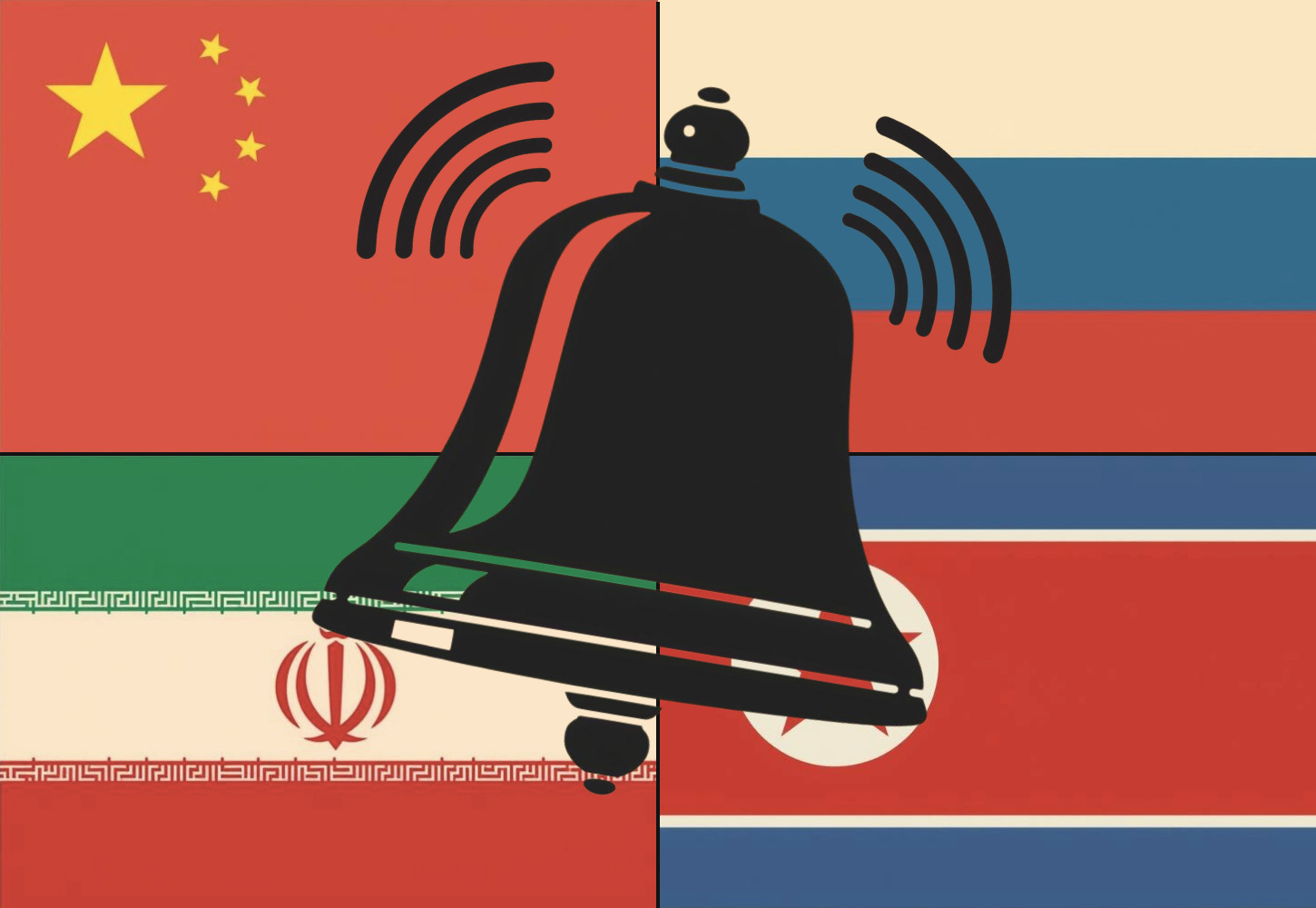
The first three weeks of 2026 have seen substantial upheavals in global politics. This includes the extradition of Nicolás Maduro, deposed President of Venezuela, from Caracas by United States (US) special forces; protests in Iran against the regime of Ayatollah Ali Khamenei, Supreme Leader of Iran, which have seen thousands killed by government forces in retaliation; and the seizure of the Marinera, a Russian ‘shadow fleet’ tanker, in the North Atlantic by American forces with British assistance.
These have all been to the detriment of the ‘CRINK’ – a loose grouping comprising the People’s Republic of China (PRC), Russia, Iran and North Korea. With its associate Venezuela looking increasingly likely to fall under US influence, and the unrest in Iran being hailed as the biggest challenge to the regime since it took power in 1979, the CRINK’s position on the global stage has been shaken. As such, for this week’s Big Ask, we asked eight experts: Is the CRINK in crisis?
Adjunct Fellow, Council on Geostrategy, and Senior Lecturer in National Security Studies, King’s College London
The question reverberating through the anxious halls of small state governments today is unlikely to be whether the CRINK is in crisis, but whether it is recruiting: dare I ask, ‘are we about to start saying “CRINKUS”?’
For decades, small states have read American power as stabilising; imperfect and self-interested, but fundamentally predictable and reliable. Venezuela and Greenland have changed the tone. They have reminded the world that the stalwart ally which most ‘superatlanticist’ small states have coveted for shelter will no longer even attempt to justify or disguise blatantly expansionist ambitions. For small states which rely on institutions and rules to soften the law of the jungle, a more transactional world creates a serious strategic dilemma.
American engagement still deters adversaries. But, when that engagement is driven unilaterally rather than in concert with allies, it destabilises the very order it once protected. At the same time, the CRINK is not a unified bloc. The PRC, Russia, Iran and North Korea pursue divergent interests and frequently pull in different directions, giving the acronym a false sense of cohesion.
For small states, security has never meant choosing sides, but managing uncertainty. In today’s world, where every major power is unsettling the system, that uncertainty now includes even those who once promised order.
That is the crisis.
Neil Brown
Honorary Fellow, Council on Geostrategy, and Geopolitical Analyst, Detroit Asset Management
The CRINK leaders continue to collaborate with each other to critical effect and mutual benefit, notably in support of Russia’s full-scale invasion of Ukraine. They remain, however, essentially an amalgamation of like-minded leaders with broadly similar prejudices against free and open nations.
Most CRINK leaders are facing domestic crises, including the Ayatollah (obviously); Russia, where President Vladimir Putin is weaker than at any point in his 20+ year tenure after almost four years without strategic success in Ukraine; and even the PRC, where the real economy continues to struggle for the demand-led growth which could wean it off a dependency on exports and address structural weaknesses.
The ability of Russia and the willingness of the PRC to aid Iran, for example, is diminished. Of the CRINK leaders, only Kim Jong Un, Supreme Leader of North Korea, appears to have gained strength thanks to what he receives from the Kremlin in return for his material support to – and participation in – the invasion of Ukraine; and even if that relationship is increasingly a concern for Beijing.
Ultimately, the CRINK is not in an immediate crisis just because – with the refocusing of American security priorities and a stubbornly lethargic ‘Old Europe’ – the political ‘West’ is. This is not just to the detriment of Ukraine, Moldova, Taiwan and Greenland. It undermines wider diplomatic, economic and military efforts to weaken CRINK leaders and their ability to coordinate adversarial activities.
International Fellow, Council on Geostrategy, and Senior Geopolitical Adviser, Business Finland
The CRINK axis is a set of partnerships that have emerged to challenge the US and to serve as a counterweight to the dominance of free and open nations. They trade in arms, energy and technology, allow sanctions evasion and provide diplomatic cover for one another, despite differing threat perceptions and strategic ambitions.
However, events in early 2026 suggest mounting vulnerabilities and potential shifts in the balance of power within the group. As a result, the CRINK is strained by asymmetric and even conflicting interests – but for now, it is not collapsing; it is adapting.
The capture of Maduro on 3rd January disrupted the CRINK’s Latin American proxy. Venezuela is now facing a US-imposed transition, and the Kremlin’s regional influence and Beijing’s resource access are being eroded. Moreover, somewhat humiliatingly, Venezuela’s air defence systems failed to stop the operation, suggesting that Russian S-300 surface-to-air missile systems and Chinese-made radars may not have been seamlessly integrated, thereby degrading their effectiveness under real combat conditions.
Concurrently, Iran’s internal turmoil, erupting just before the New Year, could weaken Tehran’s military support for Russia and, facing threats of American action, expose the regime’s fragility, risking its further isolation within the CRINK. Targeting shadow fleets, including the seizure of the Russian-flagged Marinera tanker, which was smuggling sanctioned Venezuelan and Iranian oil, undermines CRINK evasion tactics and strains Russia’s war economy.
Taken together, these events demonstrate such raw power that the PRC and Russia will have to reflect on their own strategies and capabilities.
These developments highlight CRINK asymmetries and how American assertiveness exploits weaknesses.
The CRINK’s resilience lies in mutual need and shared hostility to US-led financial and security architecture. However, they remain as a ‘transactional four’, and are often distrustful partners. Therefore, despite all grandiose talk of partnerships, it was no surprise that neither the PRC nor Russia has overtly supported Venezuela or Iran through their crises.
Lecturer in International Relations, University of Oxford
North Korea predictably condemned the recent US intervention in Venezuela as a ‘hegemony-seeking’ act, akin to how Pyongyang has derided past American intervention in Libya, Iraq and beyond. Beijing’s criticisms of Washington’s actions as an act of ‘bullying’ are also to be expected, given its longstanding oil-for-cash relationship with Caracas. Yet, unlike his counterpart in Tehran, Kim knows that North Korea is unlikely to witness the same fate as Venezuela any time soon.
Not only does North Korea have an ever-increasing ‘treasured sword’ of nuclear weapons, but Kim is currently at his most emboldened. The recent capture of the Marinera will have little impact on Pyongyang’s actions and strategy. For all its moniker as a hermit kingdom, North Korea has found increasingly innovative ways to evade sanctions, with continued Chinese and Russian assistance. Despite the changes in individual countries within the CRINK, the axis itself is not in crisis. It has never been – and is unlikely to be – a formalised strategic alliance.
None of its members, including North Korea, show any intention of leading such a grouping. Yet, US interventionism and support for opposition movements in these states will only heighten the collective anti-American attitude on the part of the CRINK. It is for this reason that free and open nations should pay more, not less, attention to them.
Assistant Professor in Politics and International Relations, University of Nottingham
The CRINK has always been a relationship of convenience, with mutual self-interest and anti-Americanism at its core. For Iran, each CRINK country has been useful for bolstering an area of strategic importance. North Korea is its leading provider of ballistic missiles; the PRC is its largest trading partner and has helped support Iran diplomatically; and Russia and Iran supply each other with security equipment, while the Kremlin also provides protection for Tehran against the United Nations (UN) Security Council.
However, the Russian-Iranian relationship has been challenged over recent years, leading to questions over whether the CRINK is in crisis. The full-scale invasion of Ukraine started the change in dynamic, escalating the competition between the two countries to sell hydrocarbons to the PRC and allowing Iran the space to regain some influence in the Caucasus.
The conflict in Gaza complicated matters further, as Russia did not have bad relations with Israel, and the Kremlin has been unable to provide many supplies to Iran while the invasion of Ukraine continues. Finally, the fall of Russia and Iran’s mutual ally in Syria has forced further adjustments in the relationship, as Putin has welcomed Ahmed al-Sharaa, President of Syria and Sunni successor to deposed dictator Bashar al-Assad.
This has left Iran feeling uncomfortable, compounded by the weakening of its ‘axis of resistance’ across the region and the new rhetoric of Donald Trump, President of the US, against Tehran. These events have left a relationship based on convenience more exposed, and likely to be tested further should such rhetoric become reality.
Member of the Advisory Board to the China Observatory, Council on Geostrategy
For the CRINK, geopolitical developments and events surrounding Venezuela, Iran and Greenland are notable more for their political and diplomatic consequences than their economic ones. With a return to the Monroe Doctrine, so to speak, the pushback against the PRC’s growing commercial presence in South America – mostly in Venezuela, Brazil, Peru and Chile (which voted in a new rightist president by a landslide in December 2025) – is likely to increase.
While Beijing may have been surprised, even embarrassed, by Washington’s actions in Venezuela, the economic consequences are not huge. The main transmission channel would be via oil prices and supply, but, so far at least, there have been no adverse effects. Nor have there been any from the protests and brutal repression in Iran.
The PRC was buying 90% of Venezuelan oil, but this was only 4% of its overall oil needs. In exchange for about US$65 billion (£48.2 billion) of now bad loans, Beijing received deeply discounted oil and access to the country’s metals and raw materials.
In relation to Chinese and global demand, however, the volumes were unremarkable. Oil imports from the Gulf, on the other hand, supply half of the PRC’s needs, so if the Straits of Hormuz were blocked for any reason, the impact on the PRC would be significant – although higher oil prices would be a boon for the Kremlin.
On the positive side for the PRC, the row over American intentions in Greenland could see other countries follow Canada’s example of trying to de-risk from the US, doing minor trade deals with the PRC and bowing to the Chinese narrative of a new world order.
British and German leaders are expected to visit the PRC later this month and next month respectively. The economic gains for the visitors will be small, but the economic statecraft gains for Beijing – still in a no-limits friendship with the Kremlin, much to European nations’ part-time chagrin – could be much bigger.
Grace Theodoulou
International Fellow, Council on Geostrategy
The CRINK is not an official alliance. While it is mostly a series of occasional and opportunistic engagements, rarely featuring all four states simultaneously, this is not to say it is non-threatening to free and open nations.
What brings the four states together is their authoritarian nature and a desire to counteract democratic international institutions. In many ways, Trump’s lack of diplomatic decorum may only work to the CRINK’s benefit.
There is no shortage of countries who are keen to flirt with the latter. South Africa, for example, is by no means authoritarian, but has increasingly come under fire from Trump for its economic and diplomatic ties with Russia. Relations between Pretoria and Washington are increasingly strained as a result. Just two weeks ago, South Africa hosted the ‘Will for Peace 2026’ naval drill exercises with the PRC, Russia and Iran. All four states are BRICS members; given that the CRINK is an unofficial alliance, some of its members can often be seen working together in other fora.
This brotherhood is not without potential threats further down the line. What would happen to Beijing’s investments in Iran, for example, if Trump were to succeed in installing a leader who is friendlier to the US?
It is unlikely that the PRC is not preparing for this outcome. However, Beijing is also courting plenty of other authoritarian governments which could be pulled further into its orbit if there is regime change in Tehran.
Executive Director, China Strategic Risk Institute
The CRINK is not in crisis because it never really existed in the first place. Yes, the PRC, Russia, Iran and North Korea share a number of common strategic goals, chiefly the weakening of the US, the North Atlantic Treaty Organisation (NATO) and broader democratic cohesion. And yes, all the evidence suggests they are increasingly willing to work together to achieve this, and will continue to do so.
However, ‘CRINK’ has never been a formalised alliance, nor have any of the constituent parts promised each other security guarantees (with the exception of that between the PRC and North Korea). The lack of response from Russia and the PRC to the American bombing of Iranian nuclear facilities in June 2025 dispelled any illusions that the CRINK might be anything more than a broad strategic alignment.
Certainly, recent events have not gone the way the CRINK would have wanted. The prospect of Venezuela’s oil coming under US control reduces Russia’s ability to leverage its own oil assets while also inflicting further economic pain on an embattled Iranian regime. The move is less catastrophic for the PRC, which has more options to diversify energy imports, and confirms its existing efforts to increase energy independence.
That said, the long-term picture may still give cause for optimism, at least for the Kremlin and Beijing. For Russia, having the US bogged down in the mechanics of regime change in Venezuela, amid its broader focus on the ‘Western Hemisphere’, is good news for continuing its invasion of Ukraine. While it might not welcome increased American attention on Greenland, it is quite happy to see NATO tear itself apart over the issue – a view shared by the PRC.
For Beijing more broadly, the fact that it hasn’t come to the aid of Caracas or Tehran tells very little about its willingness to assert its interests with military force closer to home. It sees the biggest flashpoint – its desire to annex Taiwan – fundamentally differently; as a domestic issue rather than international. The tepid response of Xi Jinping, General Secretary of the Chinese Communist Party (CCP) to the CRINK’s latest setbacks should not fool commentators into thinking him a passive or weak actor.
If you enjoyed this Big Ask, please subscribe or pledge your support!
What do you think about the perspectives put forward in this Big Ask? Why not leave a comment below?
This piece truly resonated. I concur with your analysis.